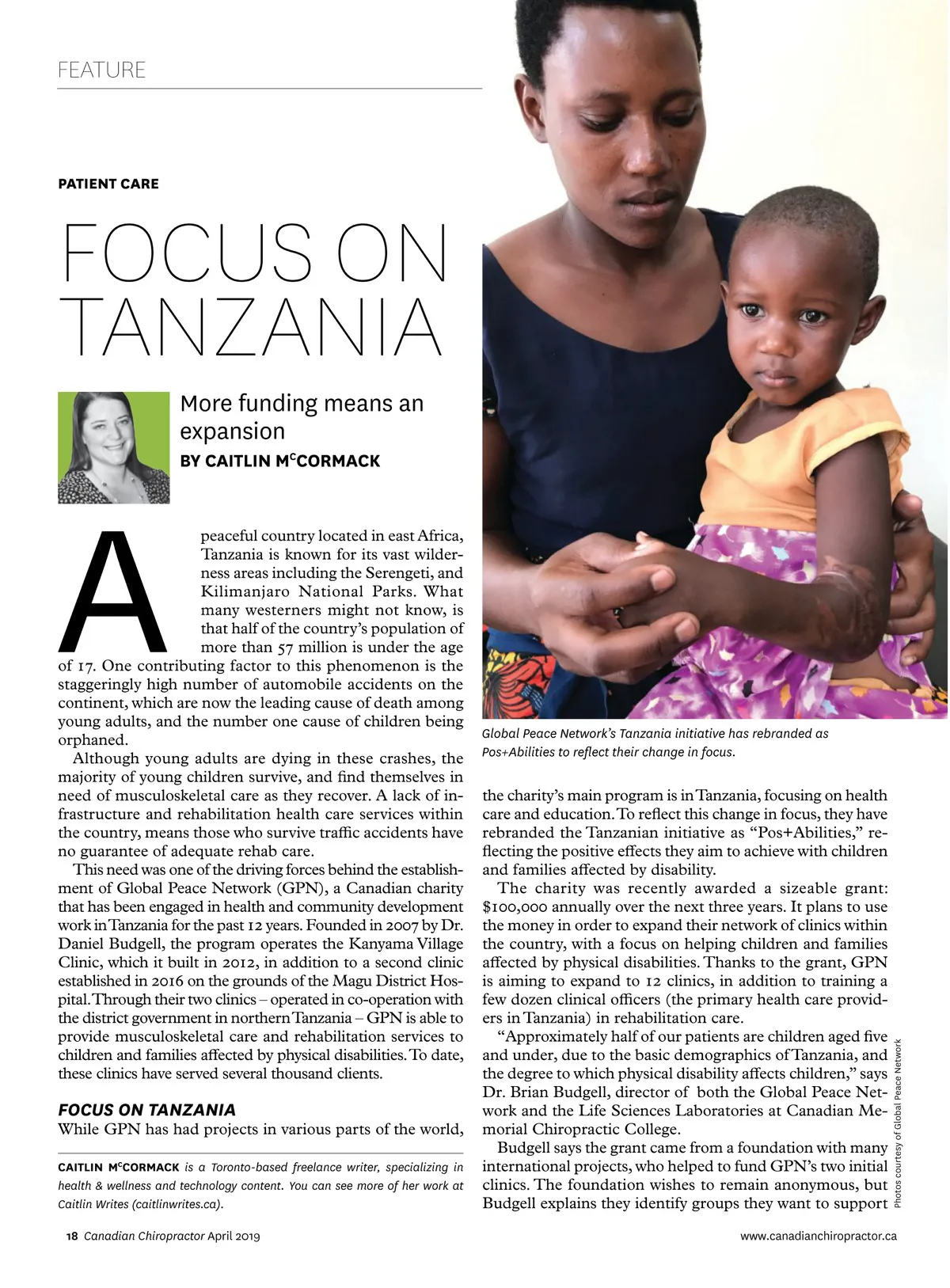
FEATURE PATIENT CARE FOCUS ON TANZANIA More funding means an expansion A BY CAITLIN M C CORMACK FOCUS ON TANZANIA While GPN has had projects in various parts of the world, CAITLIN M C CORMACK is a Toronto-based freelance writer, specializing in health & wellness and technology content. You can see more of her work at Caitlin Writes (caitlinwrites.ca). 18 Canadian Chiropractor April 2019 www.canadianchiropractor.ca Photos courtesy of Global Peace Network peaceful country located in east Africa, Tanzania is known for its vast wilder-ness areas including the Serengeti, and Kilimanjaro National Parks. What many westerners might not know, is that half of the country’s population of more than 57 million is under the age of 17. One contributing factor to this phenomenon is the staggeringly high number of automobile accidents on the continent, which are now the leading cause of death among young adults, and the number one cause of children being orphaned. Although young adults are dying in these crashes, the majority of young children survive, and find themselves in need of musculoskeletal care as they recover. A lack of in-frastructure and rehabilitation health care services within the country, means those who survive traffic accidents have no guarantee of adequate rehab care. This need was one of the driving forces behind the establish-ment of Global Peace Network (GPN), a Canadian charity that has been engaged in health and community development work in Tanzania for the past 12 years. Founded in 2007 by Dr. Daniel Budgell, the program operates the Kanyama Village Clinic, which it built in 2012, in addition to a second clinic established in 2016 on the grounds of the Magu District Hos-pital. Through their two clinics – operated in co-operation with the district government in northern Tanzania – GPN is able to provide musculoskeletal care and rehabilitation services to children and families affected by physical disabilities. To date, these clinics have served several thousand clients. Global Peace Network’s Tanzania initiative has rebranded as Pos+Abilities to reflect their change in focus. the charity’s main program is in Tanzania, focusing on health care and education. To reflect this change in focus, they have rebranded the Tanzanian initiative as “Pos+Abilities,” re-flecting the positive effects they aim to achieve with children and families affected by disability. The charity was recently awarded a sizeable grant: $100,000 annually over the next three years. It plans to use the money in order to expand their network of clinics within the country, with a focus on helping children and families affected by physical disabilities. Thanks to the grant, GPN is aiming to expand to 12 clinics, in addition to training a few dozen clinical officers (the primary health care provid-ers in Tanzania) in rehabilitation care. “Approximately half of our patients are children aged five and under, due to the basic demographics of Tanzania, and the degree to which physical disability affects children,” says Dr. Brian Budgell, director of both the Global Peace Net-work and the Life Sciences Laboratories at Canadian Me-morial Chiropractic College. Budgell says the grant came from a foundation with many international projects, who helped to fund GPN’s two initial clinics. The foundation wishes to remain anonymous, but Budgell explains they identify groups they want to support
Chiropractic + Naturopathic Doctor April 2019: Page 18