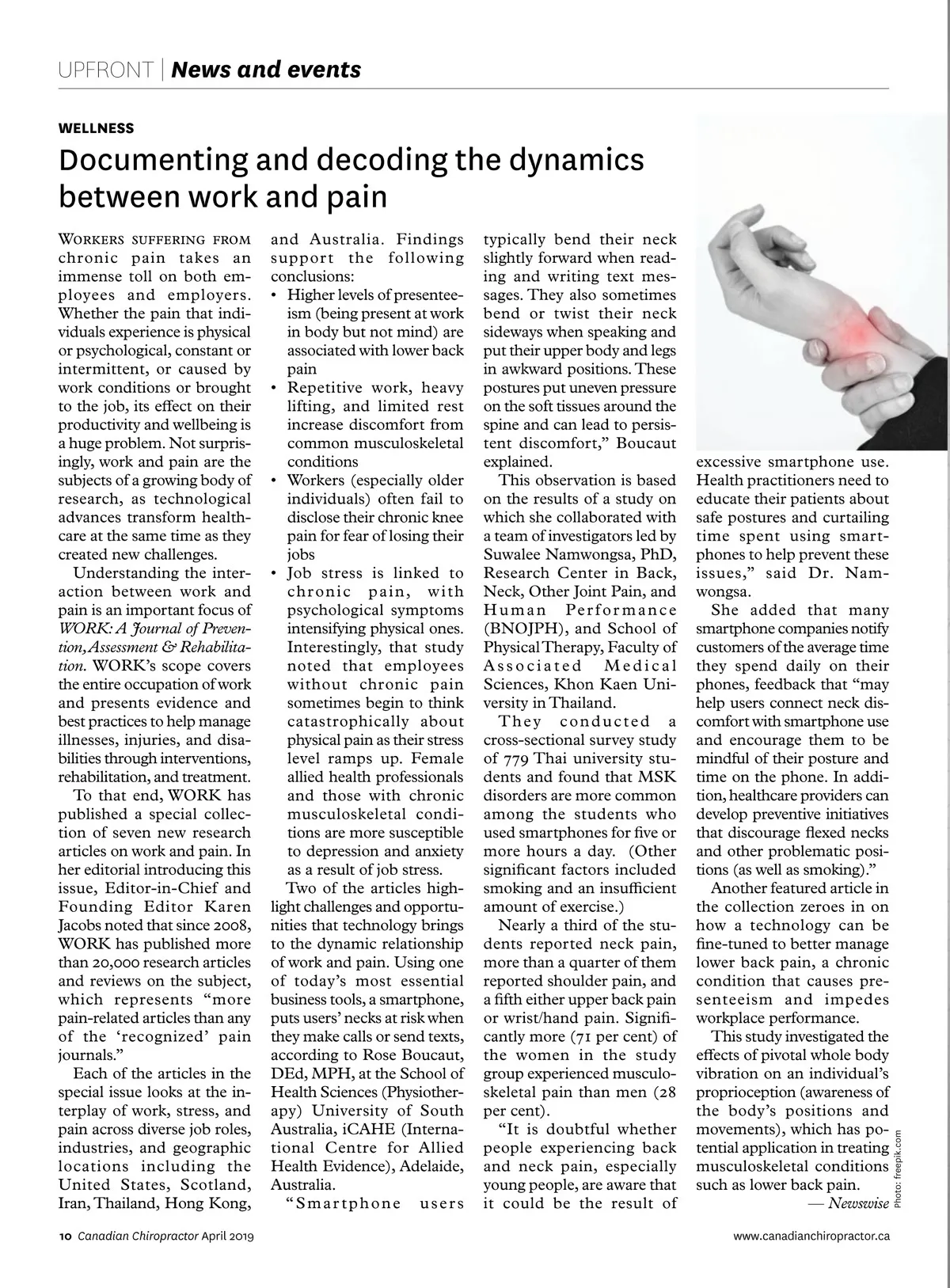
UPFRONT | News and events WELLNESS Documenting and decoding the dynamics between work and pain Workers suffering from chronic pain takes an immense toll on both em-ployees and employers. Whether the pain that indi-viduals experience is physical or psychological, constant or intermittent, or caused by work conditions or brought to the job, its effect on their productivity and wellbeing is a huge problem. Not surpris-ingly, work and pain are the subjects of a growing body of research, as technological advances transform health-care at the same time as they created new challenges. Understanding the inter-action between work and pain is an important focus of WORK: A Journal of Preven-tion, Assessment & Rehabilita-tion. WORK’s scope covers the entire occupation of work and presents evidence and best practices to help manage illnesses, injuries, and disa-bilities through interventions, rehabilitation, and treatment. To that end, WORK has published a special collec-tion of seven new research articles on work and pain. In her editorial introducing this issue, Editor-in-Chief and Founding Editor Karen Jacobs noted that since 2008, WORK has published more than 20,000 research articles and reviews on the subject, which represents “more pain-related articles than any of the ‘recognized’ pain journals.” Each of the articles in the special issue looks at the in-terplay of work, stress, and pain across diverse job roles, industries, and geographic locations including the United States, Scotland, Iran, Thailand, Hong Kong, 10 Canadian Chiropractor April 2019 and Australia. Findings support the following conclusions: • Higher levels of presentee-ism (being present at work in body but not mind) are associated with lower back pain • Repetitive work, heavy lifting, and limited rest increase discomfort from common musculoskeletal conditions • Workers (especially older individuals) often fail to disclose their chronic knee pain for fear of losing their jobs • Job stress is linked to chronic pain, with psychological symptoms intensifying physical ones. Interestingly, that study noted that employees without chronic pain sometimes begin to think catastrophically about physical pain as their stress level ramps up. Female allied health professionals and those with chronic musculoskeletal condi-tions are more susceptible to depression and anxiety as a result of job stress. Two of the articles high-light challenges and opportu-nities that technology brings to the dynamic relationship of work and pain. Using one of today’s most essential business tools, a smartphone, puts users’ necks at risk when they make calls or send texts, according to Rose Boucaut, DEd, MPH, at the School of Health Sciences (Physiother-apy) University of South Australia, iCAHE (Interna-tional Centre for Allied Health Evidence), Adelaide, Australia. “Smartphone users typically bend their neck slightly forward when read-ing and writing text mes-sages. They also sometimes bend or twist their neck sideways when speaking and put their upper body and legs in awkward positions. These postures put uneven pressure on the soft tissues around the spine and can lead to persis-tent discomfort,” Boucaut explained. This observation is based on the results of a study on which she collaborated with a team of investigators led by Suwalee Namwongsa, PhD, Research Center in Back, Neck, Other Joint Pain, and Human Performance (BNOJPH), and School of Physical Therapy, Faculty of Associated Medical Sciences, Khon Kaen Uni-versity in Thailand. They conducted a cross-sectional survey study of 779 Thai university stu-dents and found that MSK disorders are more common among the students who used smartphones for five or more hours a day. (Other significant factors included smoking and an insufficient amount of exercise.) Nearly a third of the stu-dents reported neck pain, more than a quarter of them reported shoulder pain, and a fifth either upper back pain or wrist/hand pain. Signifi-cantly more (71 per cent) of the women in the study group experienced musculo-skeletal pain than men (28 per cent). “It is doubtful whether people experiencing back and neck pain, especially young people, are aware that it could be the result of excessive smartphone use. Health practitioners need to educate their patients about safe postures and curtailing time spent using smart-phones to help prevent these issues,” said Dr. Nam-wongsa. She added that many smartphone companies notify customers of the average time they spend daily on their phones, feedback that “may help users connect neck dis-comfort with smartphone use and encourage them to be mindful of their posture and time on the phone. In addi-tion, healthcare providers can develop preventive initiatives that discourage flexed necks and other problematic posi-tions (as well as smoking).” Another featured article in the collection zeroes in on how a technology can be fine-tuned to better manage lower back pain, a chronic condition that causes pre-senteeism and impedes workplace performance. This study investigated the effects of pivotal whole body vibration on an individual’s proprioception (awareness of the body’s positions and movements), which has po-tential application in treating musculoskeletal conditions such as lower back pain. — Newswise www.canadianchiropractor.ca Photo: freepik.com
Chiropractic + Naturopathic Doctor April 2019: Page 10