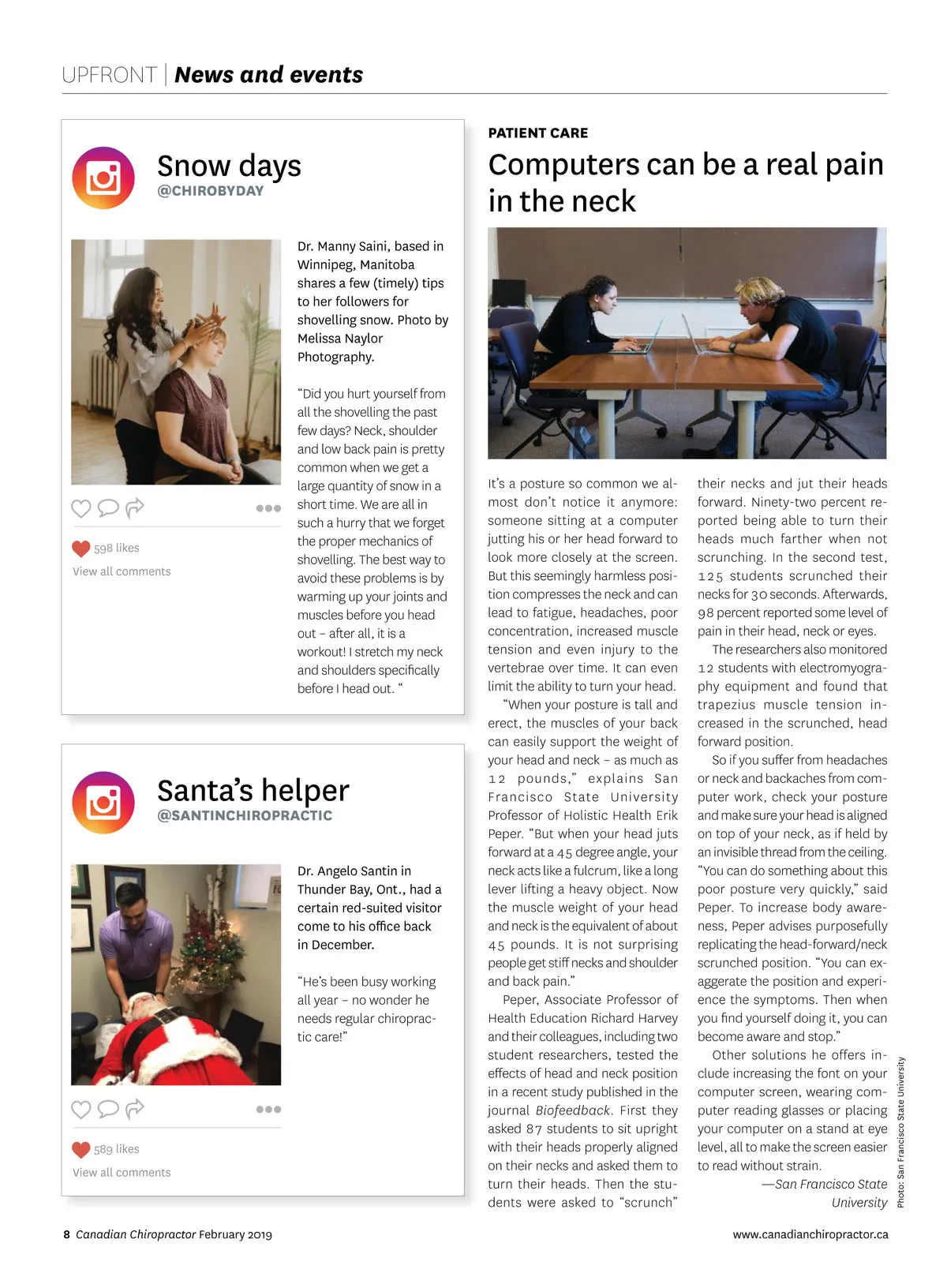
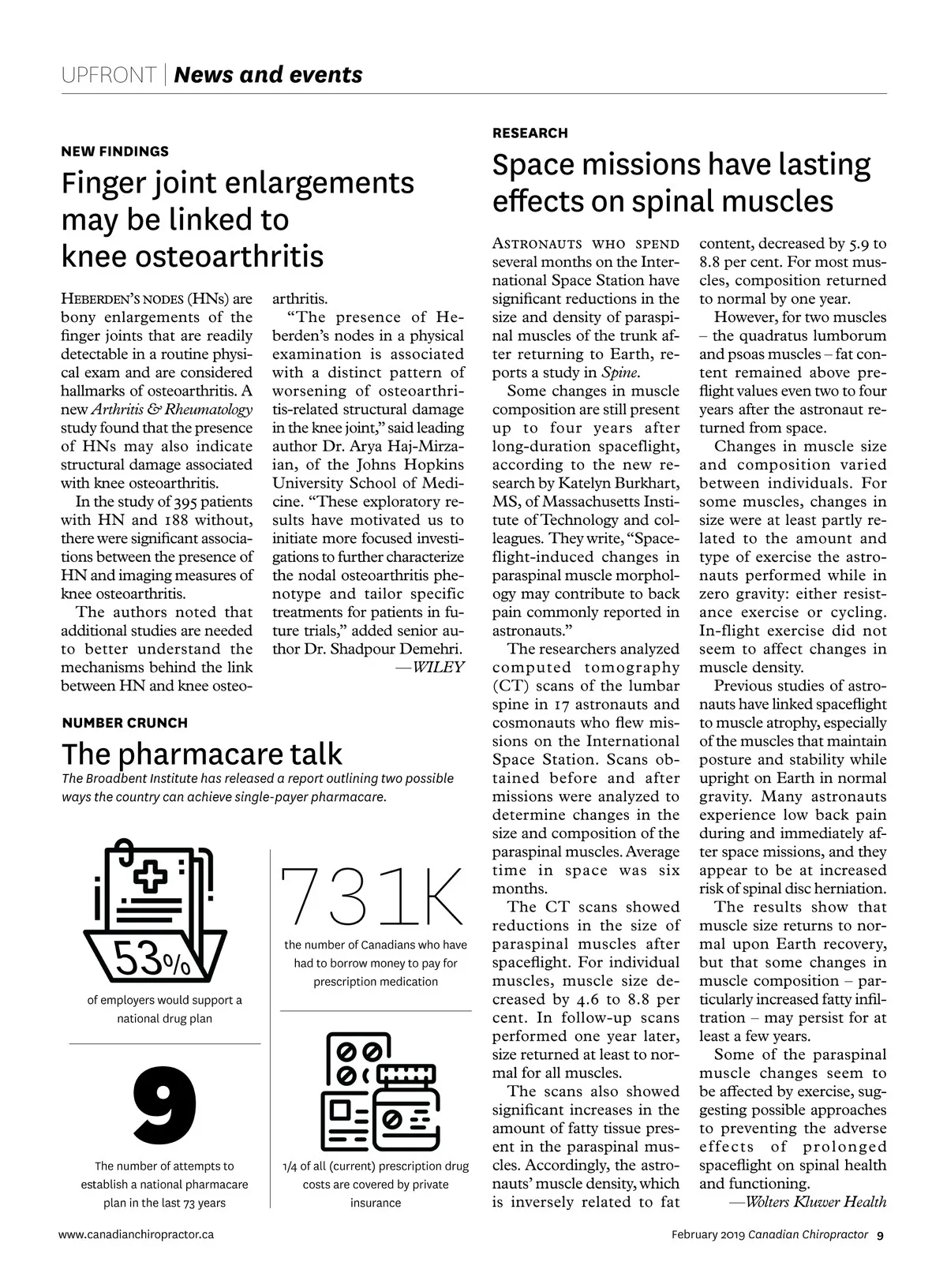
UPFRONT | News and events Snow days @CHIROBYDAY Dr. Manny Saini, based in Winnipeg, Manitoba shares a few (timely) tips to her followers for shovelling snow. Photo by Melissa Naylor Photography. “Did you hurt yourself from all the shovelling the past few days? Neck, shoulder and low back pain is pretty common when we get a large quantity of snow in a short time. We are all in such a hurry that we forget the proper mechanics of shovelling. The best way to avoid these problems is by warming up your joints and muscles before you head out – after all, it is a workout! I stretch my neck and shoulders specifically before I head out. “ Computers can be a real pain in the neck PATIENT CARE 598 likes View all comments Santa’s helper @SANTINCHIROPRACTIC Dr. Angelo Santin in Thunder Bay, Ont., had a certain red-suited visitor come to his office back in December. “He’s been busy working all year – no wonder he needs regular chiroprac-tic care!” 589 likes View all comments It’s a posture so common we al-most don’t notice it anymore: someone sitting at a computer jutting his or her head forward to look more closely at the screen. But this seemingly harmless posi-tion compresses the neck and can lead to fatigue, headaches, poor concentration, increased muscle tension and even injury to the vertebrae over time. It can even limit the ability to turn your head. “When your posture is tall and erect, the muscles of your back can easily support the weight of your head and neck – as much as 12 pounds,” explains San Francisco State University Professor of Holistic Health Erik Peper. “But when your head juts forward at a 45 degree angle, your neck acts like a fulcrum, like a long lever lifting a heavy object. Now the muscle weight of your head and neck is the equivalent of about 45 pounds. It is not surprising people get stiff necks and shoulder and back pain.” Peper, Associate Professor of Health Education Richard Harvey and their colleagues, including two student researchers, tested the effects of head and neck position in a recent study published in the journal Biofeedback . First they asked 87 students to sit upright with their heads properly aligned on their necks and asked them to turn their heads. Then the stu-dents were asked to “scrunch” their necks and jut their heads forward. Ninety-two percent re-ported being able to turn their heads much farther when not scrunching. In the second test, 125 students scrunched their necks for 30 seconds. Afterwards, 98 percent reported some level of pain in their head, neck or eyes. The researchers also monitored 12 students with electromyogra-phy equipment and found that trapezius muscle tension in-creased in the scrunched, head forward position. So if you suffer from headaches or neck and backaches from com-puter work, check your posture and make sure your head is aligned on top of your neck, as if held by an invisible thread from the ceiling. “You can do something about this poor posture very quickly,” said Peper. To increase body aware-ness, Peper advises purposefully replicating the head-forward/neck scrunched position. “You can ex-aggerate the position and experi-ence the symptoms. Then when you find yourself doing it, you can become aware and stop.” Other solutions he offers in-clude increasing the font on your computer screen, wearing com-puter reading glasses or placing your computer on a stand at eye level, all to make the screen easier to read without strain. —San Francisco State University www.canadianchiropractor.ca 8 Canadian Chiropractor February 2019 Photo: San Francisco State University
Chiropractic + Naturopathic Doctor February 2019: Page 8