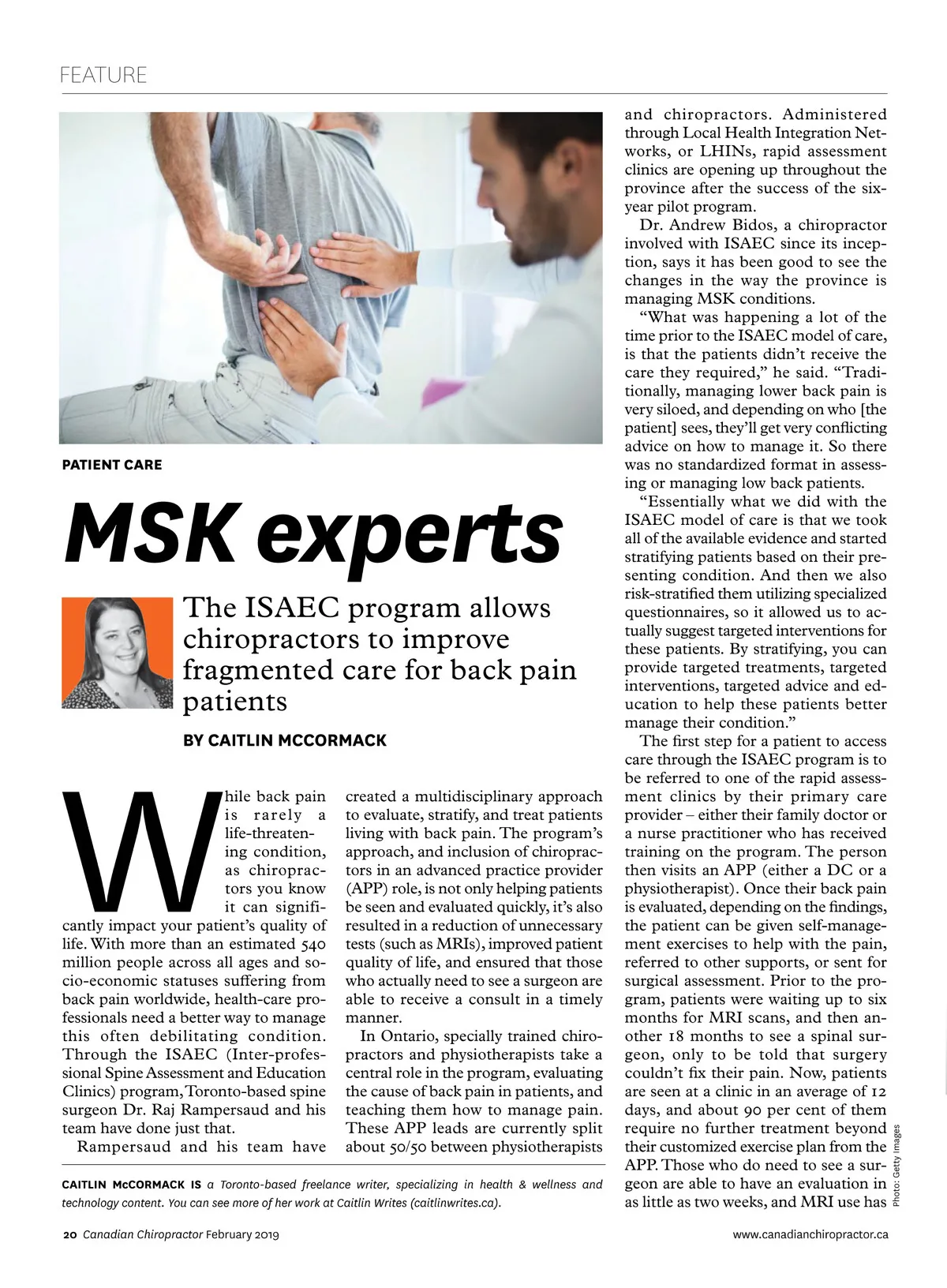
FEATURE and chiropractors. Administered through Local Health Integration Net-works, or LHINs, rapid assessment clinics are opening up throughout the province after the success of the six-year pilot program. Dr. Andrew Bidos, a chiropractor involved with ISAEC since its incep-tion, says it has been good to see the changes in the way the province is managing MSK conditions. “What was happening a lot of the time prior to the ISAEC model of care, is that the patients didn’t receive the care they required,” he said. “Tradi-tionally, managing lower back pain is very siloed, and depending on who [the patient] sees, they’ll get very conflicting advice on how to manage it. So there was no standardized format in assess-ing or managing low back patients. “Essentially what we did with the ISAEC model of care is that we took all of the available evidence and started stratifying patients based on their pre-senting condition. And then we also risk-stratified them utilizing specialized questionnaires, so it allowed us to ac-tually suggest targeted interventions for these patients. By stratifying, you can provide targeted treatments, targeted interventions, targeted advice and ed-ucation to help these patients better manage their condition.” The first step for a patient to access care through the ISAEC program is to be referred to one of the rapid assess-ment clinics by their primary care provider – either their family doctor or a nurse practitioner who has received training on the program. The person then visits an APP (either a DC or a physiotherapist). Once their back pain is evaluated, depending on the findings, the patient can be given self-manage-ment exercises to help with the pain, referred to other supports, or sent for surgical assessment. Prior to the pro-gram, patients were waiting up to six months for MRI scans, and then an-other 18 months to see a spinal sur-geon, only to be told that surgery couldn’t fix their pain. Now, patients are seen at a clinic in an average of 12 days, and about 90 per cent of them require no further treatment beyond their customized exercise plan from the APP. Those who do need to see a sur-geon are able to have an evaluation in as little as two weeks, and MRI use has www.canadianchiropractor.ca PATIENT CARE MSK experts W The ISAEC program allows chiropractors to improve fragmented care for back pain patients BY CAITLIN MCCORMACK created a multidisciplinary approach to evaluate, stratify, and treat patients living with back pain. The program’s approach, and inclusion of chiroprac-tors in an advanced practice provider (APP) role, is not only helping patients be seen and evaluated quickly, it’s also resulted in a reduction of unnecessary tests (such as MRIs), improved patient quality of life, and ensured that those who actually need to see a surgeon are able to receive a consult in a timely manner. In Ontario, specially trained chiro-practors and physiotherapists take a central role in the program, evaluating the cause of back pain in patients, and teaching them how to manage pain. These APP leads are currently split about 50/50 between physiotherapists CAITLIN McCORMACK IS a Toronto-based freelance writer, specializing in health & wellness and technology content. You can see more of her work at Caitlin Writes (caitlinwrites.ca). 20 Canadian Chiropractor February 2019 Photo: Getty Images hile back pain is rarely a life-threaten-ing condition, as chiroprac-tors you know it can signifi-cantly impact your patient’s quality of life. With more than an estimated 540 million people across all ages and so-cio-economic statuses suffering from back pain worldwide, health-care pro-fessionals need a better way to manage this often debilitating condition. Through the ISAEC (Inter-profes-sional Spine Assessment and Education Clinics) program, Toronto-based spine surgeon Dr. Raj Rampersaud and his team have done just that. Rampersaud and his team have
Chiropractic + Naturopathic Doctor February 2019: Page 20