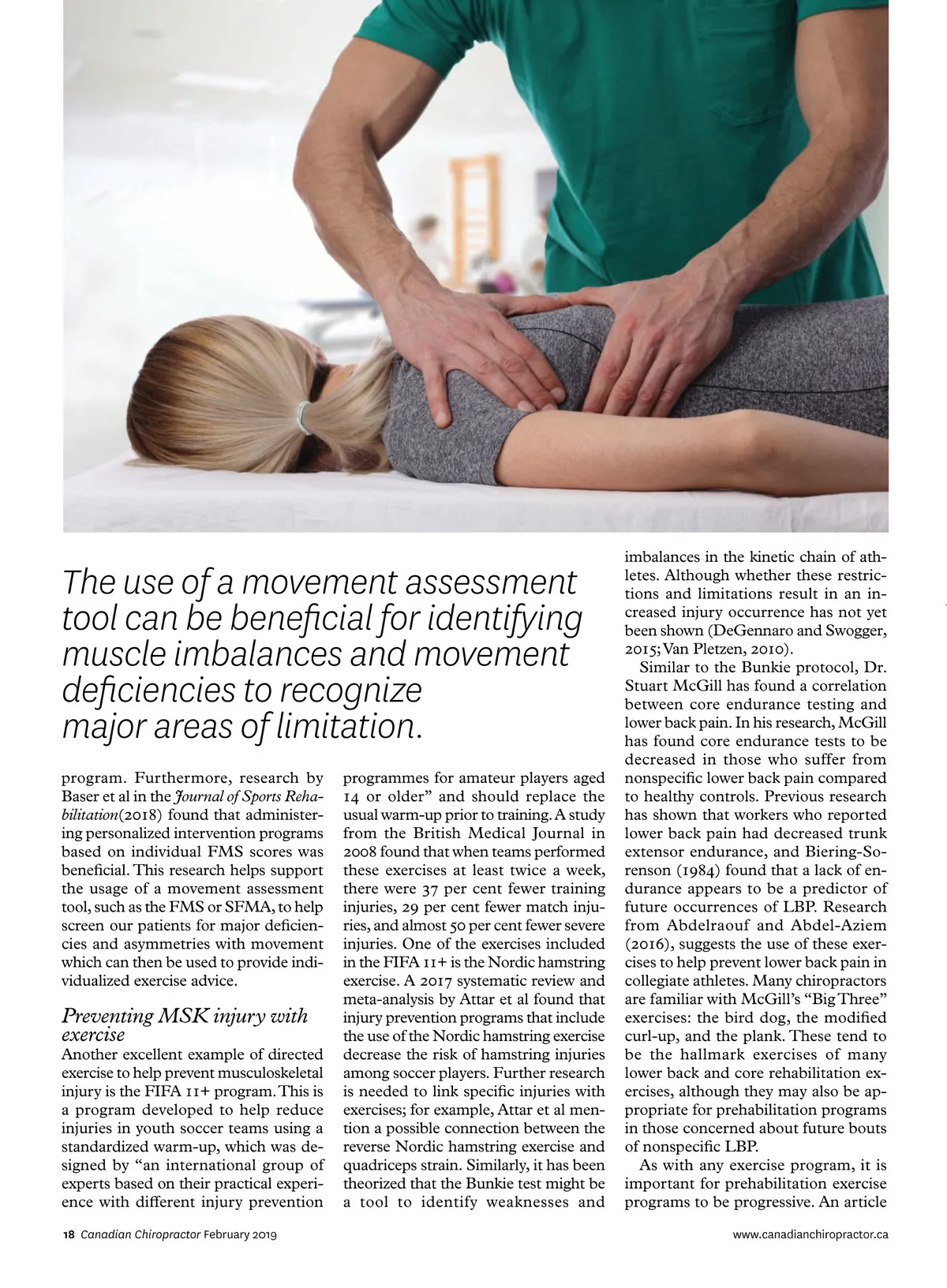
The use of a movement assessment tool can be beneficial for identifying muscle imbalances and movement deficiencies to recognize major areas of limitation. program. Furthermore, research by Baser et al in the Journal of Sports Reha-bilitation (2018) found that administer-ing personalized intervention programs based on individual FMS scores was beneficial. This research helps support the usage of a movement assessment tool, such as the FMS or SFMA, to help screen our patients for major deficien-cies and asymmetries with movement which can then be used to provide indi-vidualized exercise advice. programmes for amateur players aged 14 or older” and should replace the usual warm-up prior to training. A study from the British Medical Journal in 2008 found that when teams performed these exercises at least twice a week, there were 37 per cent fewer training injuries, 29 per cent fewer match inju-ries, and almost 50 per cent fewer severe injuries. One of the exercises included in the FIFA 11+ is the Nordic hamstring exercise. A 2017 systematic review and meta-analysis by Attar et al found that injury prevention programs that include the use of the Nordic hamstring exercise decrease the risk of hamstring injuries among soccer players. Further research is needed to link specific injuries with exercises; for example, Attar et al men-tion a possible connection between the reverse Nordic hamstring exercise and quadriceps strain. Similarly, it has been theorized that the Bunkie test might be a tool to identify weaknesses and Another excellent example of directed exercise to help prevent musculoskeletal injury is the FIFA 11+ program. This is a program developed to help reduce injuries in youth soccer teams using a standardized warm-up, which was de-signed by “an international group of experts based on their practical experi-ence with different injury prevention 18 Canadian Chiropractor February 2019 Preventing MSK injury with exercise imbalances in the kinetic chain of ath-letes. Although whether these restric-tions and limitations result in an in-creased injury occurrence has not yet been shown (DeGennaro and Swogger, 2015; Van Pletzen, 2010). Similar to the Bunkie protocol, Dr. Stuart McGill has found a correlation between core endurance testing and lower back pain. In his research, McGill has found core endurance tests to be decreased in those who suffer from nonspecific lower back pain compared to healthy controls. Previous research has shown that workers who reported lower back pain had decreased trunk extensor endurance, and Biering-So-renson (1984) found that a lack of en-durance appears to be a predictor of future occurrences of LBP. Research from Abdelraouf and Abdel-Aziem (2016), suggests the use of these exer-cises to help prevent lower back pain in collegiate athletes. Many chiropractors are familiar with McGill’s “Big Three” exercises: the bird dog, the modified curl-up, and the plank. These tend to be the hallmark exercises of many lower back and core rehabilitation ex-ercises, although they may also be ap-propriate for prehabilitation programs in those concerned about future bouts of nonspecific LBP. As with any exercise program, it is important for prehabilitation exercise programs to be progressive. An article www.canadianchiropractor.ca
Chiropractic + Naturopathic Doctor February 2019: Page 18