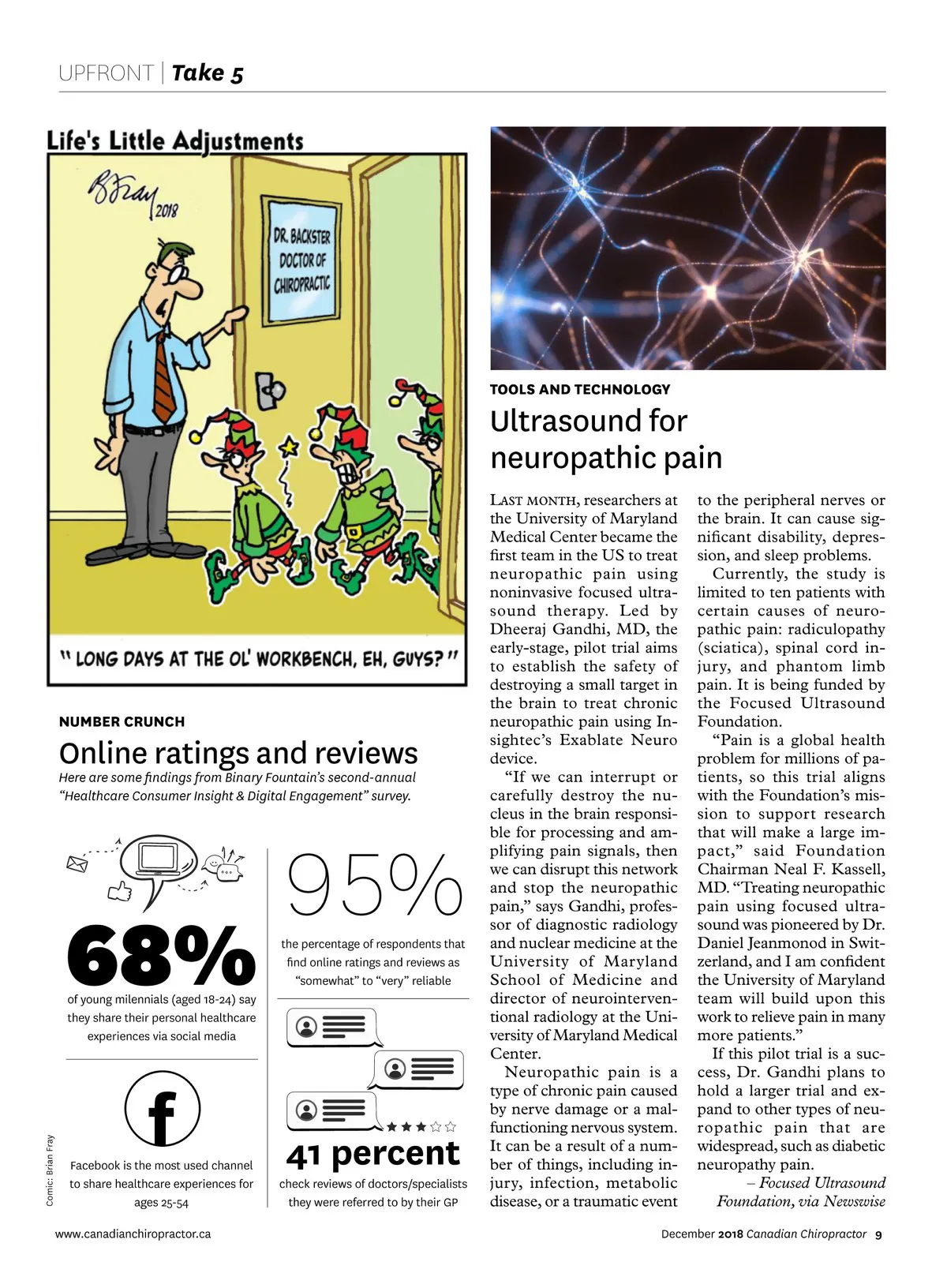
UPFRONT | Take 5 TOOLS AND TECHNOLOGY Ultrasound for neuropathic pain Last month, researchers at the University of Maryland Medical Center became the first team in the US to treat neuropathic pain using noninvasive focused ultra-sound therapy. Led by Dheeraj Gandhi, MD, the early-stage, pilot trial aims to establish the safety of destroying a small target in the brain to treat chronic neuropathic pain using In-sightec’s Exablate Neuro device. “If we can interrupt or carefully destroy the nu-cleus in the brain responsi-ble for processing and am-plifying pain signals, then we can disrupt this network and stop the neuropathic pain,” says Gandhi, profes-sor of diagnostic radiology and nuclear medicine at the University of Maryland School of Medicine and director of neurointerven-tional radiology at the Uni-versity of Maryland Medical Center. Neuropathic pain is a type of chronic pain caused by nerve damage or a mal-functioning nervous system. It can be a result of a num-ber of things, including in-jury, infection, metabolic disease, or a traumatic event to the peripheral nerves or the brain. It can cause sig-nificant disability, depres-sion, and sleep problems. Currently, the study is limited to ten patients with certain causes of neuro-pathic pain: radiculopathy (sciatica), spinal cord in-jury, and phantom limb pain. It is being funded by the Focused Ultrasound Foundation. “Pain is a global health problem for millions of pa-tients, so this trial aligns with the Foundation’s mis-sion to support research that will make a large im-pact,” said Foundation Chairman Neal F. Kassell, MD. “Treating neuropathic pain using focused ultra-sound was pioneered by Dr. Daniel Jeanmonod in Swit-zerland, and I am confident the University of Maryland team will build upon this work to relieve pain in many more patients.” If this pilot trial is a suc-cess, Dr. Gandhi plans to hold a larger trial and ex-pand to other types of neu-ropathic pain that are widespread, such as diabetic neuropathy pain. – Focused Ultrasound Foundation, via Newswise NUMBER CRUNCH Online ratings and reviews Here are some findings from Binary Fountain’s second-annual “Healthcare Consumer Insight & Digital Engagement” survey. 68% of young milennials (aged 18-24) say they share their personal healthcare experiences via social media Comic: Brian Fray 95% the percentage of respondents that find online ratings and reviews as “somewhat” to “very” reliable Facebook is the most used channel to share healthcare experiences for ages 25-54 www.canadianchiropractor.ca 41 percent check reviews of doctors/specialists they were referred to by their GP December 2018 Canadian Chiropractor 9
Chiropractic + Naturopathic Doctor December 2018: Page 9