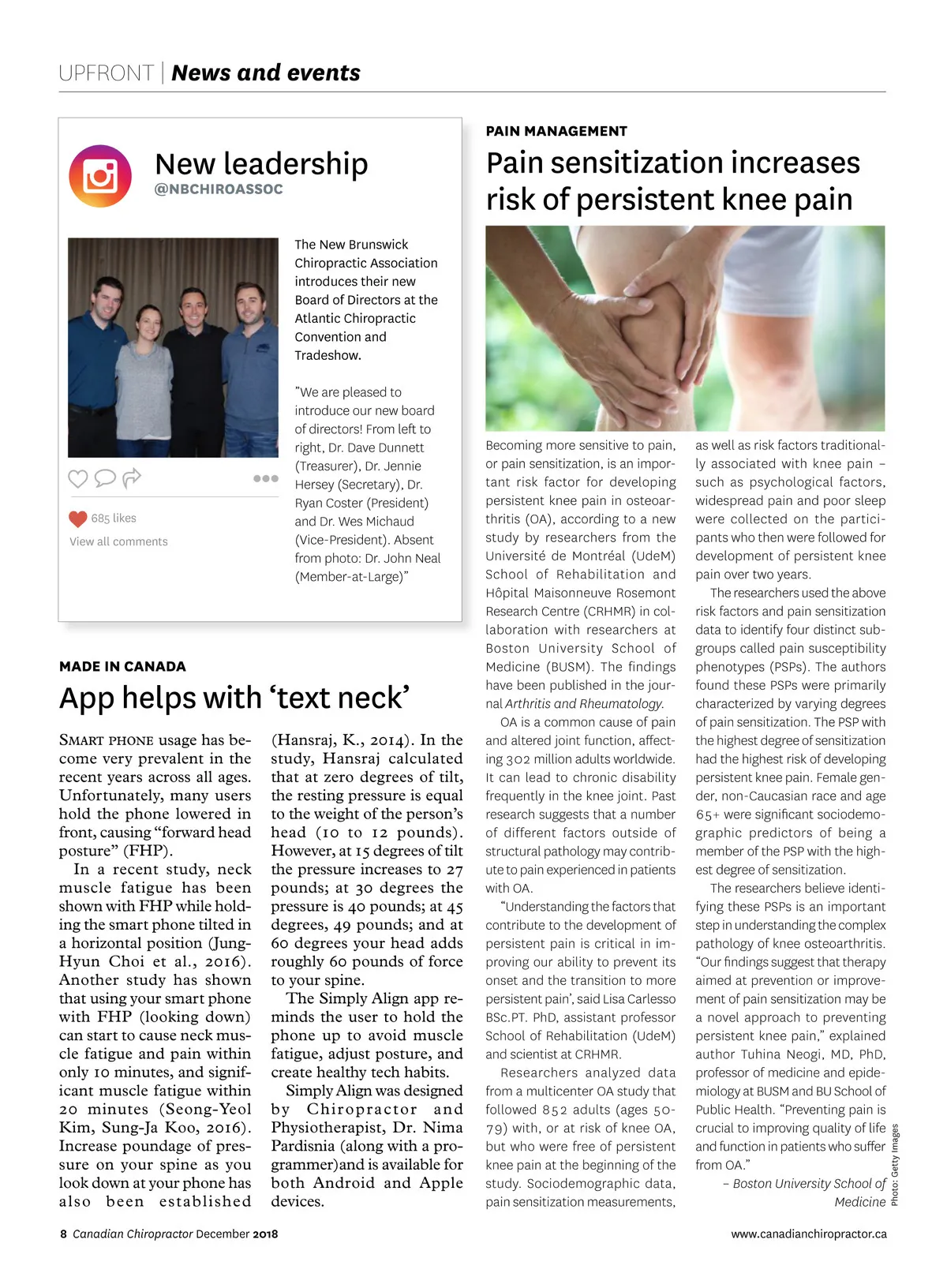
UPFRONT | News and events PAIN MANAGEMENT New leadership @NBCHIROASSOC The New Brunswick Chiropractic Association introduces their new Board of Directors at the Atlantic Chiropractic Convention and Tradeshow. ”We are pleased to introduce our new board of directors! From left to right, Dr. Dave Dunnett (Treasurer), Dr. Jennie Hersey (Secretary), Dr. Ryan Coster (President) and Dr. Wes Michaud (Vice-President). Absent from photo: Dr. John Neal (Member-at-Large)” Pain sensitization increases risk of persistent knee pain 685 likes View all comments MADE IN CANADA App helps with ‘text neck’ Smart phone usage has be-come very prevalent in the recent years across all ages. Unfortunately, many users hold the phone lowered in front, causing “forward head posture” (FHP). In a recent study, neck muscle fatigue has been shown with FHP while hold-ing the smart phone tilted in a horizontal position (Jung-Hyun Choi et al., 2016). Another study has shown that using your smart phone with FHP (looking down) can start to cause neck mus-cle fatigue and pain within only 10 minutes, and signif-icant muscle fatigue within 20 minutes (Seong-Yeol Kim, Sung-Ja Koo, 2016). Increase poundage of pres-sure on your spine as you look down at your phone has also been established (Hansraj, K., 2014). In the study, Hansraj calculated that at zero degrees of tilt, the resting pressure is equal to the weight of the person’s head (10 to 12 pounds). However, at 15 degrees of tilt the pressure increases to 27 pounds; at 30 degrees the pressure is 40 pounds; at 45 degrees, 49 pounds; and at 60 degrees your head adds roughly 60 pounds of force to your spine. The Simply Align app re-minds the user to hold the phone up to avoid muscle fatigue, adjust posture, and create healthy tech habits. Simply Align was designed by Chiropractor and Physiotherapist, Dr. Nima Pardisnia (along with a pro-grammer)and is available for both Android and Apple devices. Becoming more sensitive to pain, or pain sensitization, is an impor-tant risk factor for developing persistent knee pain in osteoar-thritis (OA), according to a new study by researchers from the Université de Montréal (UdeM) School of Rehabilitation and Hôpital Maisonneuve Rosemont Research Centre (CRHMR) in col-laboration with researchers at Boston University School of Medicine (BUSM). The findings have been published in the jour-nal Arthritis and Rheumatology. OA is a common cause of pain and altered joint function, affect-ing 302 million adults worldwide. It can lead to chronic disability frequently in the knee joint. Past research suggests that a number of different factors outside of structural pathology may contrib-ute to pain experienced in patients with OA. “Understanding the factors that contribute to the development of persistent pain is critical in im-proving our ability to prevent its onset and the transition to more persistent pain’, said Lisa Carlesso BSc.PT. PhD, assistant professor School of Rehabilitation (UdeM) and scientist at CRHMR. Researchers analyzed data from a multicenter OA study that followed 852 adults (ages 50-79) with, or at risk of knee OA, but who were free of persistent knee pain at the beginning of the study. Sociodemographic data, pain sensitization measurements, as well as risk factors traditional-ly associated with knee pain – such as psychological factors, widespread pain and poor sleep were collected on the partici-pants who then were followed for development of persistent knee pain over two years. The researchers used the above risk factors and pain sensitization data to identify four distinct sub-groups called pain susceptibility phenotypes (PSPs). The authors found these PSPs were primarily characterized by varying degrees of pain sensitization. The PSP with the highest degree of sensitization had the highest risk of developing persistent knee pain. Female gen-der, non-Caucasian race and age 65+ were significant sociodemo-graphic predictors of being a member of the PSP with the high-est degree of sensitization. The researchers believe identi-fying these PSPs is an important step in understanding the complex pathology of knee osteoarthritis. “Our findings suggest that therapy aimed at prevention or improve-ment of pain sensitization may be a novel approach to preventing persistent knee pain,” explained author Tuhina Neogi, MD, PhD, professor of medicine and epide-miology at BUSM and BU School of Public Health. “Preventing pain is crucial to improving quality of life and function in patients who suffer from OA.” – Boston University School of Medicine www.canadianchiropractor.ca 8 Canadian Chiropractor December 2018 Photo: Getty Images
Chiropractic + Naturopathic Doctor December 2018: Page 8