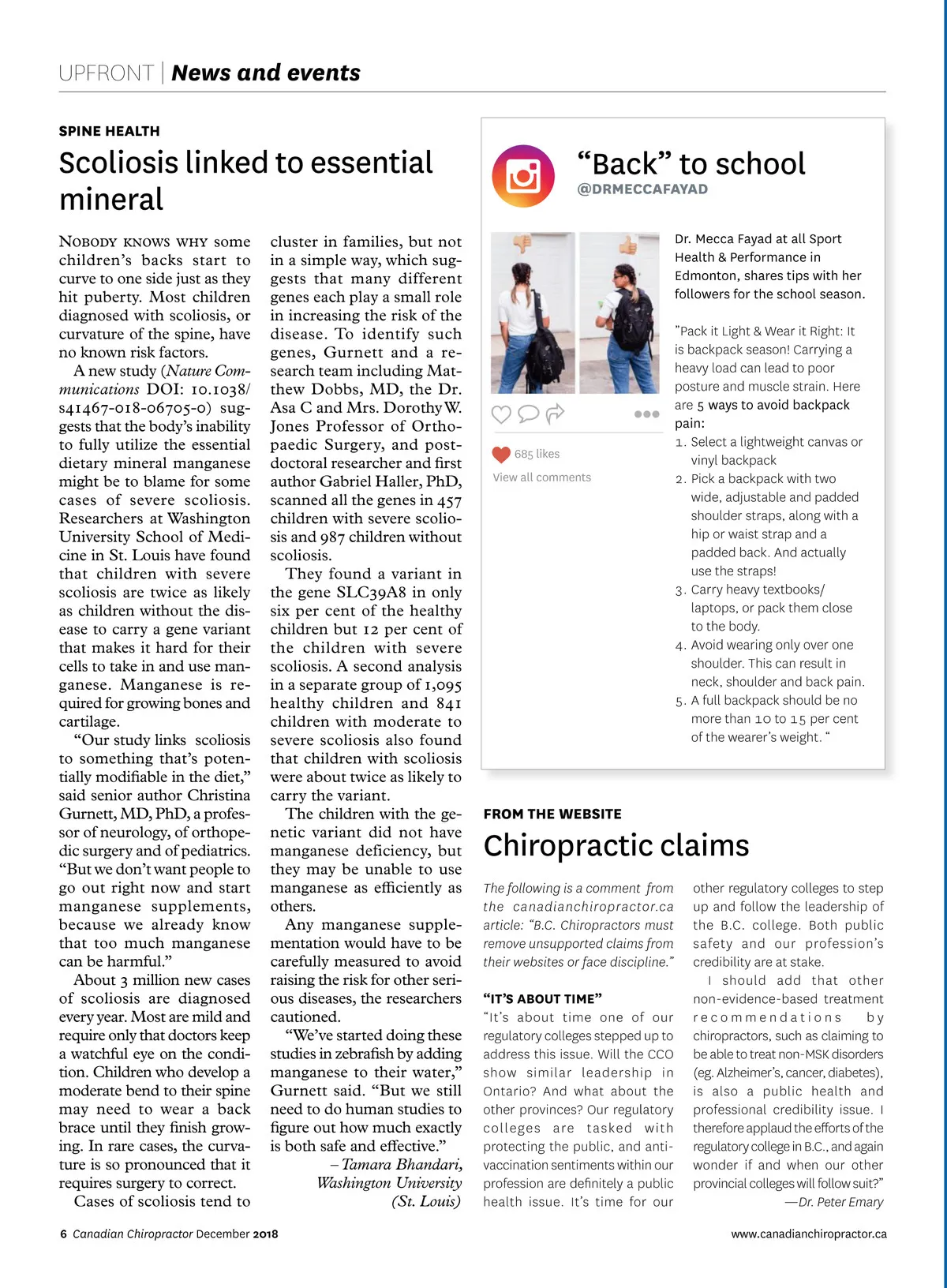
UPFRONT | News and events SPINE HEALTH Scoliosis linked to essential mineral Nobody knows why some children’s backs start to curve to one side just as they hit puberty. Most children diagnosed with scoliosis, or curvature of the spine, have no known risk factors. A new study ( Nature Com-munications DOI: 10.1038/ s41467-018-06705-0) sug-gests that the body’s inability to fully utilize the essential dietary mineral manganese might be to blame for some cases of severe scoliosis. Researchers at Washington University School of Medi-cine in St. Louis have found that children with severe scoliosis are twice as likely as children without the dis-ease to carry a gene variant that makes it hard for their cells to take in and use man-ganese. Manganese is re-quired for growing bones and cartilage. “Our study links scoliosis to something that’s poten-tially modifiable in the diet,” said senior author Christina Gurnett, MD, PhD, a profes-sor of neurology, of orthope-dic surgery and of pediatrics. “But we don’t want people to go out right now and start manganese supplements, because we already know that too much manganese can be harmful.” About 3 million new cases of scoliosis are diagnosed every year. Most are mild and require only that doctors keep a watchful eye on the condi-tion. Children who develop a moderate bend to their spine may need to wear a back brace until they finish grow-ing. In rare cases, the curva-ture is so pronounced that it requires surgery to correct. Cases of scoliosis tend to cluster in families, but not in a simple way, which sug-gests that many different genes each play a small role in increasing the risk of the disease. To identify such genes, Gurnett and a re-search team including Mat-thew Dobbs, MD, the Dr. Asa C and Mrs. Dorothy W. Jones Professor of Ortho-paedic Surgery, and post-doctoral researcher and first author Gabriel Haller, PhD, scanned all the genes in 457 children with severe scolio-sis and 987 children without scoliosis. They found a variant in the gene SLC39A8 in only six per cent of the healthy children but 12 per cent of the children with severe scoliosis. A second analysis in a separate group of 1,095 healthy children and 841 children with moderate to severe scoliosis also found that children with scoliosis were about twice as likely to carry the variant. The children with the ge-netic variant did not have manganese deficiency, but they may be unable to use manganese as efficiently as others. Any manganese supple-mentation would have to be carefully measured to avoid raising the risk for other seri-ous diseases, the researchers cautioned. “We’ve started doing these studies in zebrafish by adding manganese to their water,” Gurnett said. “But we still need to do human studies to figure out how much exactly is both safe and effective.” – Tamara Bhandari, Washington University (St. Louis) “Back” to school @DRMECCAFAYAD Dr. Mecca Fayad at all Sport Health & Performance in Edmonton, shares tips with her followers for the school season. ”Pack it Light & Wear it Right: It is backpack season! Carrying a heavy load can lead to poor posture and muscle strain. Here are 5 ways to avoid backpack pain: 1. Select a lightweight canvas or vinyl backpack 2. Pick a backpack with two wide, adjustable and padded shoulder straps, along with a hip or waist strap and a padded back. And actually use the straps! 3. Carry heavy textbooks/ laptops, or pack them close to the body. 4. Avoid wearing only over one shoulder. This can result in neck, shoulder and back pain. 5. A full backpack should be no more than 10 to 15 per cent of the wearer’s weight. “ 685 likes View all comments FROM THE WEBSITE Chiropractic claims The following is a comment from the canadianchiropractor.ca article: “B.C. Chiropractors must remove unsupported claims from their websites or face discipline.” “IT’S ABOUT TIME” “It’s about time one of our regulatory colleges stepped up to address this issue. Will the CCO show similar leadership in Ontario? And what about the other provinces? Our regulatory colleges are tasked with protecting the public, and anti-vaccination sentiments within our profession are definitely a public health issue. It’s time for our other regulatory colleges to step up and follow the leadership of the B.C. college. Both public safety and our profession’s credibility are at stake. I should add that other non-evidence-based treatment recommendations by chiropractors, such as claiming to be able to treat non-MSK disorders (eg. Alzheimer’s, cancer, diabetes), is also a public health and professional credibility issue. I therefore applaud the efforts of the regulatory college in B.C., and again wonder if and when our other provincial colleges will follow suit?” —Dr. Peter Emary www.canadianchiropractor.ca 6 Canadian Chiropractor December 2018
Chiropractic + Naturopathic Doctor December 2018: Page 6