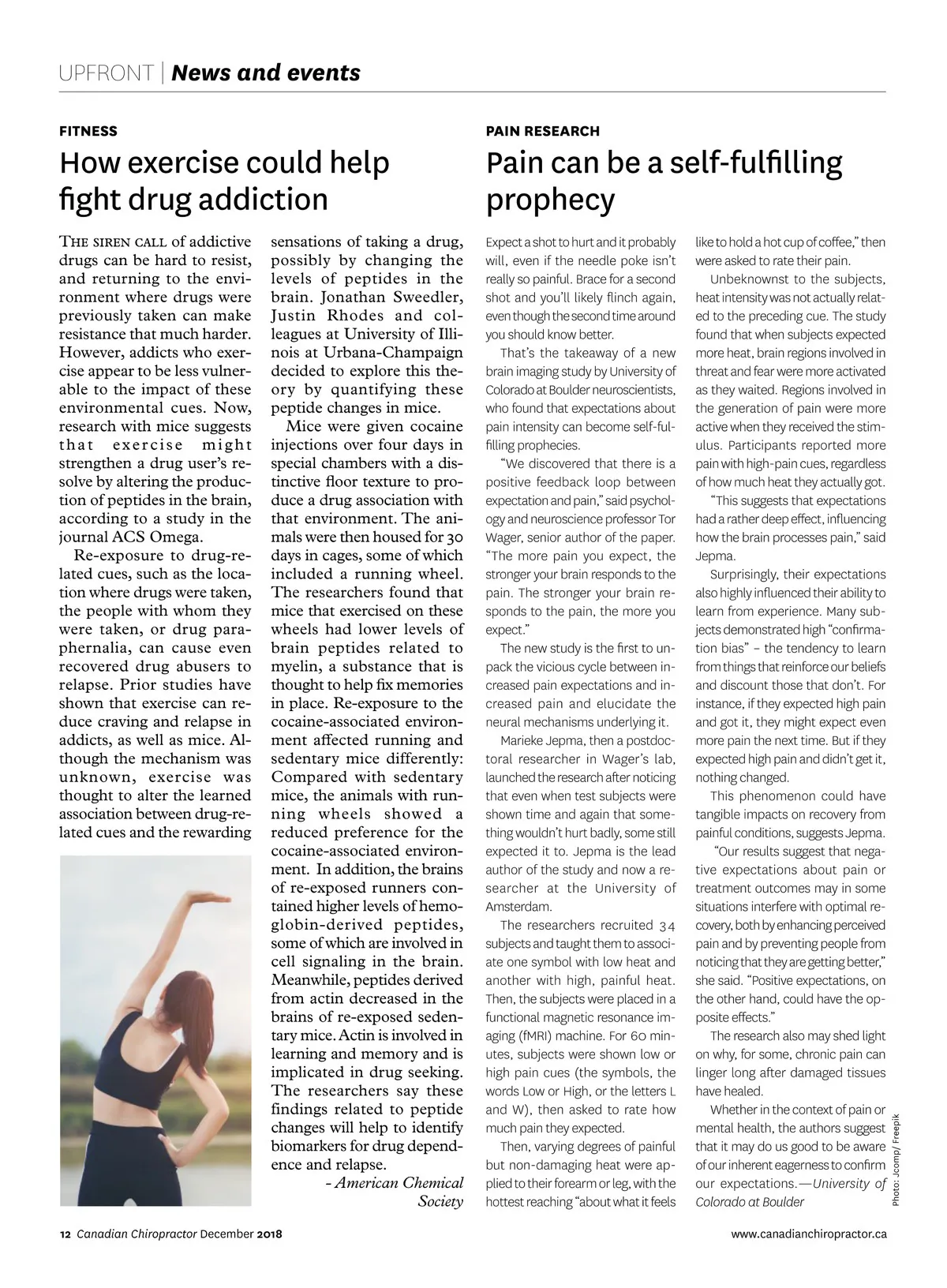
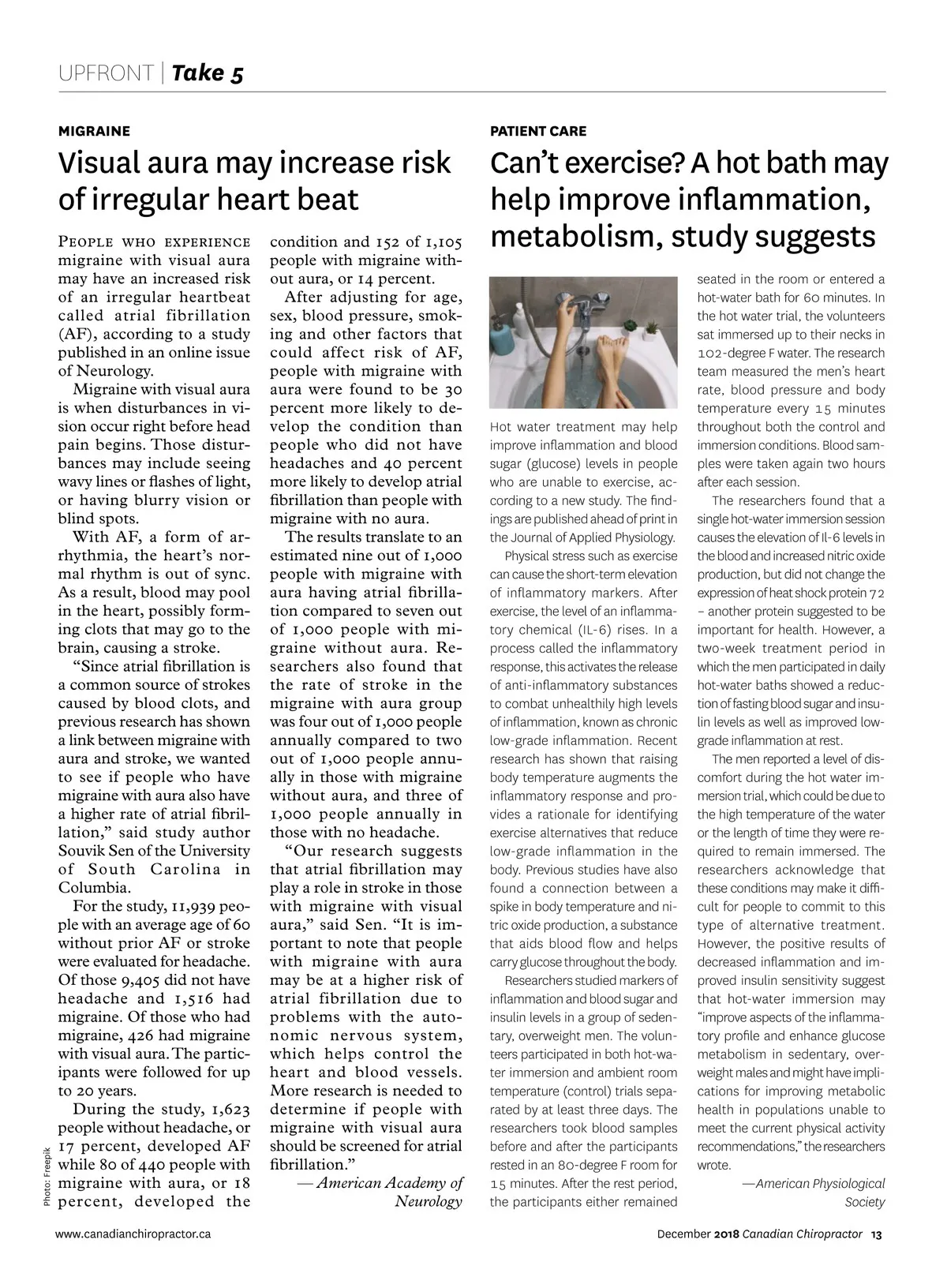
UPFRONT | Take 5 MIGRAINE Visual aura may increase risk of irregular heart beat People who experience migraine with visual aura may have an increased risk of an irregular heartbeat called atrial fibrillation (AF), according to a study published in an online issue of Neurology. Migraine with visual aura is when disturbances in vi-sion occur right before head pain begins. Those distur-bances may include seeing wavy lines or flashes of light, or having blurry vision or blind spots. With AF, a form of ar-rhythmia, the heart’s nor-mal rhythm is out of sync. As a result, blood may pool in the heart, possibly form-ing clots that may go to the brain, causing a stroke. “Since atrial fibrillation is a common source of strokes caused by blood clots, and previous research has shown a link between migraine with aura and stroke, we wanted to see if people who have migraine with aura also have a higher rate of atrial fibril-lation,” said study author Souvik Sen of the University of South Carolina in Columbia. For the study, 11,939 peo-ple with an average age of 60 without prior AF or stroke were evaluated for headache. Of those 9,405 did not have headache and 1,516 had migraine. Of those who had migraine, 426 had migraine with visual aura. The partic-ipants were followed for up to 20 years. During the study, 1,623 people without headache, or 17 percent, developed AF while 80 of 440 people with migraine with aura, or 18 percent, developed the www.canadianchiropractor.ca PATIENT CARE condition and 152 of 1,105 people with migraine with-out aura, or 14 percent. After adjusting for age, sex, blood pressure, smok-ing and other factors that could affect risk of AF, people with migraine with aura were found to be 30 percent more likely to de-velop the condition than people who did not have headaches and 40 percent more likely to develop atrial fibrillation than people with migraine with no aura. The results translate to an estimated nine out of 1,000 people with migraine with aura having atrial fibrilla-tion compared to seven out of 1,000 people with mi-graine without aura. Re-searchers also found that the rate of stroke in the migraine with aura group was four out of 1,000 people annually compared to two out of 1,000 people annu-ally in those with migraine without aura, and three of 1,000 people annually in those with no headache. “Our research suggests that atrial fibrillation may play a role in stroke in those with migraine with visual aura,” said Sen. “It is im-portant to note that people with migraine with aura may be at a higher risk of atrial fibrillation due to problems with the auto-nomic nervous system, which helps control the heart and blood vessels. More research is needed to determine if people with migraine with visual aura should be screened for atrial fibrillation.” — American Academy of Neurology Can’t exercise? A hot bath may help improve inflammation, metabolism, study suggests seated in the room or entered a hot-water bath for 60 minutes. In the hot water trial, the volunteers sat immersed up to their necks in 102-degree F water. The research team measured the men’s heart rate, blood pressure and body temperature every 15 minutes throughout both the control and immersion conditions. Blood sam-ples were taken again two hours after each session. The researchers found that a single hot-water immersion session causes the elevation of Il-6 levels in the blood and increased nitric oxide production, but did not change the expression of heat shock protein 72 – another protein suggested to be important for health. However, a two-week treatment period in which the men participated in daily hot-water baths showed a reduc-tion of fasting blood sugar and insu-lin levels as well as improved low-grade inflammation at rest. The men reported a level of dis-comfort during the hot water im-mersion trial, which could be due to the high temperature of the water or the length of time they were re-quired to remain immersed. The researchers acknowledge that these conditions may make it diffi-cult for people to commit to this type of alternative treatment. However, the positive results of decreased inflammation and im-proved insulin sensitivity suggest that hot-water immersion may “improve aspects of the inflamma-tory profile and enhance glucose metabolism in sedentary, over-weight males and might have impli-cations for improving metabolic health in populations unable to meet the current physical activity recommendations,” the researchers wrote. — American Physiological Society Hot water treatment may help improve inflammation and blood sugar (glucose) levels in people who are unable to exercise, ac-cording to a new study. The find-ings are published ahead of print in the Journal of Applied Physiology. Physical stress such as exercise can cause the short-term elevation of inflammatory markers. After exercise, the level of an inflamma-tory chemical (IL-6) rises. In a process called the inflammatory response, this activates the release of anti-inflammatory substances to combat unhealthily high levels of inflammation, known as chronic low-grade inflammation. Recent research has shown that raising body temperature augments the inflammatory response and pro-vides a rationale for identifying exercise alternatives that reduce low-grade inflammation in the body. Previous studies have also found a connection between a spike in body temperature and ni-tric oxide production, a substance that aids blood flow and helps carry glucose throughout the body. Researchers studied markers of inflammation and blood sugar and insulin levels in a group of seden-tary, overweight men. The volun-teers participated in both hot-wa-ter immersion and ambient room temperature (control) trials sepa-rated by at least three days. The researchers took blood samples before and after the participants rested in an 80-degree F room for 15 minutes. After the rest period, the participants either remained Photo: Freepik December 2018 Canadian Chiropractor 13
Chiropractic + Naturopathic Doctor December 2018: Page 13