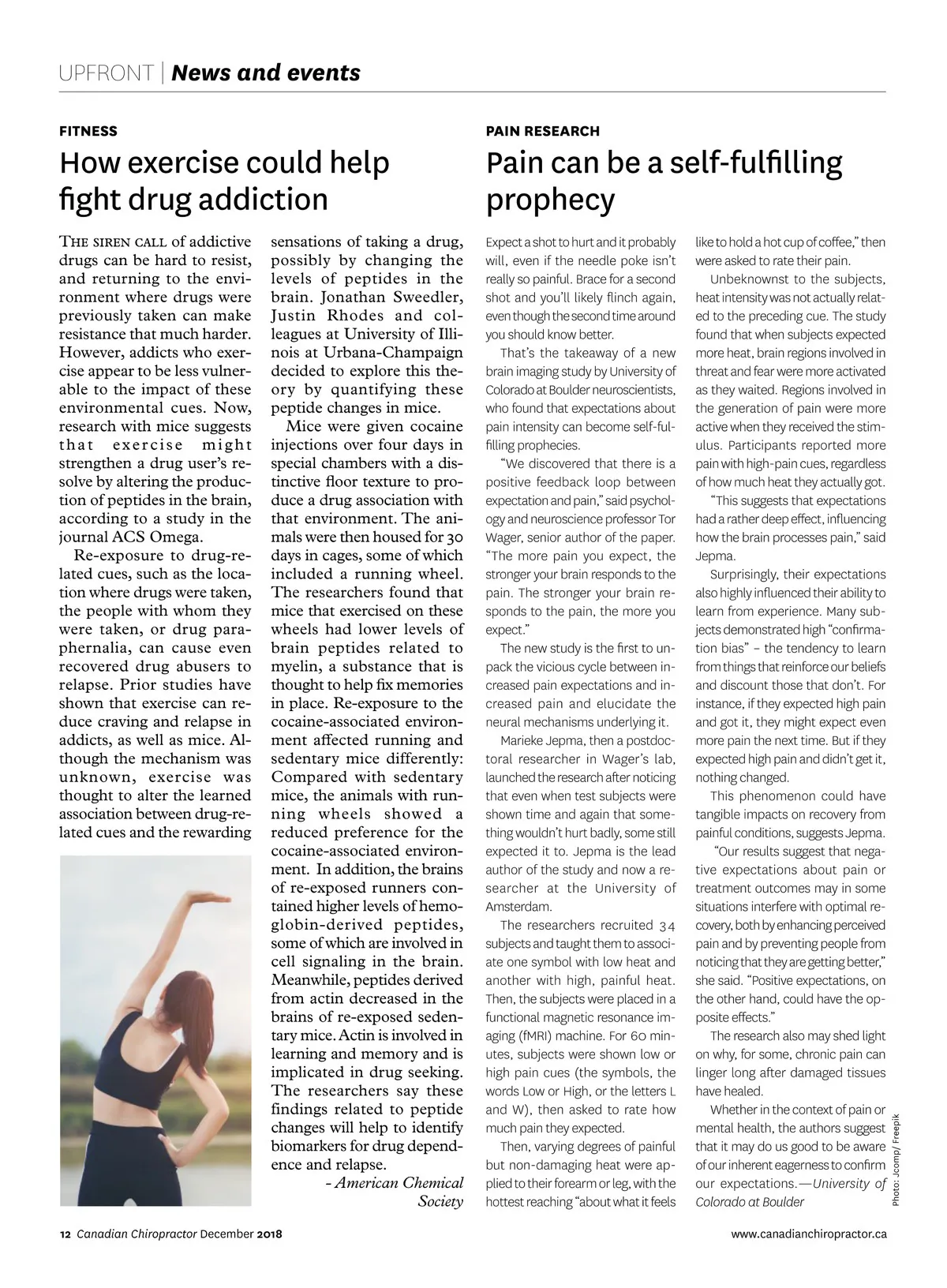
UPFRONT | News and events FITNESS How exercise could help fight drug addiction The siren call of addictive drugs can be hard to resist, and returning to the envi-ronment where drugs were previously taken can make resistance that much harder. However, addicts who exer-cise appear to be less vulner-able to the impact of these environmental cues. Now, research with mice suggests that exercise might strengthen a drug user’s re-solve by altering the produc-tion of peptides in the brain, according to a study in the journal ACS Omega. Re-exposure to drug-re-lated cues, such as the loca-tion where drugs were taken, the people with whom they were taken, or drug para-phernalia, can cause even recovered drug abusers to relapse. Prior studies have shown that exercise can re-duce craving and relapse in addicts, as well as mice. Al-though the mechanism was unknown, exercise was thought to alter the learned association between drug-re-lated cues and the rewarding sensations of taking a drug, possibly by changing the levels of peptides in the brain. Jonathan Sweedler, Justin Rhodes and col-leagues at University of Illi-nois at Urbana-Champaign decided to explore this the-ory by quantifying these peptide changes in mice. Mice were given cocaine injections over four days in special chambers with a dis-tinctive floor texture to pro-duce a drug association with that environment. The ani-mals were then housed for 30 days in cages, some of which included a running wheel. The researchers found that mice that exercised on these wheels had lower levels of brain peptides related to myelin, a substance that is thought to help fix memories in place. Re-exposure to the cocaine-associated environ-ment affected running and sedentary mice differently: Compared with sedentary mice, the animals with run-ning wheels showed a reduced preference for the cocaine-associated environ-ment. In addition, the brains of re-exposed runners con-tained higher levels of hemo-globin-derived peptides, some of which are involved in cell signaling in the brain. Meanwhile, peptides derived from actin decreased in the brains of re-exposed seden-tary mice. Actin is involved in learning and memory and is implicated in drug seeking. The researchers say these findings related to peptide changes will help to identify biomarkers for drug depend-ence and relapse. -American Chemical Society PAIN RESEARCH Pain can be a self-fulfilling prophecy Expect a shot to hurt and it probably will, even if the needle poke isn’t really so painful. Brace for a second shot and you’ll likely flinch again, even though the second time around you should know better. That’s the takeaway of a new brain imaging study by University of Colorado at Boulder neuroscientists, who found that expectations about pain intensity can become self-ful-filling prophecies. “We discovered that there is a positive feedback loop between expectation and pain,” said psychol-ogy and neuroscience professor Tor Wager, senior author of the paper. “The more pain you expect, the stronger your brain responds to the pain. The stronger your brain re-sponds to the pain, the more you expect.” The new study is the first to un-pack the vicious cycle between in-creased pain expectations and in-creased pain and elucidate the neural mechanisms underlying it. Marieke Jepma, then a postdoc-toral researcher in Wager’s lab, launched the research after noticing that even when test subjects were shown time and again that some-thing wouldn’t hurt badly, some still expected it to. Jepma is the lead author of the study and now a re-searcher at the University of Amsterdam. The researchers recruited 34 subjects and taught them to associ-ate one symbol with low heat and another with high, painful heat. Then, the subjects were placed in a functional magnetic resonance im-aging (fMRI) machine. For 60 min-utes, subjects were shown low or high pain cues (the symbols, the words Low or High, or the letters L and W), then asked to rate how much pain they expected. Then, varying degrees of painful but non-damaging heat were ap-plied to their forearm or leg, with the hottest reaching “about what it feels like to hold a hot cup of coffee,” then were asked to rate their pain. Unbeknownst to the subjects, heat intensity was not actually relat-ed to the preceding cue. The study found that when subjects expected more heat, brain regions involved in threat and fear were more activated as they waited. Regions involved in the generation of pain were more active when they received the stim-ulus. Participants reported more pain with high-pain cues, regardless of how much heat they actually got. “This suggests that expectations had a rather deep effect, influencing how the brain processes pain,” said Jepma. Surprisingly, their expectations also highly influenced their ability to learn from experience. Many sub-jects demonstrated high “confirma-tion bias” – the tendency to learn from things that reinforce our beliefs and discount those that don’t. For instance, if they expected high pain and got it, they might expect even more pain the next time. But if they expected high pain and didn’t get it, nothing changed. This phenomenon could have tangible impacts on recovery from painful conditions, suggests Jepma. “Our results suggest that nega-tive expectations about pain or treatment outcomes may in some situations interfere with optimal re-covery, both by enhancing perceived pain and by preventing people from noticing that they are getting better,” she said. “Positive expectations, on the other hand, could have the op-posite effects.” The research also may shed light on why, for some, chronic pain can linger long after damaged tissues have healed. Whether in the context of pain or mental health, the authors suggest that it may do us good to be aware of our inherent eagerness to confirm our expectations.— University of Colorado at Boulder www.canadianchiropractor.ca 12 Canadian Chiropractor December 2018 Photo: Jcomp/ Freepik
Chiropractic + Naturopathic Doctor December 2018: Page 12