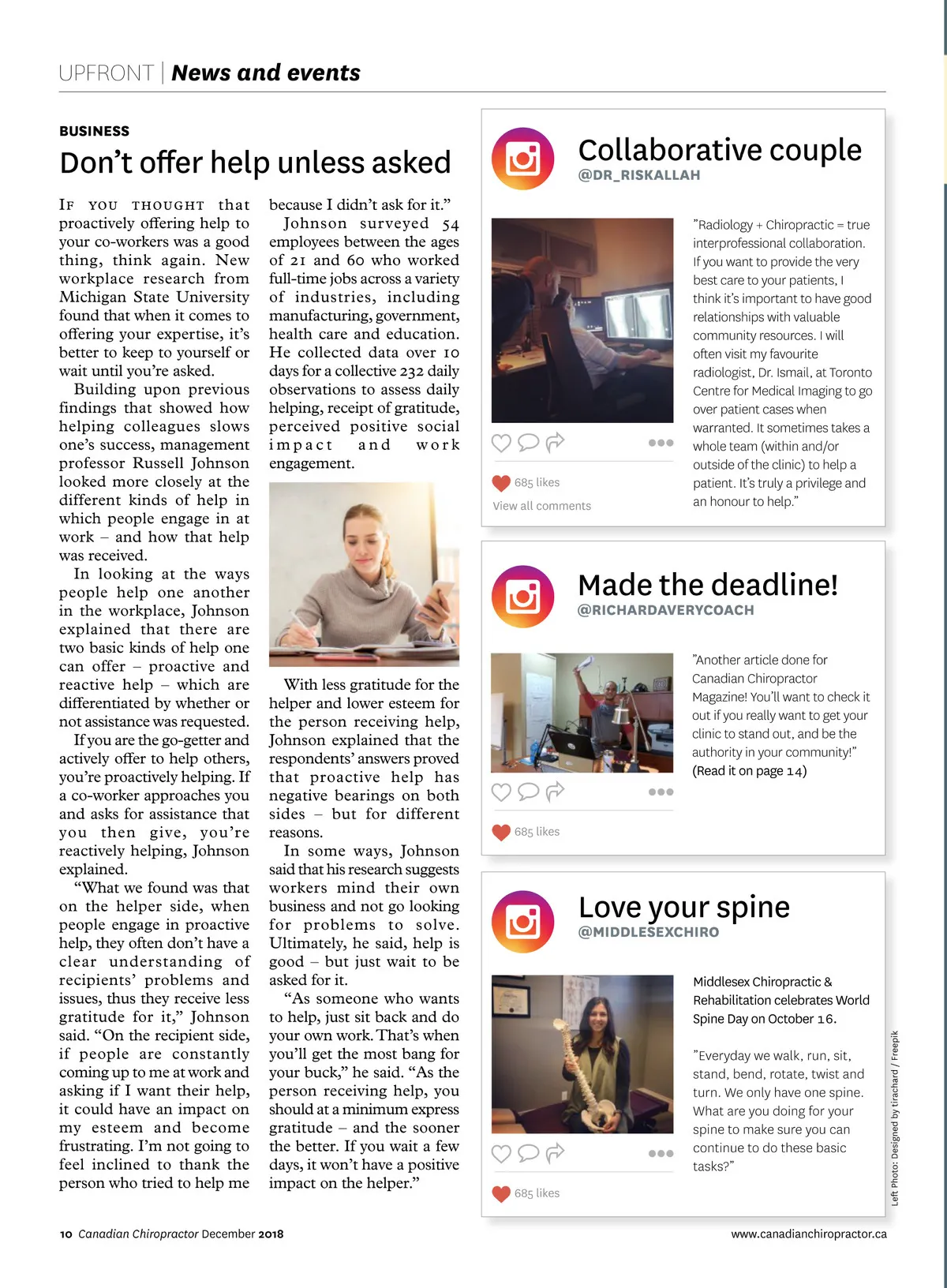
UPFRONT | News and events BUSINESS Don’t offer help unless asked If you thought that proactively offering help to your co-workers was a good thing, think again. New workplace research from Michigan State University found that when it comes to offering your expertise, it’s better to keep to yourself or wait until you’re asked. Building upon previous findings that showed how helping colleagues slows one’s success, management professor Russell Johnson looked more closely at the different kinds of help in which people engage in at work – and how that help was received. In looking at the ways people help one another in the workplace, Johnson explained that there are two basic kinds of help one can offer – proactive and reactive help – which are differentiated by whether or not assistance was requested. If you are the go-getter and actively offer to help others, you’re proactively helping. If a co-worker approaches you and asks for assistance that you then give, you’re reactively helping, Johnson explained. “What we found was that on the helper side, when people engage in proactive help, they often don’t have a clear understanding of recipients’ problems and issues, thus they receive less gratitude for it,” Johnson said. “On the recipient side, if people are constantly coming up to me at work and asking if I want their help, it could have an impact on my esteem and become frustrating. I’m not going to feel inclined to thank the person who tried to help me because I didn’t ask for it.” Johnson surveyed 54 employees between the ages of 21 and 60 who worked full-time jobs across a variety of industries, including manufacturing, government, health care and education. He collected data over 10 days for a collective 232 daily observations to assess daily helping, receipt of gratitude, perceived positive social impact and work engagement. 685 likes Collaborative couple @DR_RISKALLAH ”Radiology + Chiropractic = true interprofessional collaboration. If you want to provide the very best care to your patients, I think it’s important to have good relationships with valuable community resources. I will often visit my favourite radiologist, Dr. Ismail, at Toronto Centre for Medical Imaging to go over patient cases when warranted. It sometimes takes a whole team (within and/or outside of the clinic) to help a patient. It’s truly a privilege and an honour to help.” View all comments Made the deadline! @RICHARDAVERYCOACH With less gratitude for the helper and lower esteem for the person receiving help, Johnson explained that the respondents’ answers proved that proactive help has negative bearings on both sides – but for different reasons. In some ways, Johnson said that his research suggests workers mind their own business and not go looking for problems to solve. Ultimately, he said, help is good – but just wait to be asked for it. “As someone who wants to help, just sit back and do your own work. That’s when you’ll get the most bang for your buck,” he said. “As the person receiving help, you should at a minimum express gratitude – and the sooner the better. If you wait a few days, it won’t have a positive impact on the helper.” ”Another article done for Canadian Chiropractor Magazine! You’ll want to check it out if you really want to get your clinic to stand out, and be the authority in your community!” (Read it on page 14) 685 likes Love your spine @MIDDLESEXCHIRO Middlesex Chiropractic & Rehabilitation celebrates World Spine Day on October 16. ”Everyday we walk, run, sit, stand, bend, rotate, twist and turn. We only have one spine. What are you doing for your spine to make sure you can continue to do these basic tasks?” 685 likes www.canadianchiropractor.ca Left Photo: Designed by tirachard / Freepik 10 Canadian Chiropractor December 2018
Chiropractic + Naturopathic Doctor December 2018: Page 10