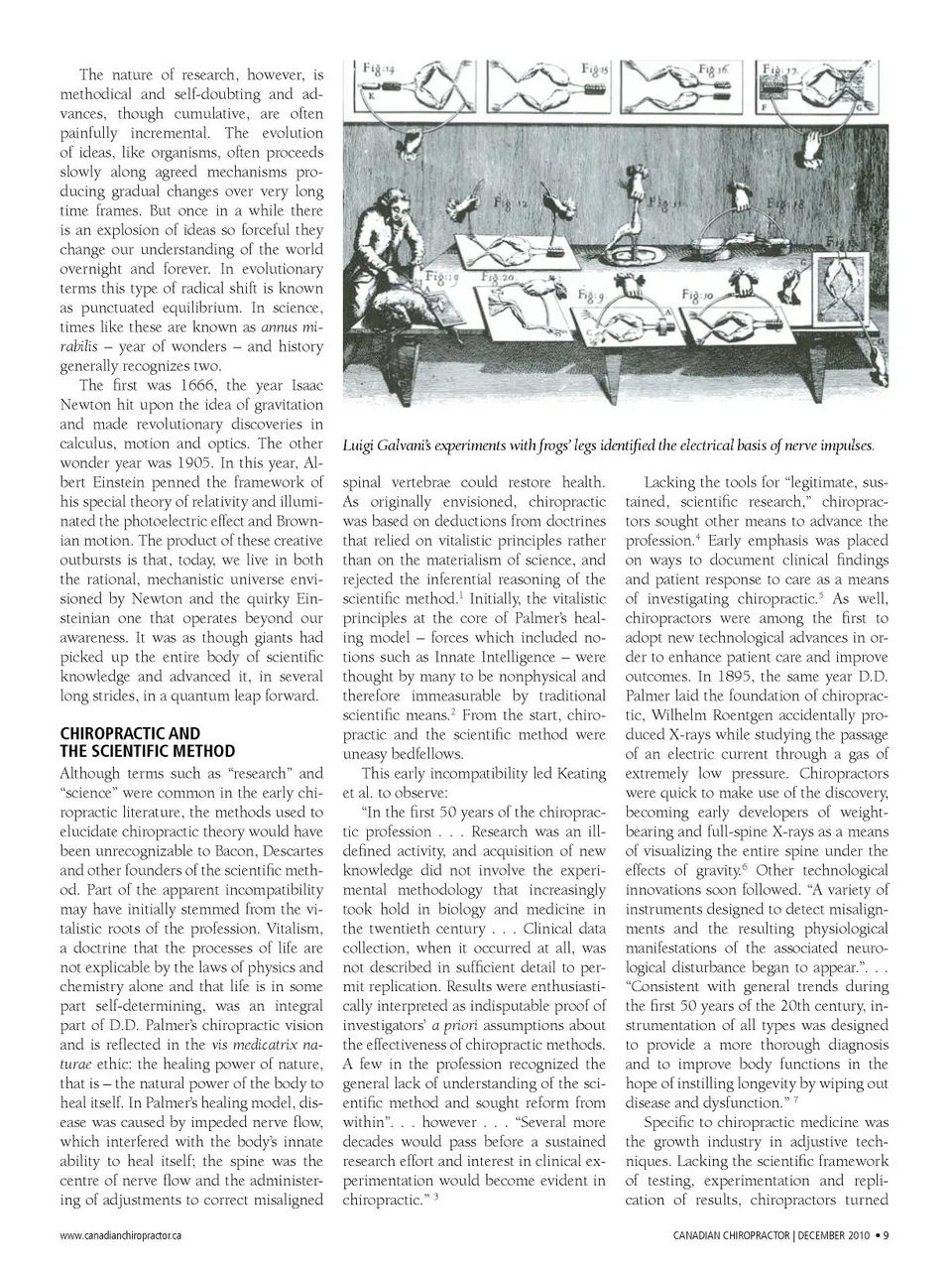
The nature of research, however, is methodical and self-doubting and ad-vances, though cumulative, are often painfully incremental. The evolution of ideas, like organisms, often proceeds slowly along agreed mechanisms pro-ducing gradual changes over very long time frames. But once in a while there is an explosion of ideas so forceful they change our understanding of the world overnight and forever. In evolutionary terms this type of radical shift is known as punctuated equilibrium. In science, times like these are known as annus mi-rabilis – year of wonders – and history generally recognizes two. The first was 1666, the year Isaac Newton hit upon the idea of gravitation and made revolutionary discoveries in calculus, motion and optics. The other wonder year was 1905. In this year, Al-bert Einstein penned the framework of his special theory of relativity and illumi-nated the photoelectric effect and Brown-ian motion. The product of these creative outbursts is that, today, we live in both the rational, mechanistic universe envi-sioned by Newton and the quirky Ein-steinian one that operates beyond our awareness. It was as though giants had picked up the entire body of scientific knowledge and advanced it, in several long strides, in a quantum leap forward. Luigi Galvani’s experiments with frogs’ legs identified the electrical basis of nerve impulses. spinal vertebrae could restore health. As originally envisioned, chiropractic was based on deductions from doctrines that relied on vitalistic principles rather than on the materialism of science, and rejected the inferential reasoning of the scientific method. 1 Initially, the vitalistic principles at the core of Palmer’s heal-ing model – forces which included no-tions such as Innate Intelligence – were thought by many to be nonphysical and therefore immeasurable by traditional scientific means. 2 From the start, chiro-practic and the scientific method were uneasy bedfellows. This early incompatibility led Keating et al. to observe: “In the first 50 years of the chiroprac-tic profession . . . Research was an ill-defined activity, and acquisition of new knowledge did not involve the experi-mental methodology that increasingly took hold in biology and medicine in the twentieth century . . . Clinical data collection, when it occurred at all, was not described in sufficient detail to per-mit replication. Results were enthusiasti-cally interpreted as indisputable proof of investigators’ a priori assumptions about the effectiveness of chiropractic methods. A few in the profession recognized the general lack of understanding of the sci-entific method and sought reform from within”. . . however . . . “Several more decades would pass before a sustained research effort and interest in clinical ex-perimentation would become evident in chiropractic.” 3 Lacking the tools for “legitimate, sus-tained, scientific research,” chiroprac-tors sought other means to advance the profession. 4 Early emphasis was placed on ways to document clinical findings and patient response to care as a means of investigating chiropractic. 5 As well, chiropractors were among the first to adopt new technological advances in or-der to enhance patient care and improve outcomes. In 1895, the same year D.D. Palmer laid the foundation of chiroprac-tic, Wilhelm Roentgen accidentally pro-duced X-rays while studying the passage of an electric current through a gas of extremely low pressure. Chiropractors were quick to make use of the discovery, becoming early developers of weight-bearing and full-spine X-rays as a means of visualizing the entire spine under the effects of gravity. 6 Other technological innovations soon followed. “A variety of instruments designed to detect misalign-ments and the resulting physiological manifestations of the associated neuro-logical disturbance began to appear.”. . . “Consistent with general trends during the first 50 years of the 20th century, in-strumentation of all types was designed to provide a more thorough diagnosis and to improve body functions in the hope of instilling longevity by wiping out disease and dysfunction.” 7 Specific to chiropractic medicine was the growth industry in adjustive tech-niques. Lacking the scientific framework of testing, experimentation and repli-cation of results, chiropractors turned CaNaDIaN CHIROPRaCTOR | DECEMBER 2010 • 9 CHIROPRACTIC AND THE SCIENTIFIC METHOD Although terms such as “research” and “science” were common in the early chi-ropractic literature, the methods used to elucidate chiropractic theory would have been unrecognizable to Bacon, Descartes and other founders of the scientific meth-od. Part of the apparent incompatibility may have initially stemmed from the vi-talistic roots of the profession. Vitalism, a doctrine that the processes of life are not explicable by the laws of physics and chemistry alone and that life is in some part self-determining, was an integral part of D.D. Palmer’s chiropractic vision and is reflected in the vis medicatrix na-turae ethic: the healing power of nature, that is – the natural power of the body to heal itself. In Palmer’s healing model, dis-ease was caused by impeded nerve flow, which interfered with the body’s innate ability to heal itself; the spine was the centre of nerve flow and the administer-ing of adjustments to correct misaligned www.canadianchiropractor.ca
Chiropractic + Naturopathic Doctor December 2010: Page 9