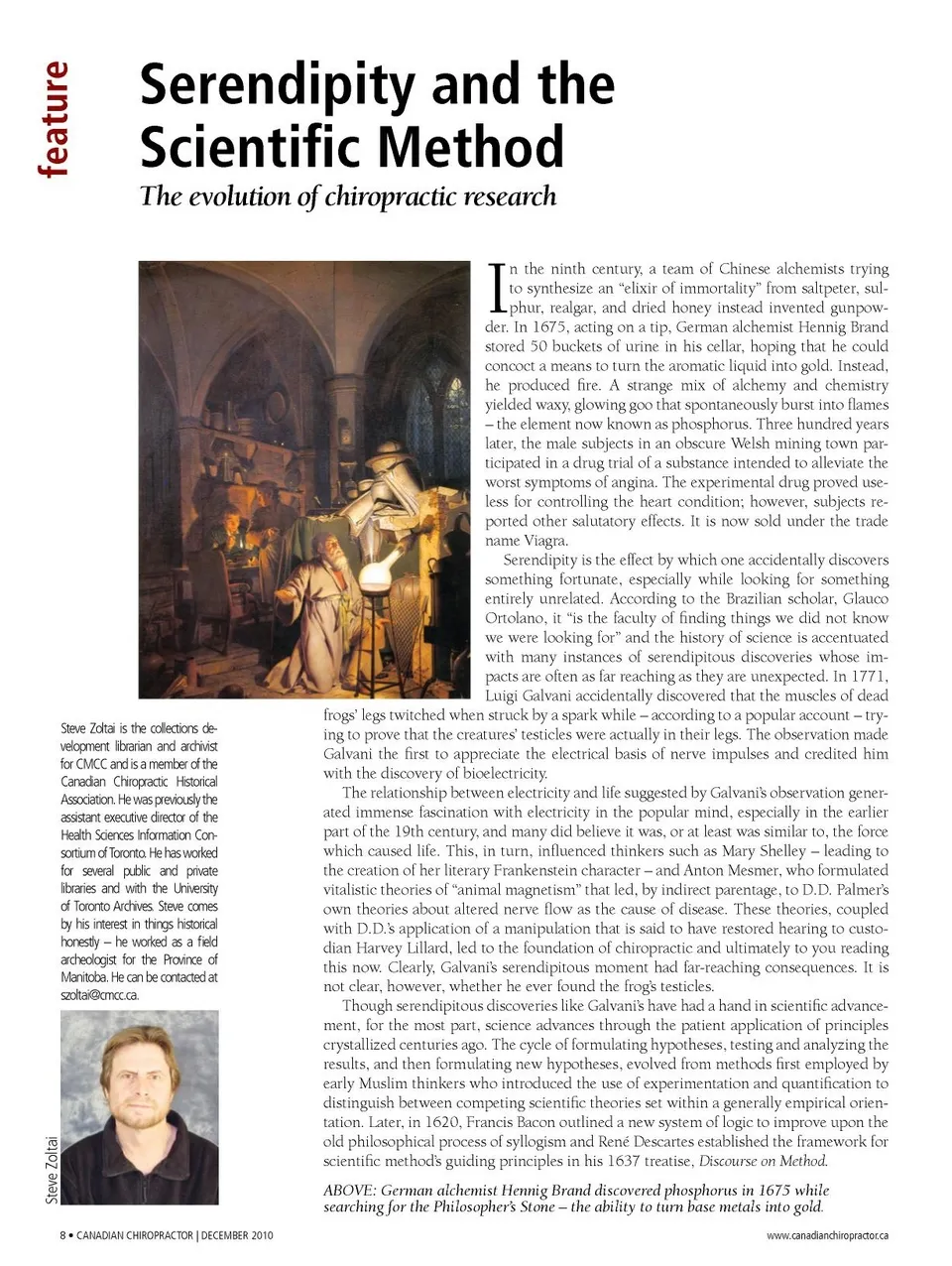
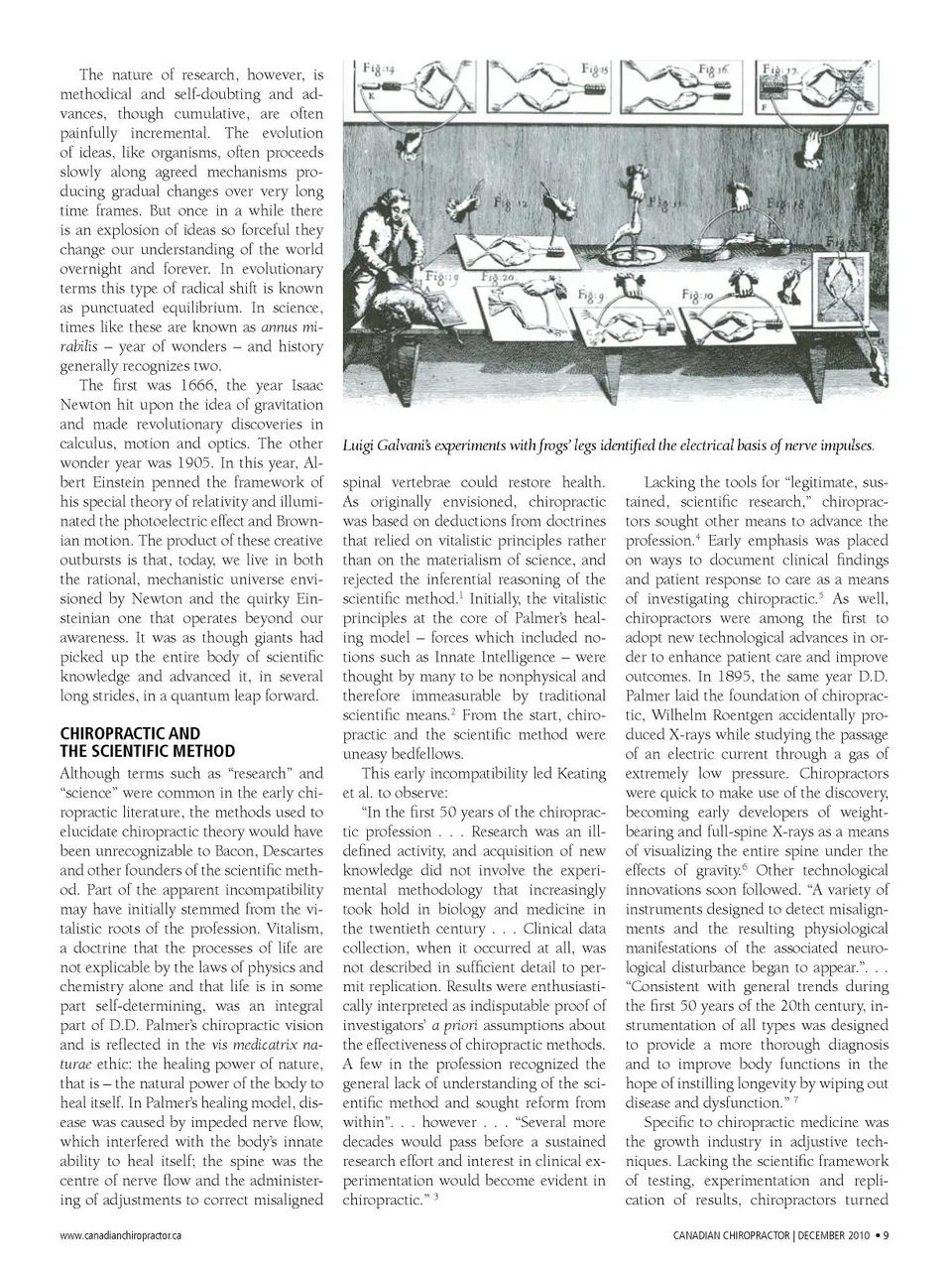
Serendipity and the Scientific Method The evolution of chiropractic research n the ninth century, a team of Chinese alchemists trying to synthesize an “elixir of immortality” from saltpeter, sul-phur, realgar, and dried honey instead invented gunpow-der. In 1675, acting on a tip, German alchemist Hennig Brand stored 50 buckets of urine in his cellar, hoping that he could concoct a means to turn the aromatic liquid into gold. Instead, he produced fire. A strange mix of alchemy and chemistry yielded waxy, glowing goo that spontaneously burst into flames – the element now known as phosphorus. Three hundred years later, the male subjects in an obscure Welsh mining town par-ticipated in a drug trial of a substance intended to alleviate the worst symptoms of angina. The experimental drug proved use-less for controlling the heart condition; however, subjects re-ported other salutatory effects. It is now sold under the trade name Viagra. Serendipity is the effect by which one accidentally discovers something fortunate, especially while looking for something entirely unrelated. According to the Brazilian scholar, Glauco Ortolano, it “is the faculty of finding things we did not know we were looking for” and the history of science is accentuated with many instances of serendipitous discoveries whose im-pacts are often as far reaching as they are unexpected. In 1771, Luigi Galvani accidentally discovered that the muscles of dead frogs’ legs twitched when struck by a spark while – according to a popular account – try-ing to prove that the creatures’ testicles were actually in their legs. The observation made Galvani the first to appreciate the electrical basis of nerve impulses and credited him with the discovery of bioelectricity. The relationship between electricity and life suggested by Galvani’s observation gener-ated immense fascination with electricity in the popular mind, especially in the earlier part of the 19th century, and many did believe it was, or at least was similar to, the force which caused life. This, in turn, influenced thinkers such as Mary Shelley – leading to the creation of her literary Frankenstein character – and Anton Mesmer, who formulated vitalistic theories of “animal magnetism” that led, by indirect parentage, to D.D. Palmer’s own theories about altered nerve flow as the cause of disease. These theories, coupled with D.D.’s application of a manipulation that is said to have restored hearing to custo-dian Harvey Lillard, led to the foundation of chiropractic and ultimately to you reading this now. Clearly, Galvani’s serendipitous moment had far-reaching consequences. It is not clear, however, whether he ever found the frog’s testicles. Though serendipitous discoveries like Galvani’s have had a hand in scientific advance-ment, for the most part, science advances through the patient application of principles crystallized centuries ago. The cycle of formulating hypotheses, testing and analyzing the results, and then formulating new hypotheses, evolved from methods first employed by early Muslim thinkers who introduced the use of experimentation and quantification to distinguish between competing scientific theories set within a generally empirical orien-tation. Later, in 1620, Francis Bacon outlined a new system of logic to improve upon the old philosophical process of syllogism and René Descartes established the framework for scientific method’s guiding principles in his 1637 treatise, Discourse on Method. ABOVE: German alchemist Hennig Brand discovered phosphorus in 1675 while searching for the Philosopher’s Stone – the ability to turn base metals into gold. www.canadianchiropractor.ca feature I Steve Zoltai is the collections de-velopment librarian and archivist for CMCC and is a member of the Canadian Chiropractic Historical association. He was previously the assistant executive director of the Health Sciences Information Con-sortium of Toronto. He has worked for several public and private libraries and with the University of Toronto archives. Steve comes by his interest in things historical honestly – he worked as a field archeologist for the Province of Manitoba. He can be contacted at [email protected]. Steve Zoltai 8 • CaNaDIaN CHIROPRaCTOR | DECEMBER 2010
Chiropractic + Naturopathic Doctor December 2010: Page 8