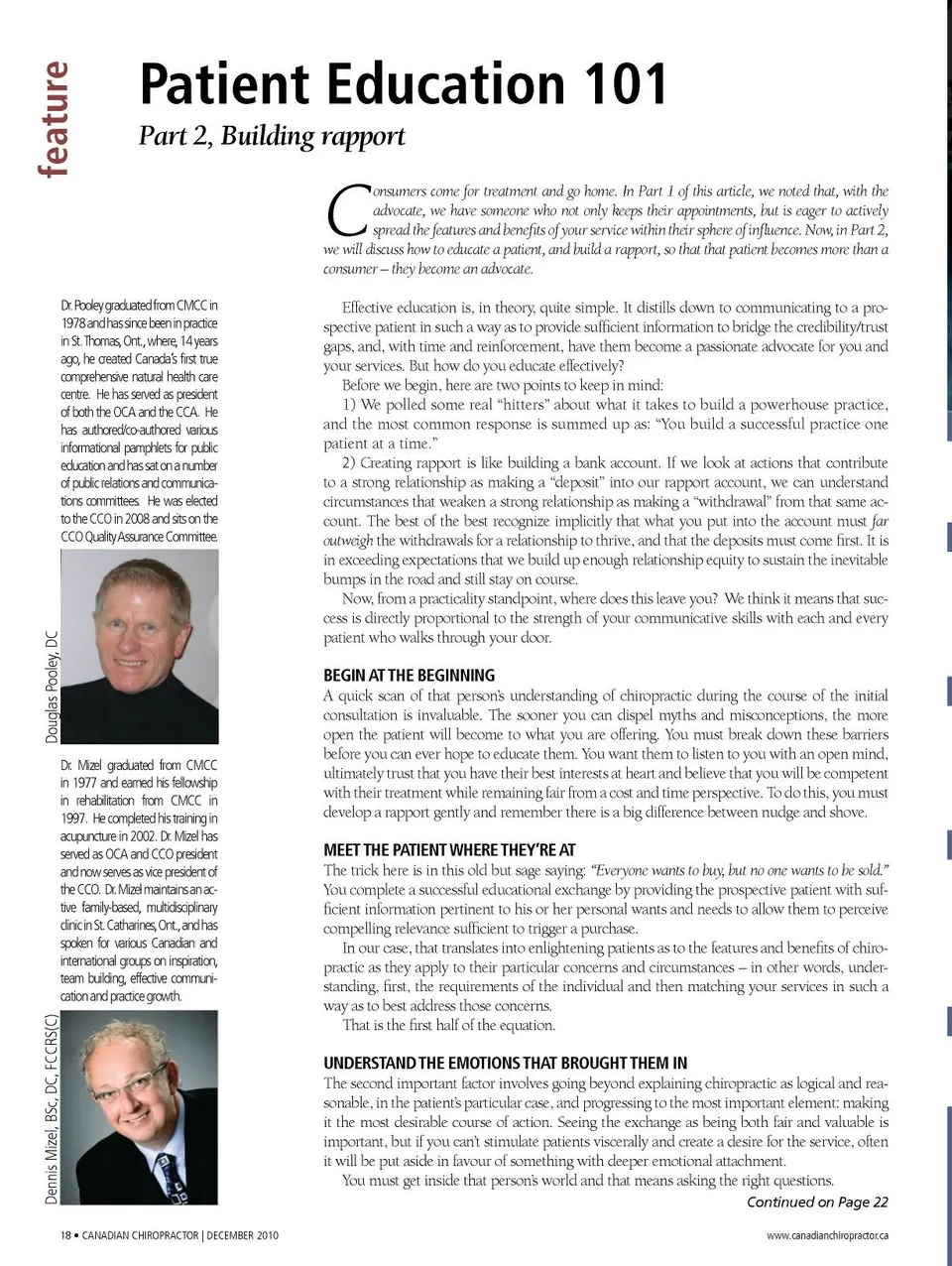
feature Patient Education 101 Part 2, Building rapport onsumers come for treatment and go home. In Part 1 of this article, we noted that, with the advocate, we have someone who not only keeps their appointments, but is eager to actively spread the features and benefits of your service within their sphere of influence. Now, in Part 2, we will discuss how to educate a patient, and build a rapport, so that that patient becomes more than a consumer – they become an advocate. C Dr. Pooley graduated from CMCC in 1978 and has since been in practice in St. Thomas, Ont., where, 14 years ago, he created Canada’s first true comprehensive natural health care centre. He has served as president of both the OCa and the CCa. He has authored/co-authored various informational pamphlets for public education and has sat on a number of public relations and communica-tions committees. He was elected to the CCO in 2008 and sits on the CCO Quality assurance Committee. Douglas Pooley, DC Effective education is, in theory, quite simple. It distills down to communicating to a pro-spective patient in such a way as to provide sufficient information to bridge the credibility/trust gaps, and, with time and reinforcement, have them become a passionate advocate for you and your services. But how do you educate effectively? Before we begin, here are two points to keep in mind: 1) We polled some real “hitters” about what it takes to build a powerhouse practice, and the most common response is summed up as: “You build a successful practice one patient at a time.” 2) Creating rapport is like building a bank account. If we look at actions that contribute to a strong relationship as making a “deposit” into our rapport account, we can understand circumstances that weaken a strong relationship as making a “withdrawal” from that same ac-count. The best of the best recognize implicitly that what you put into the account must far outweigh the withdrawals for a relationship to thrive, and that the deposits must come first. It is in exceeding expectations that we build up enough relationship equity to sustain the inevitable bumps in the road and still stay on course. Now, from a practicality standpoint, where does this leave you? We think it means that suc-cess is directly proportional to the strength of your communicative skills with each and every patient who walks through your door. Dr. Mizel graduated from CMCC in 1977 and earned his fellowship in rehabilitation from CMCC in 1997. He completed his training in acupuncture in 2002. Dr. Mizel has served as OCa and CCO president and now serves as vice president of the CCO. Dr. Mizel maintains an ac-tive family-based, multidisciplinary clinic in St. Catharines, Ont., and has spoken for various Canadian and international groups on inspiration, team building, effective communi-cation and practice growth. BEGIN AT THE BEGINNING A quick scan of that person’s understanding of chiropractic during the course of the initial consultation is invaluable. The sooner you can dispel myths and misconceptions, the more open the patient will become to what you are offering. You must break down these barriers before you can ever hope to educate them. You want them to listen to you with an open mind, ultimately trust that you have their best interests at heart and believe that you will be competent with their treatment while remaining fair from a cost and time perspective. To do this, you must develop a rapport gently and remember there is a big difference between nudge and shove. MEET THE PATIENT WHERE THEY’RE AT The trick here is in this old but sage saying: “Everyone wants to buy, but no one wants to be sold.” You complete a successful educational exchange by providing the prospective patient with suf-ficient information pertinent to his or her personal wants and needs to allow them to perceive compelling relevance sufficient to trigger a purchase. In our case, that translates into enlightening patients as to the features and benefits of chiro-practic as they apply to their particular concerns and circumstances – in other words, under-standing, first, the requirements of the individual and then matching your services in such a way as to best address those concerns. That is the first half of the equation. UNDERSTAND THE EMOTIONS THAT BROUGHT THEM IN The second important factor involves going beyond explaining chiropractic as logical and rea-sonable, in the patient’s particular case, and progressing to the most important element: making it the most desirable course of action. Seeing the exchange as being both fair and valuable is important, but if you can’t stimulate patients viscerally and create a desire for the service, often it will be put aside in favour of something with deeper emotional attachment. You must get inside that person’s world and that means asking the right questions. Continued on Page 22 www.canadianchiropractor.ca Dennis Mizel, BSc, DC, FCCRS(C) 18 • CaNaDIaN CHIROPRaCTOR | DECEMBER 2010
Chiropractic + Naturopathic Doctor December 2010: Page 18