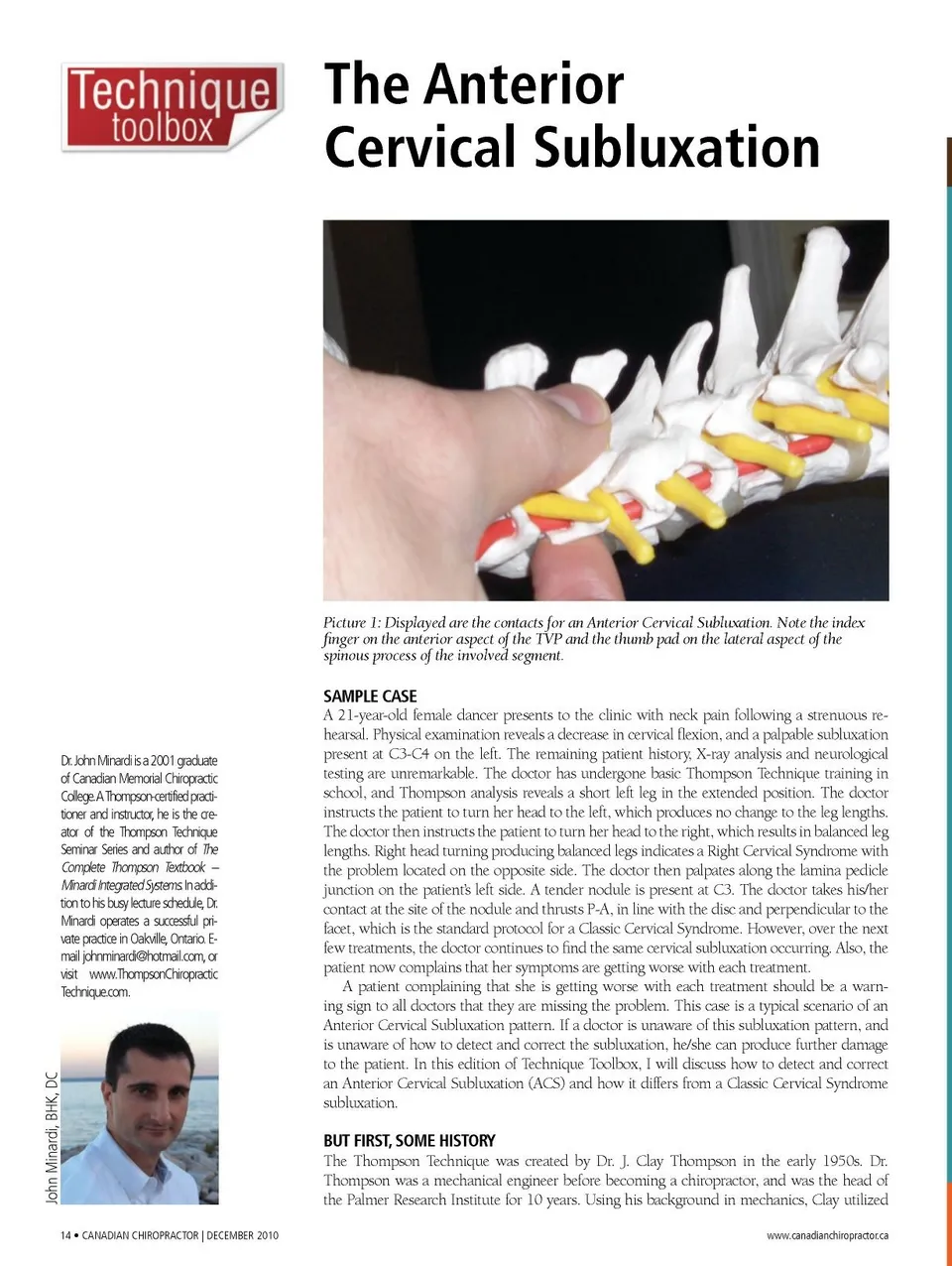
The Anterior Cervical Subluxation Picture 1: Displayed are the contacts for an Anterior Cervical Subluxation. Note the index finger on the anterior aspect of the TVP and the thumb pad on the lateral aspect of the spinous process of the involved segment. Dr. John Minardi is a 2001 graduate of Canadian Memorial Chiropractic College. a Thompson-certified practi- tioner and instructor, he is the cre-ator of the Thompson Technique Seminar Series and author of The Complete Thompson Textbook – Minardi Integrated Systems. In addi-tion to his busy lecture schedule, Dr. Minardi operates a successful pri-vate practice in Oakville, Ontario. E-mail [email protected], or visit www.ThompsonChiropractic Technique.com. John Minardi, BHK, DC SAMPLE CASE A 21-year-old female dancer presents to the clinic with neck pain following a strenuous re-hearsal. Physical examination reveals a decrease in cervical flexion, and a palpable subluxation present at C3-C4 on the left. The remaining patient history, X-ray analysis and neurological testing are unremarkable. The doctor has undergone basic Thompson Technique training in school, and Thompson analysis reveals a short left leg in the extended position. The doctor instructs the patient to turn her head to the left, which produces no change to the leg lengths. The doctor then instructs the patient to turn her head to the right, which results in balanced leg lengths. Right head turning producing balanced legs indicates a Right Cervical Syndrome with the problem located on the opposite side. The doctor then palpates along the lamina pedicle junction on the patient’s left side. A tender nodule is present at C3. The doctor takes his/her contact at the site of the nodule and thrusts P-A, in line with the disc and perpendicular to the facet, which is the standard protocol for a Classic Cervical Syndrome. However, over the next few treatments, the doctor continues to find the same cervical subluxation occurring. Also, the patient now complains that her symptoms are getting worse with each treatment. A patient complaining that she is getting worse with each treatment should be a warn-ing sign to all doctors that they are missing the problem. This case is a typical scenario of an Anterior Cervical Subluxation pattern. If a doctor is unaware of this subluxation pattern, and is unaware of how to detect and correct the subluxation, he/she can produce further damage to the patient. In this edition of Technique Toolbox, I will discuss how to detect and correct an Anterior Cervical Subluxation (ACS) and how it differs from a Classic Cervical Syndrome subluxation. BUT FIRST, SOME HISTORY The Thompson Technique was created by Dr. J. Clay Thompson in the early 1950s. Dr. Thompson was a mechanical engineer before becoming a chiropractor, and was the head of the Palmer Research Institute for 10 years. Using his background in mechanics, Clay utilized www.canadianchiropractor.ca 14 • CaNaDIaN CHIROPRaCTOR | DECEMBER 2010
Chiropractic + Naturopathic Doctor December 2010: Page 14