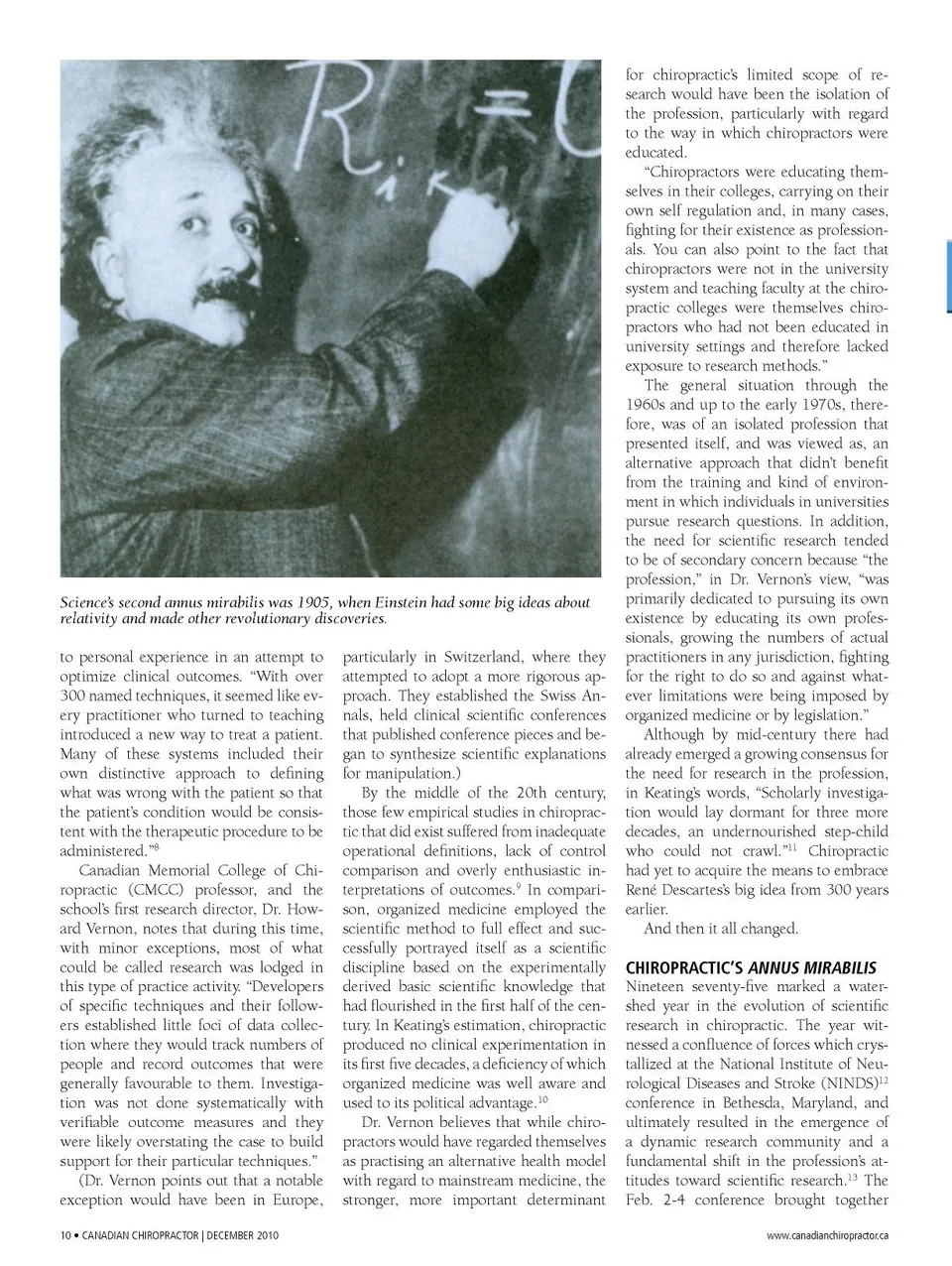
Science’s second annus mirabilis was 1905, when Einstein had some big ideas about relativity and made other revolutionary discoveries. to personal experience in an attempt to optimize clinical outcomes. “With over 300 named techniques, it seemed like ev-ery practitioner who turned to teaching introduced a new way to treat a patient. Many of these systems included their own distinctive approach to defining what was wrong with the patient so that the patient’s condition would be consis-tent with the therapeutic procedure to be administered.” 8 Canadian Memorial College of Chi-ropractic (CMCC) professor, and the school’s first research director, Dr. How-ard Vernon, notes that during this time, with minor exceptions, most of what could be called research was lodged in this type of practice activity. “Developers of specific techniques and their follow-ers established little foci of data collec-tion where they would track numbers of people and record outcomes that were generally favourable to them. Investiga-tion was not done systematically with verifiable outcome measures and they were likely overstating the case to build support for their particular techniques.” (Dr. Vernon points out that a notable exception would have been in Europe, 10 • CaNaDIaN CHIROPRaCTOR | DECEMBER 2010 particularly in Switzerland, where they attempted to adopt a more rigorous ap-proach. They established the Swiss An-nals, held clinical scientific conferences that published conference pieces and be-gan to synthesize scientific explanations for manipulation.) By the middle of the 20th century, those few empirical studies in chiroprac-tic that did exist suffered from inadequate operational definitions, lack of control comparison and overly enthusiastic in-terpretations of outcomes. 9 In compari-son, organized medicine employed the scientific method to full effect and suc-cessfully portrayed itself as a scientific discipline based on the experimentally derived basic scientific knowledge that had flourished in the first half of the cen-tury. In Keating’s estimation, chiropractic produced no clinical experimentation in its first five decades, a deficiency of which organized medicine was well aware and used to its political advantage. 10 Dr. Vernon believes that while chiro-practors would have regarded themselves as practising an alternative health model with regard to mainstream medicine, the stronger, more important determinant for chiropractic’s limited scope of re-search would have been the isolation of the profession, particularly with regard to the way in which chiropractors were educated. “Chiropractors were educating them-selves in their colleges, carrying on their own self regulation and, in many cases, fighting for their existence as profession-als. You can also point to the fact that chiropractors were not in the university system and teaching faculty at the chiro-practic colleges were themselves chiro-practors who had not been educated in university settings and therefore lacked exposure to research methods.” The general situation through the 1960s and up to the early 1970s, there-fore, was of an isolated profession that presented itself, and was viewed as, an alternative approach that didn’t benefit from the training and kind of environ-ment in which individuals in universities pursue research questions. In addition, the need for scientific research tended to be of secondary concern because “the profession,” in Dr. Vernon’s view, “was primarily dedicated to pursuing its own existence by educating its own profes-sionals, growing the numbers of actual practitioners in any jurisdiction, fighting for the right to do so and against what-ever limitations were being imposed by organized medicine or by legislation.” Although by mid-century there had already emerged a growing consensus for the need for research in the profession, in Keating’s words, “Scholarly investiga-tion would lay dormant for three more decades, an undernourished step-child who could not crawl.” 11 Chiropractic had yet to acquire the means to embrace René Descartes’s big idea from 300 years earlier. And then it all changed. CHIROPRACTIC’S ANNUS MIRABILIS Nineteen seventy-five marked a water-shed year in the evolution of scientific research in chiropractic. The year wit-nessed a confluence of forces which crys-tallized at the National Institute of Neu-rological Diseases and Stroke (NINDS) 12 conference in Bethesda, Maryland, and ultimately resulted in the emergence of a dynamic research community and a fundamental shift in the profession’s at-titudes toward scientific research. 13 The Feb. 2-4 conference brought together www.canadianchiropractor.ca
Chiropractic + Naturopathic Doctor December 2010: Page 10