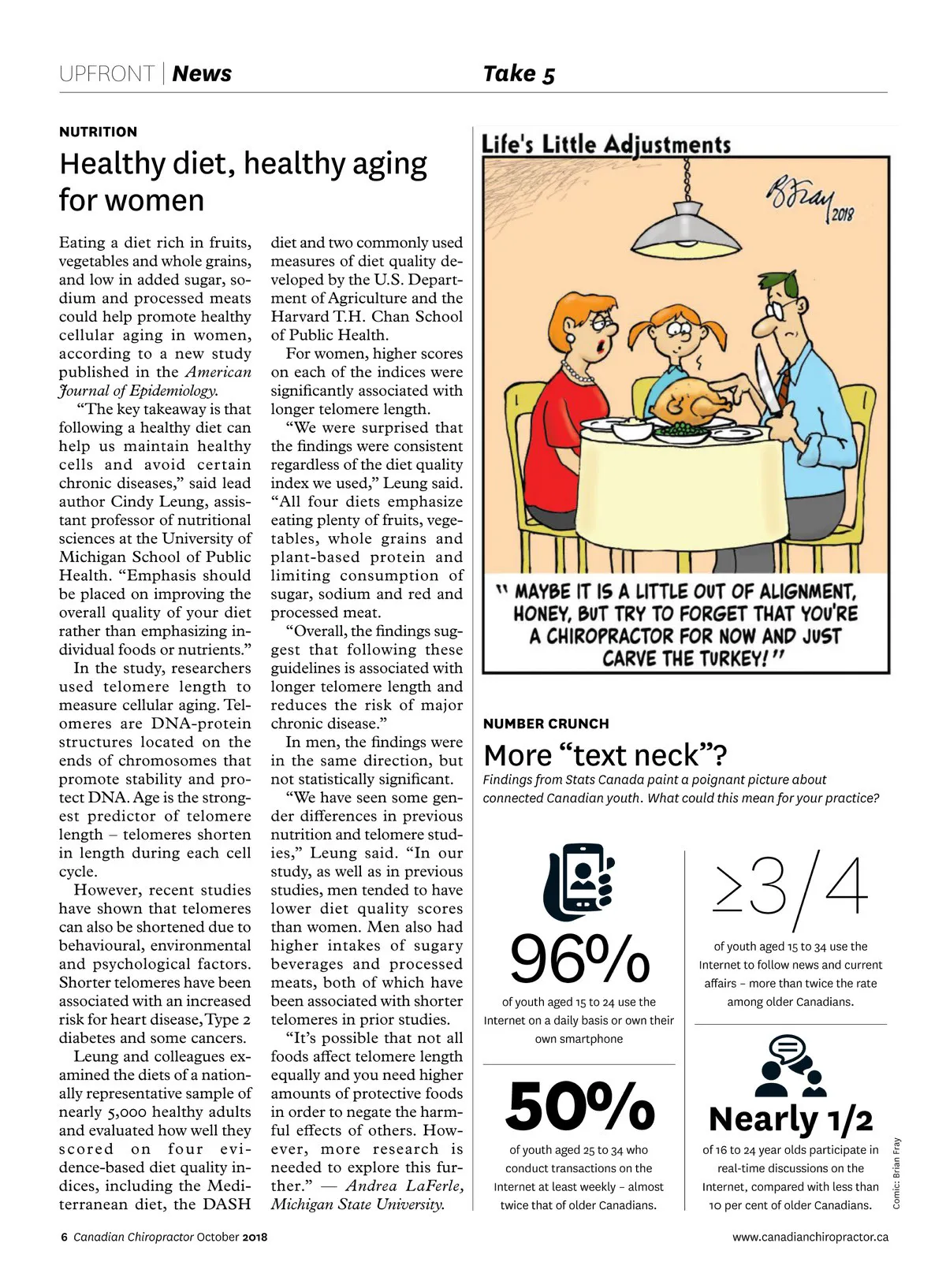
UPFRONT | News NUTRITION Take 5 Healthy diet, healthy aging for women Eating a diet rich in fruits, vegetables and whole grains, and low in added sugar, so-dium and processed meats could help promote healthy cellular aging in women, according to a new study published in the American Journal of Epidemiology. “The key takeaway is that following a healthy diet can help us maintain healthy cells and avoid certain chronic diseases,” said lead author Cindy Leung, assis-tant professor of nutritional sciences at the University of Michigan School of Public Health. “Emphasis should be placed on improving the overall quality of your diet rather than emphasizing in-dividual foods or nutrients.” In the study, researchers used telomere length to measure cellular aging. Tel-omeres are DNA-protein structures located on the ends of chromosomes that promote stability and pro-tect DNA. Age is the strong-est predictor of telomere length – telomeres shorten in length during each cell cycle. However, recent studies have shown that telomeres can also be shortened due to behavioural, environmental and psychological factors. Shorter telomeres have been associated with an increased risk for heart disease, Type 2 diabetes and some cancers. Leung and colleagues ex-amined the diets of a nation-ally representative sample of nearly 5,000 healthy adults and evaluated how well they scored on four evi -dence-based diet quality in-dices, including the Medi-terranean diet, the DASH 6 Canadian Chiropractor October 2018 diet and two commonly used measures of diet quality de-veloped by the U.S. Depart-ment of Agriculture and the Harvard T.H. Chan School of Public Health. For women, higher scores on each of the indices were significantly associated with longer telomere length. “We were surprised that the findings were consistent regardless of the diet quality index we used,” Leung said. “All four diets emphasize eating plenty of fruits, vege-tables, whole grains and plant-based protein and limiting consumption of sugar, sodium and red and processed meat. “Overall, the findings sug-gest that following these guidelines is associated with longer telomere length and reduces the risk of major chronic disease.” In men, the findings were in the same direction, but not statistically significant. “We have seen some gen-der differences in previous nutrition and telomere stud-ies,” Leung said. “In our study, as well as in previous studies, men tended to have lower diet quality scores than women. Men also had higher intakes of sugary beverages and processed meats, both of which have been associated with shorter telomeres in prior studies. “It’s possible that not all foods affect telomere length equally and you need higher amounts of protective foods in order to negate the harm-ful effects of others. How-ever, more research is needed to explore this fur-ther.” — Andrea LaFerle, Michigan State University. NUMBER CRUNCH More “text neck”? Findings from Stats Canada paint a poignant picture about connected Canadian youth. What could this mean for your practice? of youth aged 15 to 24 use the Internet on a daily basis or own their own smartphone 96% of youth aged 15 to 34 use the Internet to follow news and current affairs – more than twice the rate among older Canadians. ≥3/4 of youth aged 25 to 34 who conduct transactions on the Internet at least weekly – almost twice that of older Canadians. of 16 to 24 year olds participate in real-time discussions on the Internet, compared with less than 10 per cent of older Canadians. www.canadianchiropractor.ca Comic: Brian Fray 50% Nearly 1/2
Chiropractic + Naturopathic Doctor October 2018: Page 6