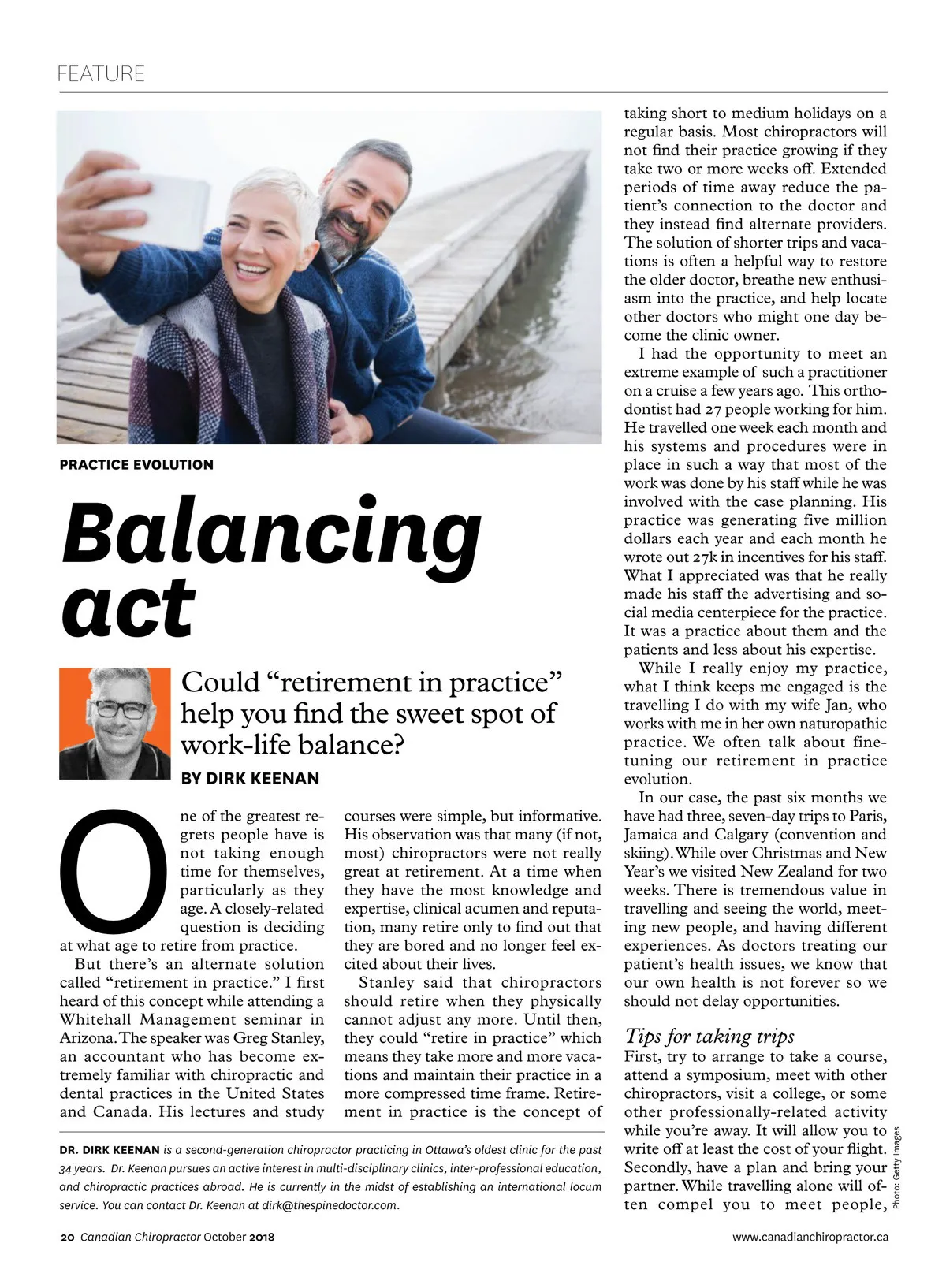
FEATURE taking short to medium holidays on a regular basis. Most chiropractors will not find their practice growing if they take two or more weeks off. Extended periods of time away reduce the pa-tient’s connection to the doctor and they instead find alternate providers. The solution of shorter trips and vaca-tions is often a helpful way to restore the older doctor, breathe new enthusi-asm into the practice, and help locate other doctors who might one day be-come the clinic owner. I had the opportunity to meet an extreme example of such a practitioner on a cruise a few years ago. This ortho-dontist had 27 people working for him. He travelled one week each month and his systems and procedures were in place in such a way that most of the work was done by his staff while he was involved with the case planning. His practice was generating five million dollars each year and each month he wrote out 27k in incentives for his staff. What I appreciated was that he really made his staff the advertising and so-cial media centerpiece for the practice. It was a practice about them and the patients and less about his expertise. While I really enjoy my practice, what I think keeps me engaged is the travelling I do with my wife Jan, who works with me in her own naturopathic practice. We often talk about fine-tuning our retirement in practice evolution. In our case, the past six months we have had three, seven-day trips to Paris, Jamaica and Calgary (convention and skiing). While over Christmas and New Year’s we visited New Zealand for two weeks. There is tremendous value in travelling and seeing the world, meet-ing new people, and having different experiences. As doctors treating our patient’s health issues, we know that our own health is not forever so we should not delay opportunities. PRACTICE EVOLUTION Balancing act O Could “retirement in practice” help you find the sweet spot of work-life balance? BY DIRK KEENAN courses were simple, but informative. His observation was that many (if not, most) chiropractors were not really great at retirement. At a time when they have the most knowledge and expertise, clinical acumen and reputa-tion, many retire only to find out that they are bored and no longer feel ex-cited about their lives. Stanley said that chiropractors should retire when they physically cannot adjust any more. Until then, they could “retire in practice” which means they take more and more vaca-tions and maintain their practice in a more compressed time frame. Retire-ment in practice is the concept of ne of the greatest re-grets people have is not taking enough time for themselves, particularly as they age. A closely-related question is deciding at what age to retire from practice. But there’s an alternate solution called “retirement in practice.” I first heard of this concept while attending a Whitehall Management seminar in Arizona. The speaker was Greg Stanley, an accountant who has become ex-tremely familiar with chiropractic and dental practices in the United States and Canada. His lectures and study Tips for taking trips DR. DIRK KEENAN is a second-generation chiropractor practicing in Ottawa’s oldest clinic for the past 34 years. Dr. Keenan pursues an active interest in multi-disciplinary clinics, inter-professional education, and chiropractic practices abroad. He is currently in the midst of establishing an international locum service. You can contact Dr. Keenan at [email protected]. 20 Canadian Chiropractor October 2018 First, try to arrange to take a course, attend a symposium, meet with other chiropractors, visit a college, or some other professionally-related activity while you’re away. It will allow you to write off at least the cost of your flight. Secondly, have a plan and bring your partner. While travelling alone will of-ten compel you to meet people, www.canadianchiropractor.ca Photo: Getty Images
Chiropractic + Naturopathic Doctor October 2018: Page 20