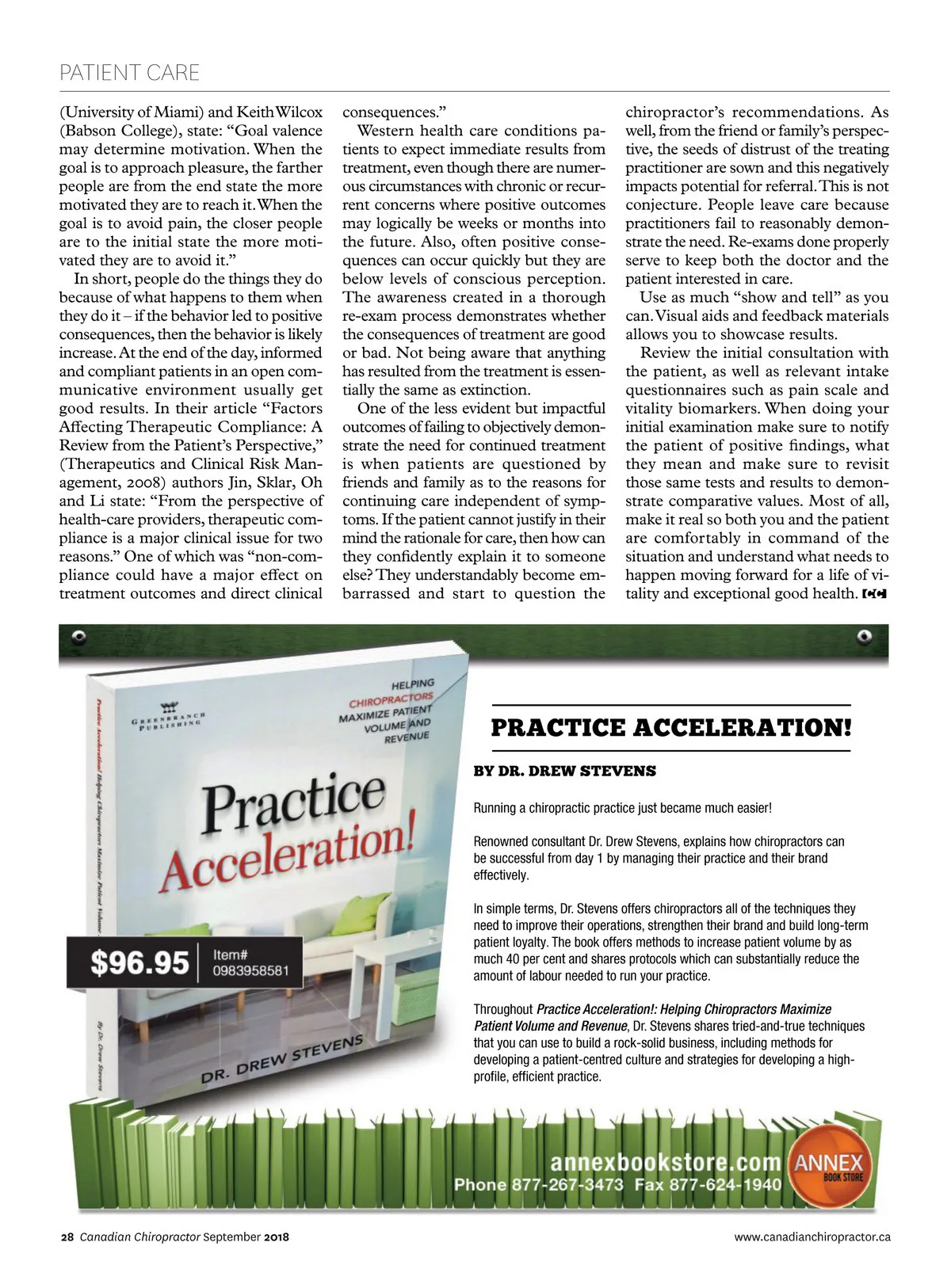
PATIENT CARE (University of Miami) and Keith Wilcox (Babson College), state: “Goal valence may determine motivation. When the goal is to approach pleasure, the farther people are from the end state the more motivated they are to reach it. When the goal is to avoid pain, the closer people are to the initial state the more moti-vated they are to avoid it.” In short, people do the things they do because of what happens to them when they do it – if the behavior led to positive consequences, then the behavior is likely increase. At the end of the day, informed and compliant patients in an open com-municative environment usually get good results. In their article “Factors Affecting Therapeutic Compliance: A Review from the Patient’s Perspective,” (Therapeutics and Clinical Risk Man-agement, 2008) authors Jin, Sklar, Oh and Li state: “From the perspective of health-care providers, therapeutic com-pliance is a major clinical issue for two reasons.” One of which was “non-com-pliance could have a major effect on treatment outcomes and direct clinical consequences.” Western health care conditions pa-tients to expect immediate results from treatment, even though there are numer-ous circumstances with chronic or recur-rent concerns where positive outcomes may logically be weeks or months into the future. Also, often positive conse-quences can occur quickly but they are below levels of conscious perception. The awareness created in a thorough re-exam process demonstrates whether the consequences of treatment are good or bad. Not being aware that anything has resulted from the treatment is essen-tially the same as extinction. One of the less evident but impactful outcomes of failing to objectively demon-strate the need for continued treatment is when patients are questioned by friends and family as to the reasons for continuing care independent of symp-toms. If the patient cannot justify in their mind the rationale for care, then how can they confidently explain it to someone else? They understandably become em-barrassed and start to question the chiropractor’s recommendations. As well, from the friend or family’s perspec-tive, the seeds of distrust of the treating practitioner are sown and this negatively impacts potential for referral. This is not conjecture. People leave care because practitioners fail to reasonably demon-strate the need. Re-exams done properly serve to keep both the doctor and the patient interested in care. Use as much “show and tell” as you can. Visual aids and feedback materials allows you to showcase results. Review the initial consultation with the patient, as well as relevant intake questionnaires such as pain scale and vitality biomarkers. When doing your initial examination make sure to notify the patient of positive findings, what they mean and make sure to revisit those same tests and results to demon-strate comparative values. Most of all, make it real so both you and the patient are comfortably in command of the situation and understand what needs to happen moving forward for a life of vi-tality and exceptional good health. PRACTICE ACCELERATION! BY DR. DREW STEVENS Running a chiropractic practice just became much easier! Renowned consultant Dr. Drew Stevens, explains how chiropractors can be successful from day 1 by managing their practice and their brand effectively. In simple terms, Dr. Stevens offers chiropractors all of the techniques they need to improve their operations, strengthen their brand and build long-term patient loyalty. The book offers methods to increase patient volume by as much 40 per cent and shares protocols which can substantially reduce the amount of labour needed to run your practice. Throughout Practice Acceleration!: Helping Chiropractors Maximize Patient Volume and Revenue , Dr. Stevens shares tried-and-true techniques that you can use to build a rock-solid business, including methods for developing a patient-centred culture and strategies for developing a high-profile, efficient practice. 28 Canadian Chiropractor September 2018 chiro book acceleration feb15.indd 1 www.canadianchiropractor.ca 2015-01-27 10:31 AM
Chiropractic + Naturopathic Doctor September 2018: Page 28