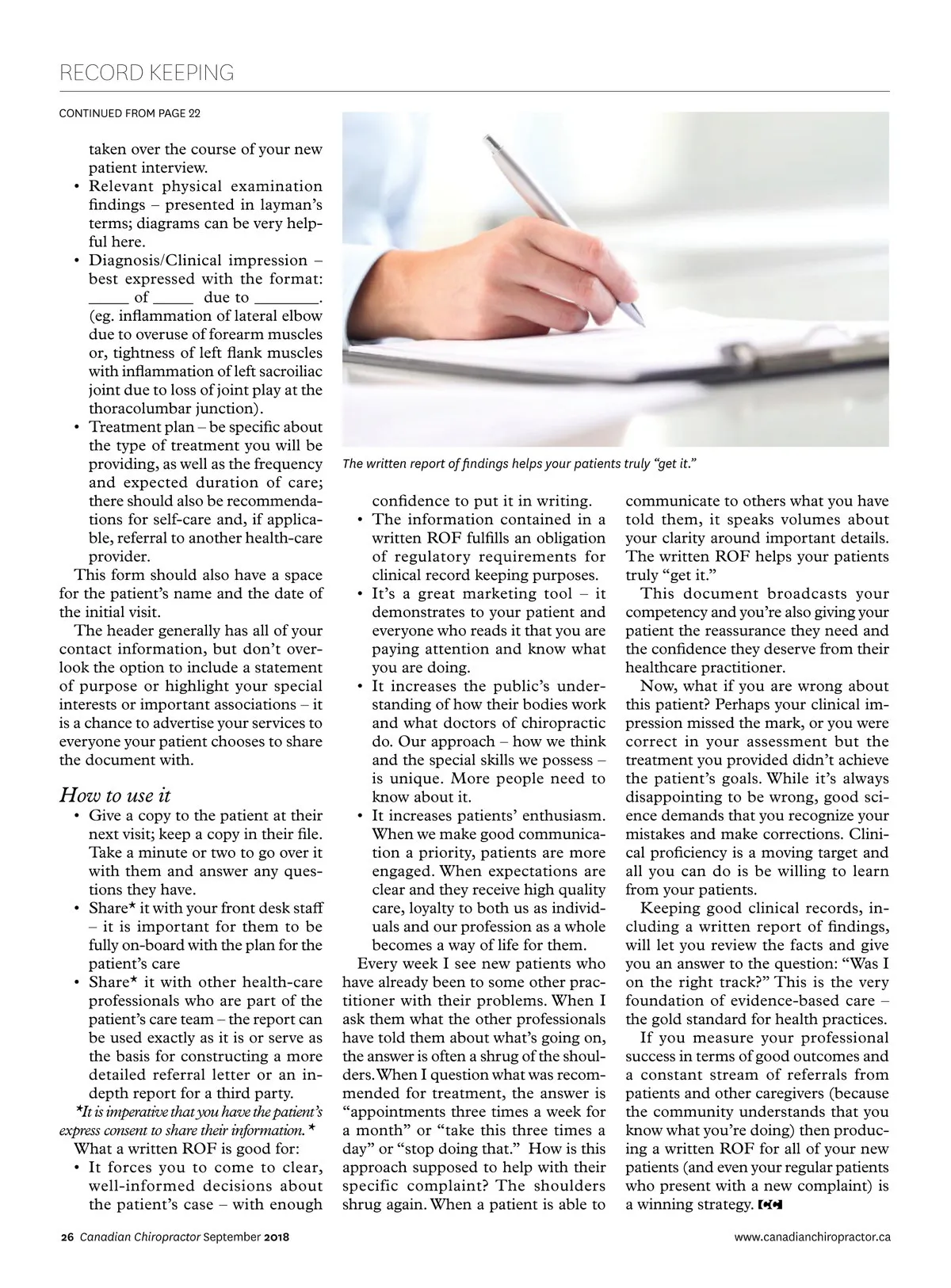
RECORD KEEPING CONTINUED FROM PAGE 22 taken over the course of your new patient interview. • Relevant physical examination findings – presented in layman’s terms; diagrams can be very help-ful here. • Diagnosis/Clinical impression – best expressed with the format: _____ of _____ due to ________. (eg. inflammation of lateral elbow due to overuse of forearm muscles or, tightness of left flank muscles with inflammation of left sacroiliac joint due to loss of joint play at the thoracolumbar junction). • Treatment plan – be specific about the type of treatment you will be providing, as well as the frequency and expected duration of care; there should also be recommenda-tions for self-care and, if applica-ble, referral to another health-care provider. This form should also have a space for the patient’s name and the date of the initial visit. The header generally has all of your contact information, but don’t over-look the option to include a statement of purpose or highlight your special interests or important associations – it is a chance to advertise your services to everyone your patient chooses to share the document with. • Give a copy to the patient at their next visit; keep a copy in their file. Take a minute or two to go over it with them and answer any ques-tions they have. • Share* it with your front desk staff – it is important for them to be fully on-board with the plan for the patient’s care • Share* it with other health-care professionals who are part of the patient’s care team – the report can be used exactly as it is or serve as the basis for constructing a more detailed referral letter or an in-depth report for a third party. *It is imperative that you have the patient’s express consent to share their information.* What a written ROF is good for: • It forces you to come to clear, well-informed decisions about the patient’s case – with enough 26 Canadian Chiropractor September 2018 The written report of findings helps your patients truly “get it.” How to use it confidence to put it in writing. • The information contained in a written ROF fulfills an obligation of regulatory requirements for clinical record keeping purposes. • It’s a great marketing tool – it demonstrates to your patient and everyone who reads it that you are paying attention and know what you are doing. • It increases the public’s under-standing of how their bodies work and what doctors of chiropractic do. Our approach – how we think and the special skills we possess – is unique. More people need to know about it. • It increases patients’ enthusiasm. When we make good communica-tion a priority, patients are more engaged. When expectations are clear and they receive high quality care, loyalty to both us as individ-uals and our profession as a whole becomes a way of life for them. Every week I see new patients who have already been to some other prac-titioner with their problems. When I ask them what the other professionals have told them about what’s going on, the answer is often a shrug of the shoul-ders. When I question what was recom-mended for treatment, the answer is “appointments three times a week for a month” or “take this three times a day” or “stop doing that.” How is this approach supposed to help with their specific complaint? The shoulders shrug again. When a patient is able to communicate to others what you have told them, it speaks volumes about your clarity around important details. The written ROF helps your patients truly “get it.” This document broadcasts your competency and you’re also giving your patient the reassurance they need and the confidence they deserve from their healthcare practitioner. Now, what if you are wrong about this patient? Perhaps your clinical im-pression missed the mark, or you were correct in your assessment but the treatment you provided didn’t achieve the patient’s goals. While it’s always disappointing to be wrong, good sci-ence demands that you recognize your mistakes and make corrections. Clini-cal proficiency is a moving target and all you can do is be willing to learn from your patients. Keeping good clinical records, in-cluding a written report of findings, will let you review the facts and give you an answer to the question: “Was I on the right track?” This is the very foundation of evidence-based care – the gold standard for health practices. If you measure your professional success in terms of good outcomes and a constant stream of referrals from patients and other caregivers (because the community understands that you know what you’re doing) then produc-ing a written ROF for all of your new patients (and even your regular patients who present with a new complaint) is a winning strategy. www.canadianchiropractor.ca
Chiropractic + Naturopathic Doctor September 2018: Page 26