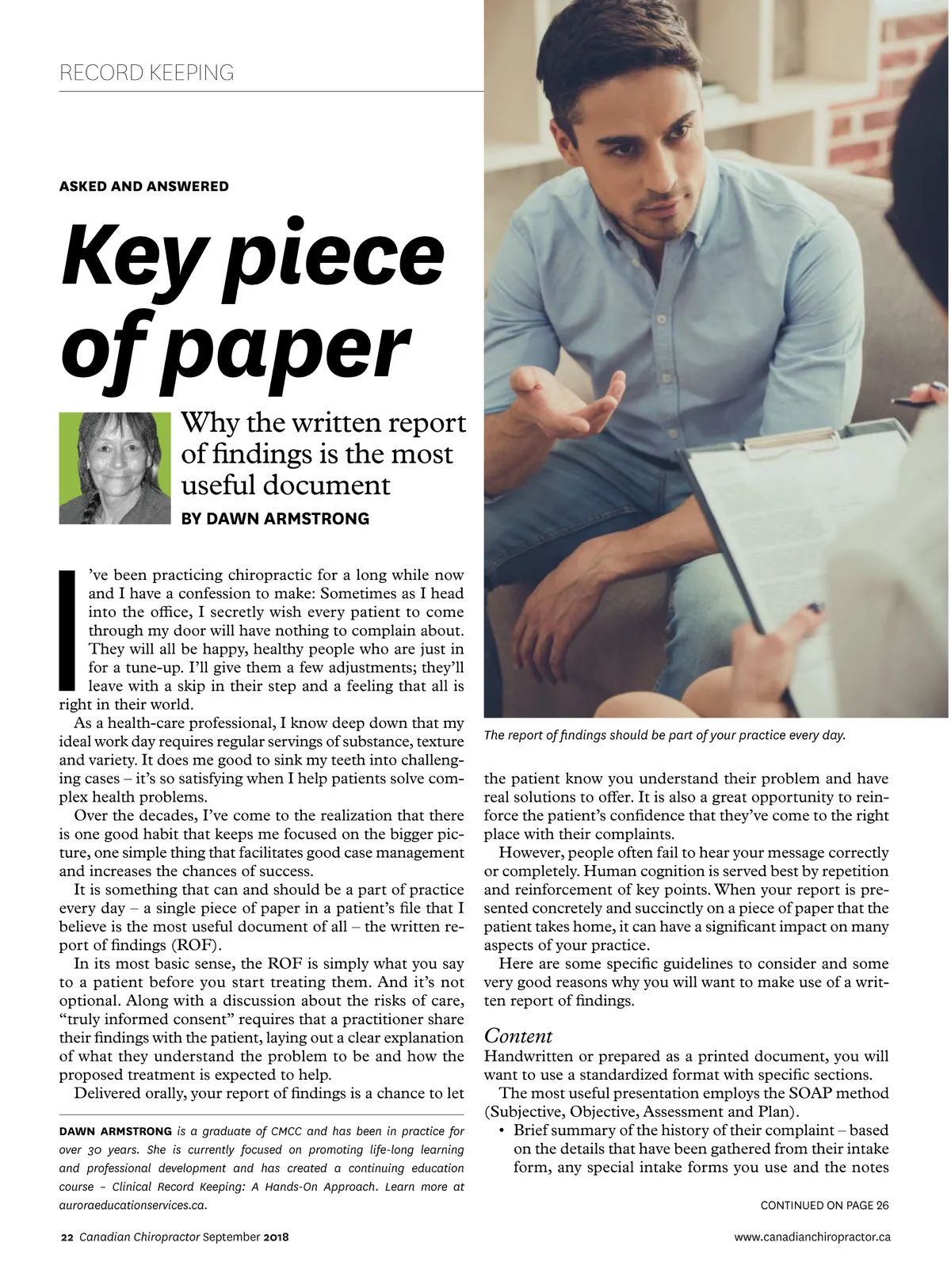
RECORD KEEPING ASKED AND ANSWERED Key piece of paper I Why the written report of findings is the most useful document BY DAWN ARMSTRONG ’ve been practicing chiropractic for a long while now and I have a confession to make: Sometimes as I head into the office, I secretly wish every patient to come through my door will have nothing to complain about. They will all be happy, healthy people who are just in for a tune-up. I’ll give them a few adjustments; they’ll leave with a skip in their step and a feeling that all is right in their world. As a health-care professional, I know deep down that my ideal work day requires regular servings of substance, texture and variety. It does me good to sink my teeth into challeng-ing cases – it’s so satisfying when I help patients solve com-plex health problems. Over the decades, I’ve come to the realization that there is one good habit that keeps me focused on the bigger pic-ture, one simple thing that facilitates good case management and increases the chances of success. It is something that can and should be a part of practice every day – a single piece of paper in a patient’s file that I believe is the most useful document of all – the written re-port of findings (ROF). In its most basic sense, the ROF is simply what you say to a patient before you start treating them. And it’s not optional. Along with a discussion about the risks of care, “truly informed consent” requires that a practitioner share their findings with the patient, laying out a clear explanation of what they understand the problem to be and how the proposed treatment is expected to help. Delivered orally, your report of findings is a chance to let The report of findings should be part of your practice every day. the patient know you understand their problem and have real solutions to offer. It is also a great opportunity to rein-force the patient’s confidence that they’ve come to the right place with their complaints. However, people often fail to hear your message correctly or completely. Human cognition is served best by repetition and reinforcement of key points. When your report is pre-sented concretely and succinctly on a piece of paper that the patient takes home, it can have a significant impact on many aspects of your practice. Here are some specific guidelines to consider and some very good reasons why you will want to make use of a writ-ten report of findings. Content DAWN ARMSTRONG is a graduate of CMCC and has been in practice for over 30 years. She is currently focused on promoting life-long learning and professional development and has created a continuing education course – Clinical Record Keeping: A Hands-On Approach. Learn more at auroraeducationservices.ca. 22 Canadian Chiropractor September 2018 Handwritten or prepared as a printed document, you will want to use a standardized format with specific sections. The most useful presentation employs the SOAP method (Subjective, Objective, Assessment and Plan). • Brief summary of the history of their complaint – based on the details that have been gathered from their intake form, any special intake forms you use and the notes CONTINUED ON PAGE 26 www.canadianchiropractor.ca
Chiropractic + Naturopathic Doctor September 2018: Page 22