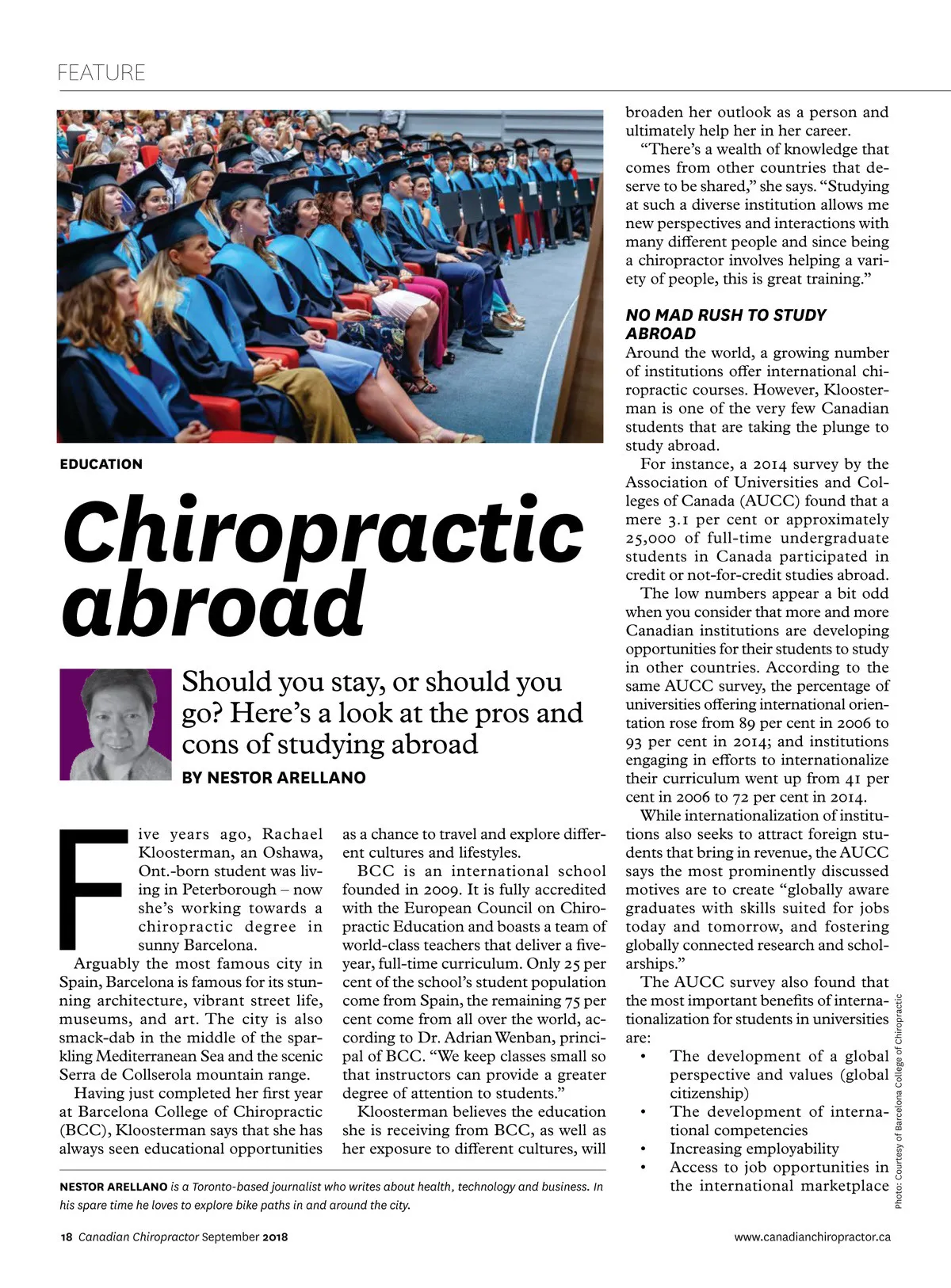
FEATURE broaden her outlook as a person and ultimately help her in her career. “There’s a wealth of knowledge that comes from other countries that de-serve to be shared,” she says. “Studying at such a diverse institution allows me new perspectives and interactions with many different people and since being a chiropractor involves helping a vari-ety of people, this is great training.” NO MAD RUSH TO STUDY ABROAD EDUCATION Chiropractic abroad NESTOR ARELLANO is a Toronto-based journalist who writes about health, technology and business. In his spare time he loves to explore bike paths in and around the city. 18 Canadian Chiropractor September 2018 www.canadianchiropractor.ca Photo: Courtesy of Barcelona College of Chiropractic F Should you stay, or should you go? Here’s a look at the pros and cons of studying abroad BY NESTOR ARELLANO as a chance to travel and explore differ-ent cultures and lifestyles. BCC is an international school founded in 2009. It is fully accredited with the European Council on Chiro-practic Education and boasts a team of world-class teachers that deliver a five-year, full-time curriculum. Only 25 per cent of the school’s student population come from Spain, the remaining 75 per cent come from all over the world, ac-cording to Dr. Adrian Wenban, princi-pal of BCC. “We keep classes small so that instructors can provide a greater degree of attention to students.” Kloosterman believes the education she is receiving from BCC, as well as her exposure to different cultures, will ive years ago, Rachael Kloosterman, an Oshawa, Ont.-born student was liv-ing in Peterborough – now she’s working towards a chiropractic degree in sunny Barcelona. Arguably the most famous city in Spain, Barcelona is famous for its stun-ning architecture, vibrant street life, museums, and art. The city is also smack-dab in the middle of the spar-kling Mediterranean Sea and the scenic Serra de Collserola mountain range. Having just completed her first year at Barcelona College of Chiropractic (BCC), Kloosterman says that she has always seen educational opportunities Around the world, a growing number of institutions offer international chi-ropractic courses. However, Klooster-man is one of the very few Canadian students that are taking the plunge to study abroad. For instance, a 2014 survey by the Association of Universities and Col-leges of Canada (AUCC) found that a mere 3.1 per cent or approximately 25,000 of full-time undergraduate students in Canada participated in credit or not-for-credit studies abroad. The low numbers appear a bit odd when you consider that more and more Canadian institutions are developing opportunities for their students to study in other countries. According to the same AUCC survey, the percentage of universities offering international orien-tation rose from 89 per cent in 2006 to 93 per cent in 2014; and institutions engaging in efforts to internationalize their curriculum went up from 41 per cent in 2006 to 72 per cent in 2014. While internationalization of institu-tions also seeks to attract foreign stu-dents that bring in revenue, the AUCC says the most prominently discussed motives are to create “globally aware graduates with skills suited for jobs today and tomorrow, and fostering globally connected research and schol-arships.” The AUCC survey also found that the most important benefits of interna-tionalization for students in universities are: • The development of a global perspective and values (global citizenship) • The development of interna-tional competencies • Increasing employability • Access to job opportunities in the international marketplace
Chiropractic + Naturopathic Doctor September 2018: Page 18