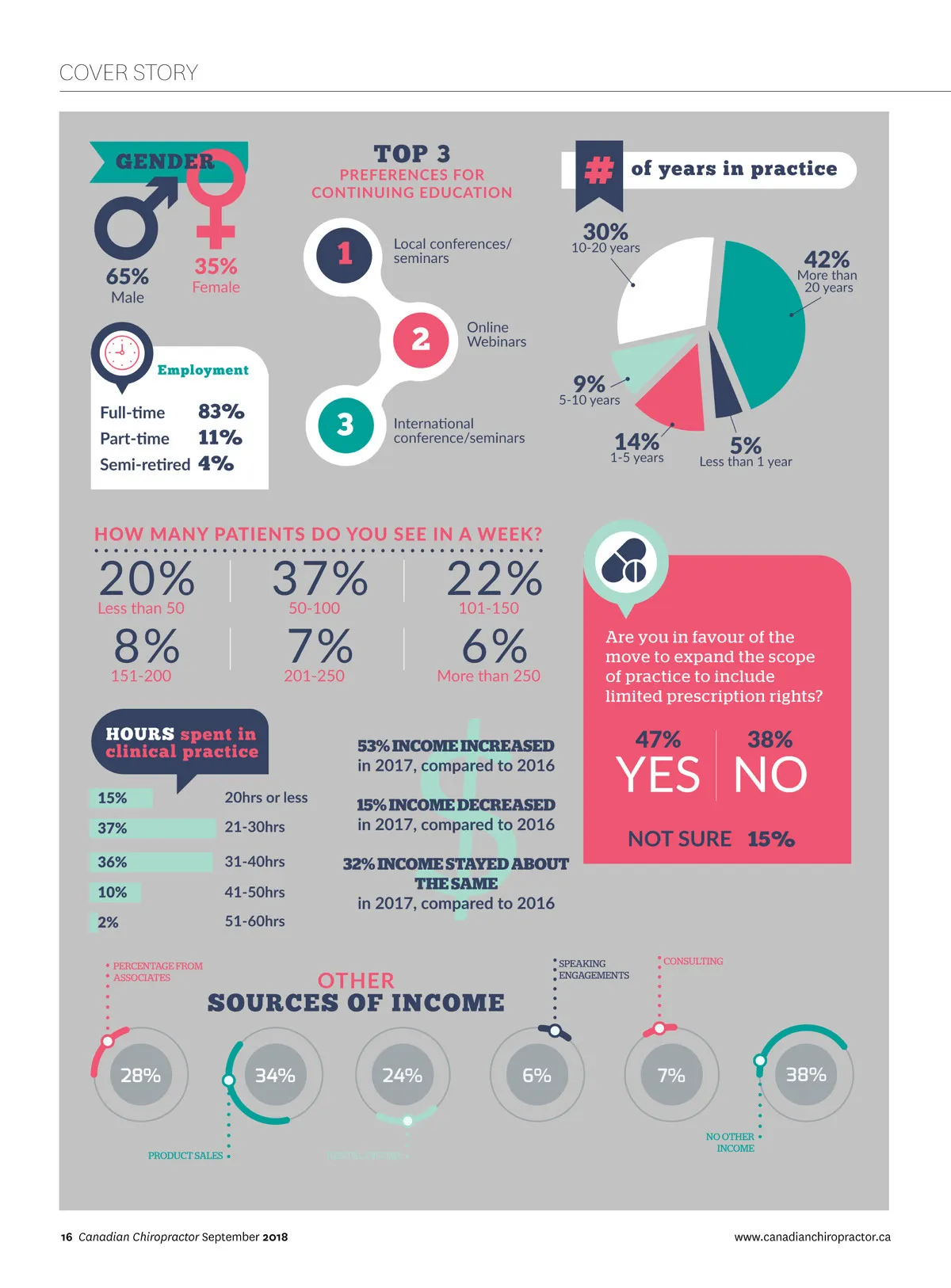
“too many chiros/low utilization rate,” “high cost of running my practice” and “lack of, or not enough interprofes-sional collaboration,” which were all hovering at around 13 per cent of re-spondents. Looking at 2018, in second place this year was “other,” so many of you took the opportunity to really specify what it is you find challenging within your practice, even if they did overlap with some of the other categories. Many cited the fact that perhaps the general population is unaware of what chiro-practors do, and have a limited belief that chiro is suited to only treat MSK conditions, without a neural compo-nent. Differentiation between other medical professionals, and lack of col-laboration within the profession were also mentioned. “It’s impossible to pick one. I don’t think I am alone in saying we have no differentiation from physiotherapists.... We have a low level of trust, probably due to the lack of collaboration and [other] chiropractors using questionable business practices or techniques. Extended health-care coverage is poor compared to other therapies, especially physiotherapy and massage therapy.” Other comments specified busi-ness-centric issues, like hiring good associates and balancing owning a business with treating other patients and/or life’s other responsibilities. Respondents were then able to select other challenges they were facing, so if low public trust and bad PR weren’t the first choice, they both were flagged as the second-biggest challenges. We then asked: “From your point of view, what can be done to solve your biggest challenge?” Education was the word that came up over and over. Pub-lic education and increased coverage. Educate and advertise ethically. Inter-professional education. Organized ed-ucation of public to the overall health and wellness benefits of chiropractic. One respondent commented: “We need to unify the profession so that there is more consistency between practice types. It is difficult for public/medical doctors to understand what it is we do when we are all practicing with different techniques and using different explanations with our patients.” www.canadianchiropractor.ca Compared to last year, respondents still said low public trust was the top challenge for the industry, but there’s a larger gap this time around. EXPANDED SCOPE DEADLOCKED The numbers have remained stagnant on this question – we had almost identical numbers in 2018 compared to 2017. However, when looking at the comments, the majority of respondents are only interested in an expanded scope of practice as it pertains to getting easily accessible diagnostic information. Below are a few comments from those who voted the way they did: UNSURE “Education of prescription drugs. I think we should be more concerned about mak-ing spinal manipulation a controlled act that only chiros can do. [Physiotherapists] learning to do it on weekend courses is ridiculous” “I am not necessarily in favour, however if it were to allow us to have conversations regarding medication with our patients without stepping outside the scope, I would be for it. ” “I think there is a lot more that can be done in terms of nutritional support for patients. Better education of both DCs and patients with respect to this would likely help set chiropractic apart from medicine. Leave the drugs to the MDs and leave chiropractic ‘natural. ’” “I think we should avoid drug depend-ency, but pain killers have a place in the acute injury phase. MDs are already in the loop providing meds, or patients use OTC themselves. Not sure why chiros would need to get involved. ” YES “Yes to moderate prescription rights, MRI, bloodwork, ultrasound. ” “It is more important that Chiropractors be allowed to order X-Rays and MRI’s from hospitals for our diagnoses than pre-scription meds that may add to the problem with over medicating the public already. ” “While chiropractic care is a natural form of health care, if we can aid in the care of a patient by prescribing certain medications, it would help the care and streamline the time in which the patient gets better. ” “I feel that chiropractors with limited prescription rights would be able to provide better information to patients regarding pain relief strategies, and potentially lead to fewer adverse events related to inappro-priate use of pain medications. ” NO “I am just gobsmacked at how prescription rights are presented as the chiros who want this care more for their patients than those who don’t. I practice in Alberta and I’m sad for our profession. We are graduating chiros who don’t know how to adjust, or who have no confidence in adjusting and they are wanting to become glorified phys-iotherapists/MDs who use a prescription pad instead of their hands to help people. I think that we as a profession are in seri-ous trouble. ” “There is a huge risk and responsibil-ity that comes with prescribing medica-tions. This goes against the definition of Chiropractic, anyway. People want more credibility? Stop trying to be medical doctors. The last thing we need in the world is more access to pain meds. There is already a huge crisis. This will defi-nitely make Chiropractic more confusing for the public.” “I would go the opposite way and have the profession move towards evi-dence-based chiropractic care that focuses on the benefits of the adjustment. Also focus more on lifestyle counselling to ele-vate health. Our society is already satu-rated with drugs that don’t increase health and we don’t need another profes-sion to start flogging them.” What will next year bring? September 2018 Canadian Chiropractor 17
Chiropractic + Naturopathic Doctor September 2018: Page 17