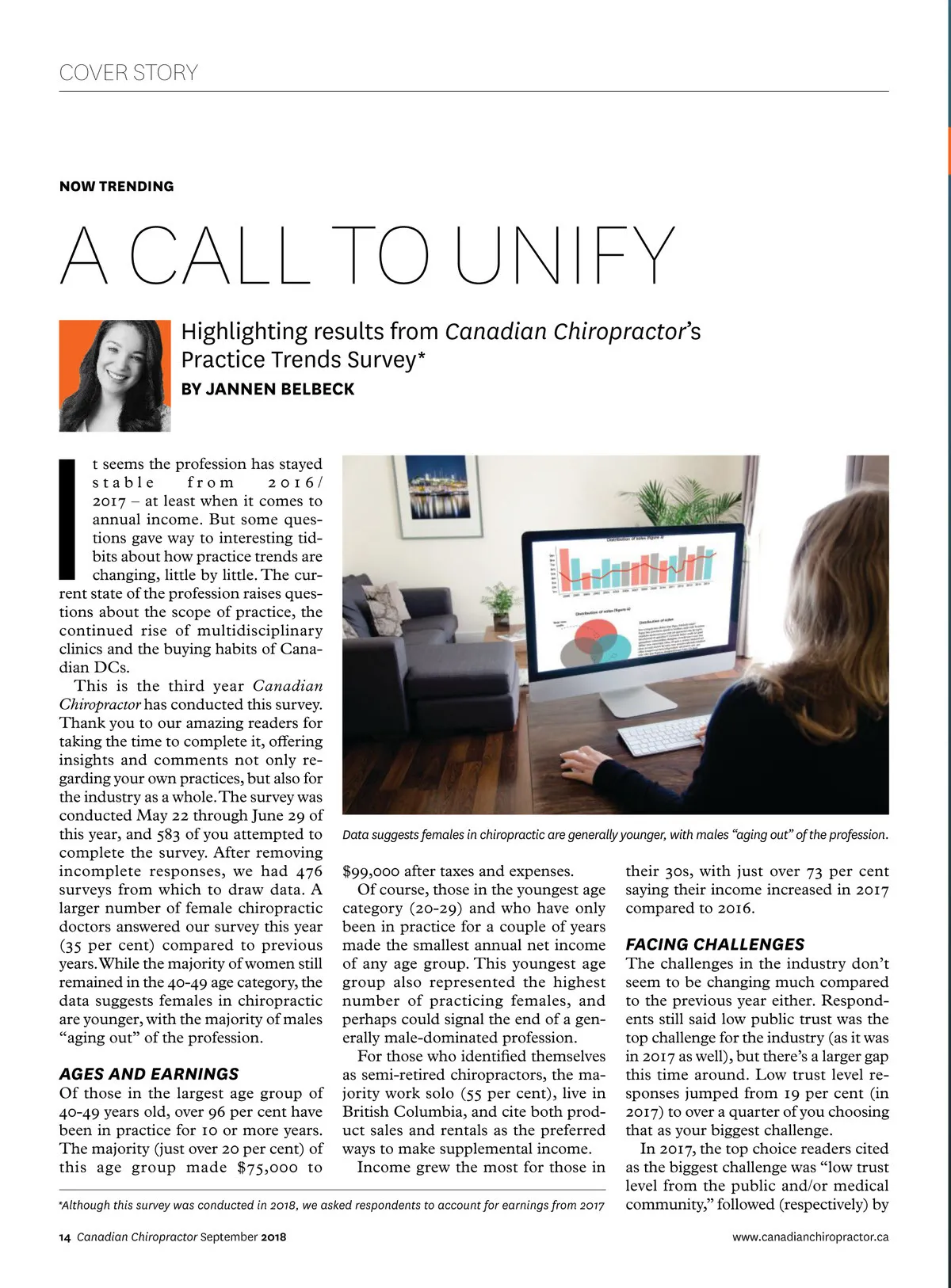
COVER STORY NOW TRENDING A CALL TO UNIFY Highlighting results from Canadian Chiropractor ’s Practice Trends Survey* I BY JANNEN BELBECK t seems the profession has stayed stable from 2016/ 2017 – at least when it comes to annual income. But some ques-tions gave way to interesting tid-bits about how practice trends are changing, little by little. The cur-rent state of the profession raises ques-tions about the scope of practice, the continued rise of multidisciplinary clinics and the buying habits of Cana-dian DCs. This is the third year Canadian Chiropractor has conducted this survey. Thank you to our amazing readers for taking the time to complete it, offering insights and comments not only re-garding your own practices, but also for the industry as a whole. The survey was conducted May 22 through June 29 of this year, and 583 of you attempted to complete the survey. After removing incomplete responses, we had 476 surveys from which to draw data. A larger number of female chiropractic doctors answered our survey this year (35 per cent) compared to previous years. While the majority of women still remained in the 40-49 age category, the data suggests females in chiropractic are younger, with the majority of males “aging out” of the profession. Data suggests females in chiropractic are generally younger, with males “aging out” of the profession. AGES AND EARNINGS Of those in the largest age group of 40-49 years old, over 96 per cent have been in practice for 10 or more years. The majority (just over 20 per cent) of this age group made $75,000 to $99,000 after taxes and expenses. Of course, those in the youngest age category (20-29) and who have only been in practice for a couple of years made the smallest annual net income of any age group. This youngest age group also represented the highest number of practicing females, and perhaps could signal the end of a gen-erally male-dominated profession. For those who identified themselves as semi-retired chiropractors, the ma-jority work solo (55 per cent), live in British Columbia, and cite both prod-uct sales and rentals as the preferred ways to make supplemental income. Income grew the most for those in their 30s, with just over 73 per cent saying their income increased in 2017 compared to 2016. FACING CHALLENGES *Although this survey was conducted in 2018, we asked respondents to account for earnings from 2017 14 Canadian Chiropractor September 2018 The challenges in the industry don’t seem to be changing much compared to the previous year either. Respond-ents still said low public trust was the top challenge for the industry (as it was in 2017 as well), but there’s a larger gap this time around. Low trust level re-sponses jumped from 19 per cent (in 2017) to over a quarter of you choosing that as your biggest challenge. In 2017, the top choice readers cited as the biggest challenge was “low trust level from the public and/or medical community,” followed (respectively) by www.canadianchiropractor.ca
Chiropractic + Naturopathic Doctor September 2018: Page 14