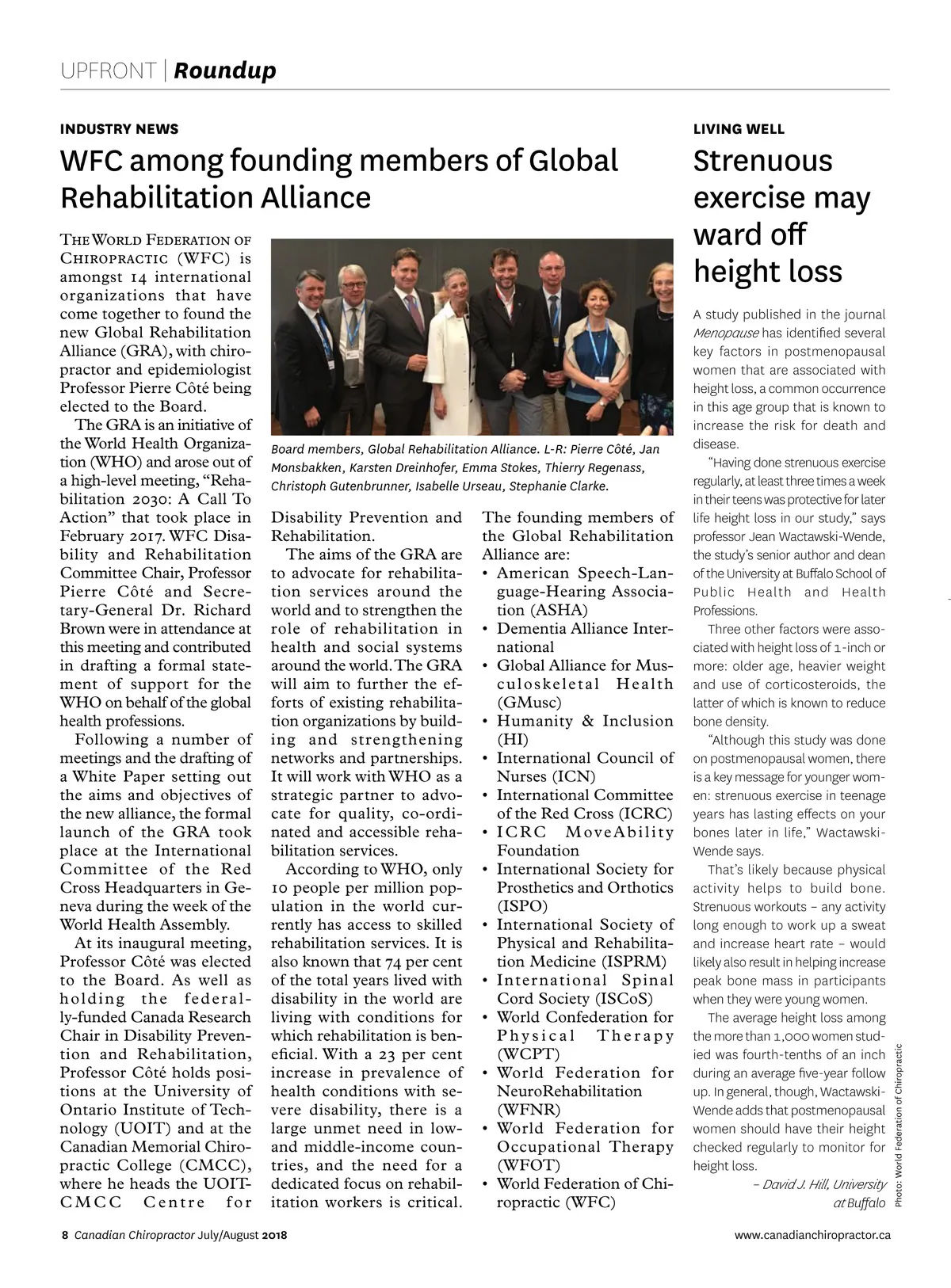
UPFRONT | Roundup INDUSTRY NEWS WFC among founding members of Global Rehabilitation Alliance The World Federation of Chiropractic (WFC) is amongst 14 international organizations that have come together to found the new Global Rehabilitation Alliance (GRA), with chiro-practor and epidemiologist Professor Pierre Côté being elected to the Board. The GRA is an initiative of the World Health Organiza-tion (WHO) and arose out of a high-level meeting, “Reha-bilitation 2030: A Call To Action” that took place in February 2017. WFC Disa-bility and Rehabilitation Committee Chair, Professor Pierre Côté and Secre-tary-General Dr. Richard Brown were in attendance at this meeting and contributed in drafting a formal state-ment of support for the WHO on behalf of the global health professions. Following a number of meetings and the drafting of a White Paper setting out the aims and objectives of the new alliance, the formal launch of the GRA took place at the International Committee of the Red Cross Headquarters in Ge-neva during the week of the World Health Assembly. At its inaugural meeting, Professor Côté was elected to the Board. As well as holding the federal -ly-funded Canada Research Chair in Disability Preven-tion and Rehabilitation, Professor Côté holds posi-tions at the University of Ontario Institute of Tech-nology (UOIT) and at the Canadian Memorial Chiro-practic College (CMCC), where he heads the UOIT-CMCC Centre for LIVING WELL Strenuous exercise may ward off height loss A study published in the journal Menopause has identified several key factors in postmenopausal women that are associated with height loss, a common occurrence in this age group that is known to increase the risk for death and disease. “Having done strenuous exercise regularly, at least three times a week in their teens was protective for later life height loss in our study,” says professor Jean Wactawski-Wende, the study’s senior author and dean of the University at Buffalo School of Public Health and Health Professions. Three other factors were asso-ciated with height loss of 1-inch or more: older age, heavier weight and use of corticosteroids, the latter of which is known to reduce bone density. “Although this study was done on postmenopausal women, there is a key message for younger wom-en: strenuous exercise in teenage years has lasting effects on your bones later in life,” Wactawski-Wende says. That’s likely because physical activity helps to build bone. Strenuous workouts – any activity long enough to work up a sweat and increase heart rate – would likely also result in helping increase peak bone mass in participants when they were young women. The average height loss among the more than 1,000 women stud-ied was fourth-tenths of an inch during an average five-year follow up. In general, though, Wactawski-Wende adds that postmenopausal women should have their height checked regularly to monitor for height loss. – David J. Hill, University at Buffalo www.canadianchiropractor.ca Board members, Global Rehabilitation Alliance. L-R: Pierre Côté, Jan Monsbakken, Karsten Dreinhofer, Emma Stokes, Thierry Regenass, Christoph Gutenbrunner, Isabelle Urseau, Stephanie Clarke. Disability Prevention and Rehabilitation. The aims of the GRA are to advocate for rehabilita-tion services around the world and to strengthen the role of rehabilitation in health and social systems around the world. The GRA will aim to further the ef-forts of existing rehabilita-tion organizations by build-ing and strengthening networks and partnerships. It will work with WHO as a strategic partner to advo-cate for quality, co-ordi-nated and accessible reha-bilitation services. According to WHO, only 10 people per million pop-ulation in the world cur-rently has access to skilled rehabilitation services. It is also known that 74 per cent of the total years lived with disability in the world are living with conditions for which rehabilitation is ben-eficial. With a 23 per cent increase in prevalence of health conditions with se-vere disability, there is a large unmet need in low-and middle-income coun-tries, and the need for a dedicated focus on rehabil-itation workers is critical. The founding members of the Global Rehabilitation Alliance are: • American Speech-Lan-guage-Hearing Associa-tion (ASHA) • Dementia Alliance Inter-national • Global Alliance for Mus-culoskeletal Health (GMusc) • Humanity & Inclusion (HI) • International Council of Nurses (ICN) • International Committee of the Red Cross (ICRC) • ICRC MoveAbility Foundation • International Society for Prosthetics and Orthotics (ISPO) • International Society of Physical and Rehabilita-tion Medicine (ISPRM) • International Spinal Cord Society (ISCoS) • World Confederation for Physical Therapy (WCPT) • World Federation for NeuroRehabilitation (WFNR) • World Federation for Occupational Therapy (WFOT) • World Federation of Chi-ropractic (WFC) 8 Canadian Chiropractor July/August 2018 Photo: World Federation of Chiropractic
Chiropractic + Naturopathic Doctor July/August 2018: Page 8