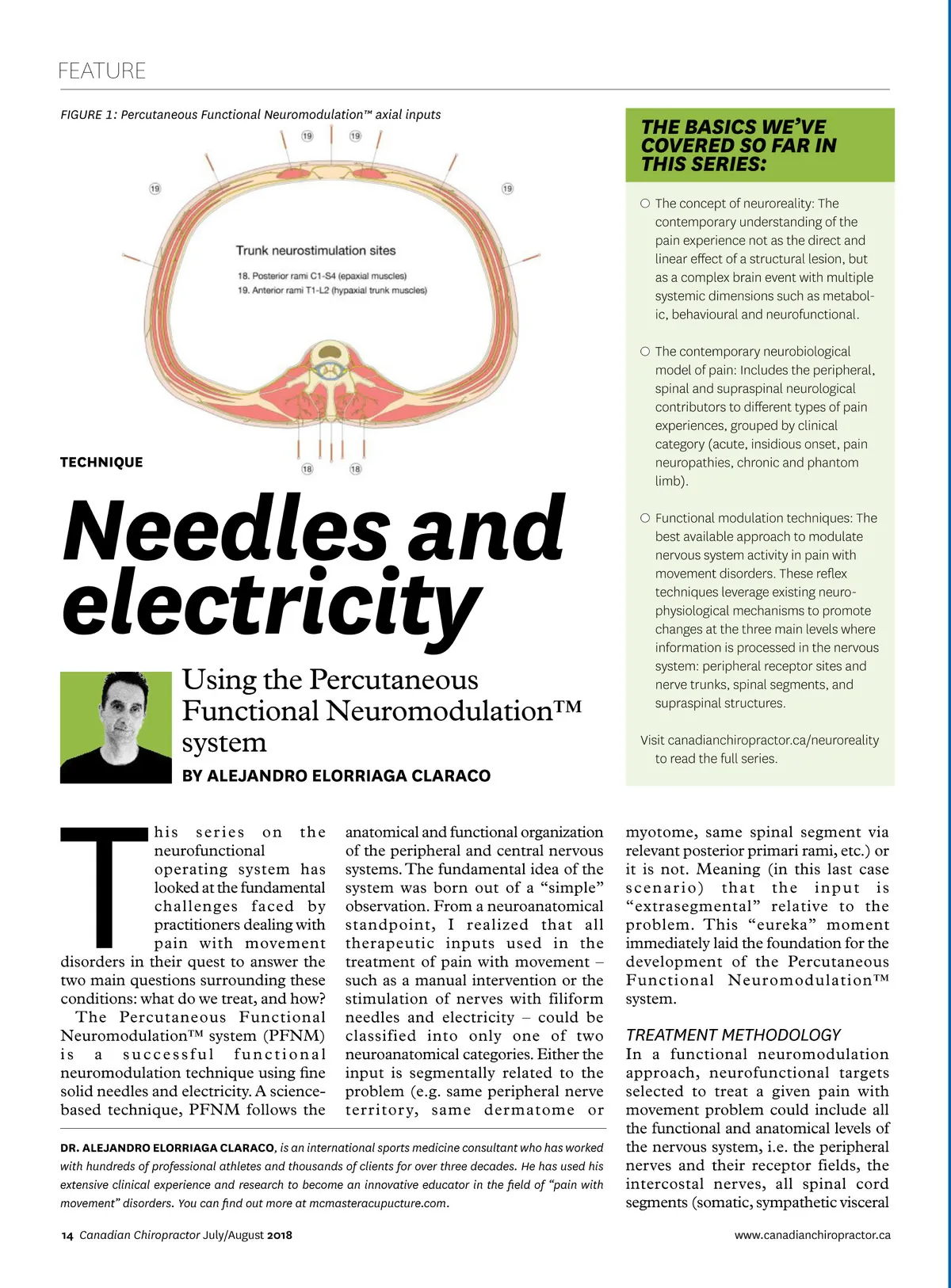
FEATURE FIGURE 1: Percutaneous Functional Neuromodulation™ axial inputs THE BASICS WE’VE COVERED SO FAR IN THIS SERIES: The concept of neuroreality: The contemporary understanding of the pain experience not as the direct and linear effect of a structural lesion, but as a complex brain event with multiple systemic dimensions such as metabol-ic, behavioural and neurofunctional. The contemporary neurobiological model of pain: Includes the peripheral, spinal and supraspinal neurological contributors to different types of pain experiences, grouped by clinical category (acute, insidious onset, pain neuropathies, chronic and phantom limb). Functional modulation techniques: The best available approach to modulate nervous system activity in pain with movement disorders. These reflex techniques leverage existing neuro-physiological mechanisms to promote changes at the three main levels where information is processed in the nervous system: peripheral receptor sites and nerve trunks, spinal segments, and supraspinal structures. Visit canadianchiropractor.ca/neuroreality to read the full series. TECHNIQUE Needles and electricity T Using the Percutaneous Functional Neuromodulation™ system BY ALEJANDRO ELORRIAGA CLARACO anatomical and functional organization of the peripheral and central nervous systems. The fundamental idea of the system was born out of a “simple” observation. From a neuroanatomical standpoint, I realized that all therapeutic inputs used in the treatment of pain with movement – such as a manual intervention or the stimulation of nerves with filiform needles and electricity – could be classified into only one of two neuroanatomical categories. Either the input is segmentally related to the problem (e.g. same peripheral nerve territory, same dermatome or his series on the neurofunctional operating system has looked at the fundamental challenges faced by practitioners dealing with pain with movement disorders in their quest to answer the two main questions surrounding these conditions: what do we treat, and how? The Percutaneous Functional Neuromodulation™ system (PFNM) is a successful functional neuromodulation technique using fine solid needles and electricity. A science-based technique, PFNM follows the myotome, same spinal segment via relevant posterior primari rami, etc.) or it is not. Meaning (in this last case scenario) that the input is “extrasegmental” relative to the problem. This “eureka” moment immediately laid the foundation for the development of the Percutaneous Functional Neuromodulation™ system. TREATMENT METHODOLOGY DR. ALEJANDRO ELORRIAGA CLARACO , is an international sports medicine consultant who has worked with hundreds of professional athletes and thousands of clients for over three decades. He has used his extensive clinical experience and research to become an innovative educator in the field of “pain with movement” disorders. You can find out more at mcmasteracupucture.com. 14 Canadian Chiropractor July/August 2018 In a functional neuromodulation approach, neurofunctional targets selected to treat a given pain with movement problem could include all the functional and anatomical levels of the nervous system, i.e. the peripheral nerves and their receptor fields, the intercostal nerves, all spinal cord segments (somatic, sympathetic visceral www.canadianchiropractor.ca
Chiropractic + Naturopathic Doctor July/August 2018: Page 14