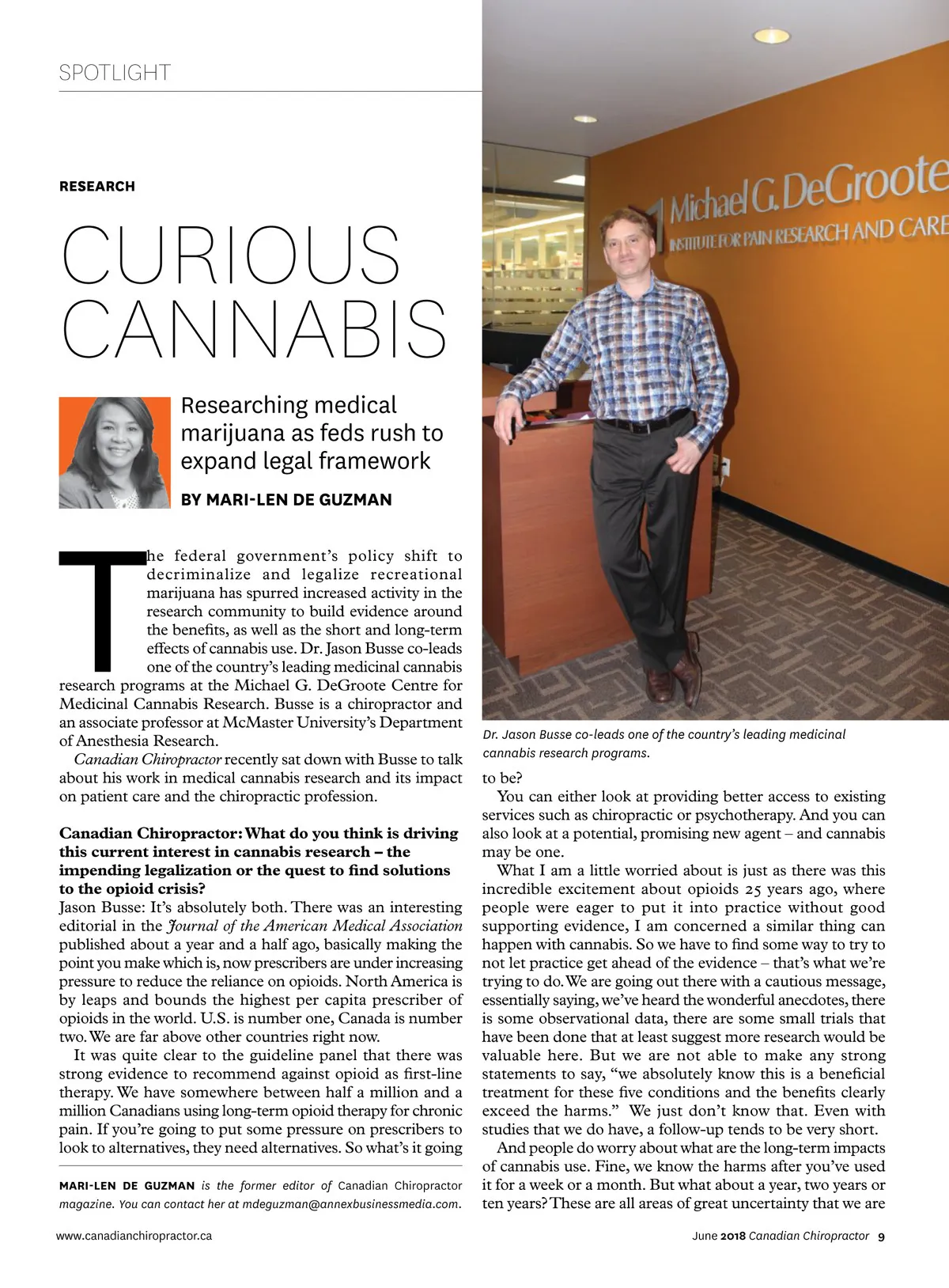
SPOTLIGHT RESEARCH CURIOUS CANNABIS Researching medical marijuana as feds rush to expand legal framework T BY MARI-LEN DE GUZMAN he federal government’s policy shift to decriminalize and legalize recreational marijuana has spurred increased activity in the research community to build evidence around the benefits, as well as the short and long-term effects of cannabis use. Dr. Jason Busse co-leads one of the country’s leading medicinal cannabis research programs at the Michael G. DeGroote Centre for Medicinal Cannabis Research. Busse is a chiropractor and an associate professor at McMaster University’s Department of Anesthesia Research. Canadian Chiropractor recently sat down with Busse to talk about his work in medical cannabis research and its impact on patient care and the chiropractic profession. Dr. Jason Busse co-leads one of the country’s leading medicinal cannabis research programs. Canadian Chiropractor: What do you think is driving this current interest in cannabis research – the impending legalization or the quest to find solutions to the opioid crisis? Jason Busse: It’s absolutely both. There was an interesting editorial in the Journal of the American Medical Association published about a year and a half ago, basically making the point you make which is, now prescribers are under increasing pressure to reduce the reliance on opioids. North America is by leaps and bounds the highest per capita prescriber of opioids in the world. U.S. is number one, Canada is number two. We are far above other countries right now. It was quite clear to the guideline panel that there was strong evidence to recommend against opioid as first-line therapy. We have somewhere between half a million and a million Canadians using long-term opioid therapy for chronic pain. If you’re going to put some pressure on prescribers to look to alternatives, they need alternatives. So what’s it going MARI-LEN DE GUZMAN is the former editor of Canadian Chiropractor magazine. You can contact her at [email protected]. www.canadianchiropractor.ca to be? You can either look at providing better access to existing services such as chiropractic or psychotherapy. And you can also look at a potential, promising new agent – and cannabis may be one. What I am a little worried about is just as there was this incredible excitement about opioids 25 years ago, where people were eager to put it into practice without good supporting evidence, I am concerned a similar thing can happen with cannabis. So we have to find some way to try to not let practice get ahead of the evidence – that’s what we’re trying to do. We are going out there with a cautious message, essentially saying, we’ve heard the wonderful anecdotes, there is some observational data, there are some small trials that have been done that at least suggest more research would be valuable here. But we are not able to make any strong statements to say, “we absolutely know this is a beneficial treatment for these five conditions and the benefits clearly exceed the harms.” We just don’t know that. Even with studies that we do have, a follow-up tends to be very short. And people do worry about what are the long-term impacts of cannabis use. Fine, we know the harms after you’ve used it for a week or a month. But what about a year, two years or ten years? These are all areas of great uncertainty that we are June 2018 Canadian Chiropractor 9
Chiropractic + Naturopathic Doctor June 2018: Page 9