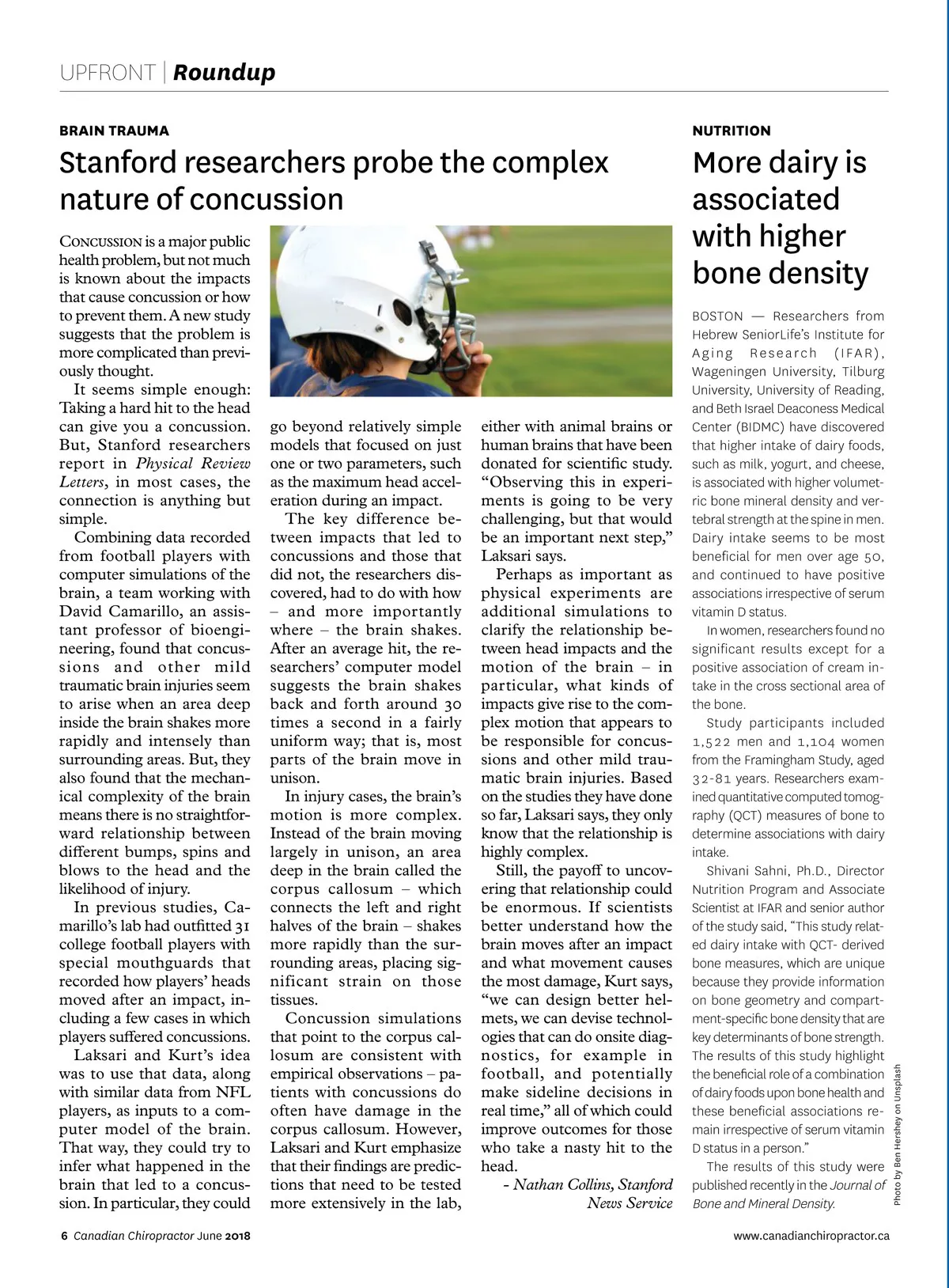
UPFRONT | Roundup BRAIN TRAUMA Stanford researchers probe the complex nature of concussion Concussion is a major public health problem, but not much is known about the impacts that cause concussion or how to prevent them. A new study suggests that the problem is more complicated than previ-ously thought. It seems simple enough: Taking a hard hit to the head can give you a concussion. But, Stanford researchers report in Physical Review Letters , in most cases, the connection is anything but simple. Combining data recorded from football players with computer simulations of the brain, a team working with David Camarillo, an assis-tant professor of bioengi-neering, found that concus-sions and other mild traumatic brain injuries seem to arise when an area deep inside the brain shakes more rapidly and intensely than surrounding areas. But, they also found that the mechan-ical complexity of the brain means there is no straightfor-ward relationship between different bumps, spins and blows to the head and the likelihood of injury. In previous studies, Ca-marillo’s lab had outfitted 31 college football players with special mouthguards that recorded how players’ heads moved after an impact, in-cluding a few cases in which players suffered concussions. Laksari and Kurt’s idea was to use that data, along with similar data from NFL players, as inputs to a com-puter model of the brain. That way, they could try to infer what happened in the brain that led to a concus-sion. In particular, they could 6 Canadian Chiropractor June 2018 NUTRITION More dairy is associated with higher bone density BOSTON — Researchers from Hebrew SeniorLife’s Institute for Aging Research (IFAR), Wageningen University, Tilburg University, University of Reading, and Beth Israel Deaconess Medical Center (BIDMC) have discovered that higher intake of dairy foods, such as milk, yogurt, and cheese, is associated with higher volumet-ric bone mineral density and ver-tebral strength at the spine in men. Dairy intake seems to be most beneficial for men over age 50, and continued to have positive associations irrespective of serum vitamin D status. In women, researchers found no significant results except for a positive association of cream in-take in the cross sectional area of the bone. Study participants included 1,522 men and 1,104 women from the Framingham Study, aged 32-81 years. Researchers exam-ined quantitative computed tomog-raphy (QCT) measures of bone to determine associations with dairy intake. Shivani Sahni, Ph.D., Director Nutrition Program and Associate Scientist at IFAR and senior author of the study said, “This study relat-ed dairy intake with QCT-derived bone measures, which are unique because they provide information on bone geometry and compart-ment-specific bone density that are key determinants of bone strength. The results of this study highlight the beneficial role of a combination of dairy foods upon bone health and these beneficial associations re-main irrespective of serum vitamin D status in a person.” The results of this study were published recently in the Journal of Bone and Mineral Density. www.canadianchiropractor.ca go beyond relatively simple models that focused on just one or two parameters, such as the maximum head accel-eration during an impact. The key difference be-tween impacts that led to concussions and those that did not, the researchers dis-covered, had to do with how – and more importantly where – the brain shakes. After an average hit, the re-searchers’ computer model suggests the brain shakes back and forth around 30 times a second in a fairly uniform way; that is, most parts of the brain move in unison. In injury cases, the brain’s motion is more complex. Instead of the brain moving largely in unison, an area deep in the brain called the corpus callosum – which connects the left and right halves of the brain – shakes more rapidly than the sur-rounding areas, placing sig-nificant strain on those tissues. Concussion simulations that point to the corpus cal-losum are consistent with empirical observations – pa-tients with concussions do often have damage in the corpus callosum. However, Laksari and Kurt emphasize that their findings are predic-tions that need to be tested more extensively in the lab, either with animal brains or human brains that have been donated for scientific study. “Observing this in experi-ments is going to be very challenging, but that would be an important next step,” Laksari says. Perhaps as important as physical experiments are additional simulations to clarify the relationship be-tween head impacts and the motion of the brain – in particular, what kinds of impacts give rise to the com-plex motion that appears to be responsible for concus-sions and other mild trau-matic brain injuries. Based on the studies they have done so far, Laksari says, they only know that the relationship is highly complex. Still, the payoff to uncov-ering that relationship could be enormous. If scientists better understand how the brain moves after an impact and what movement causes the most damage, Kurt says, “we can design better hel-mets, we can devise technol-ogies that can do onsite diag-nostics, for example in football, and potentially make sideline decisions in real time,” all of which could improve outcomes for those who take a nasty hit to the head. -Nathan Collins, Stanford News Service Photo by Ben Hershey on Unsplash
Chiropractic + Naturopathic Doctor June 2018: Page 6