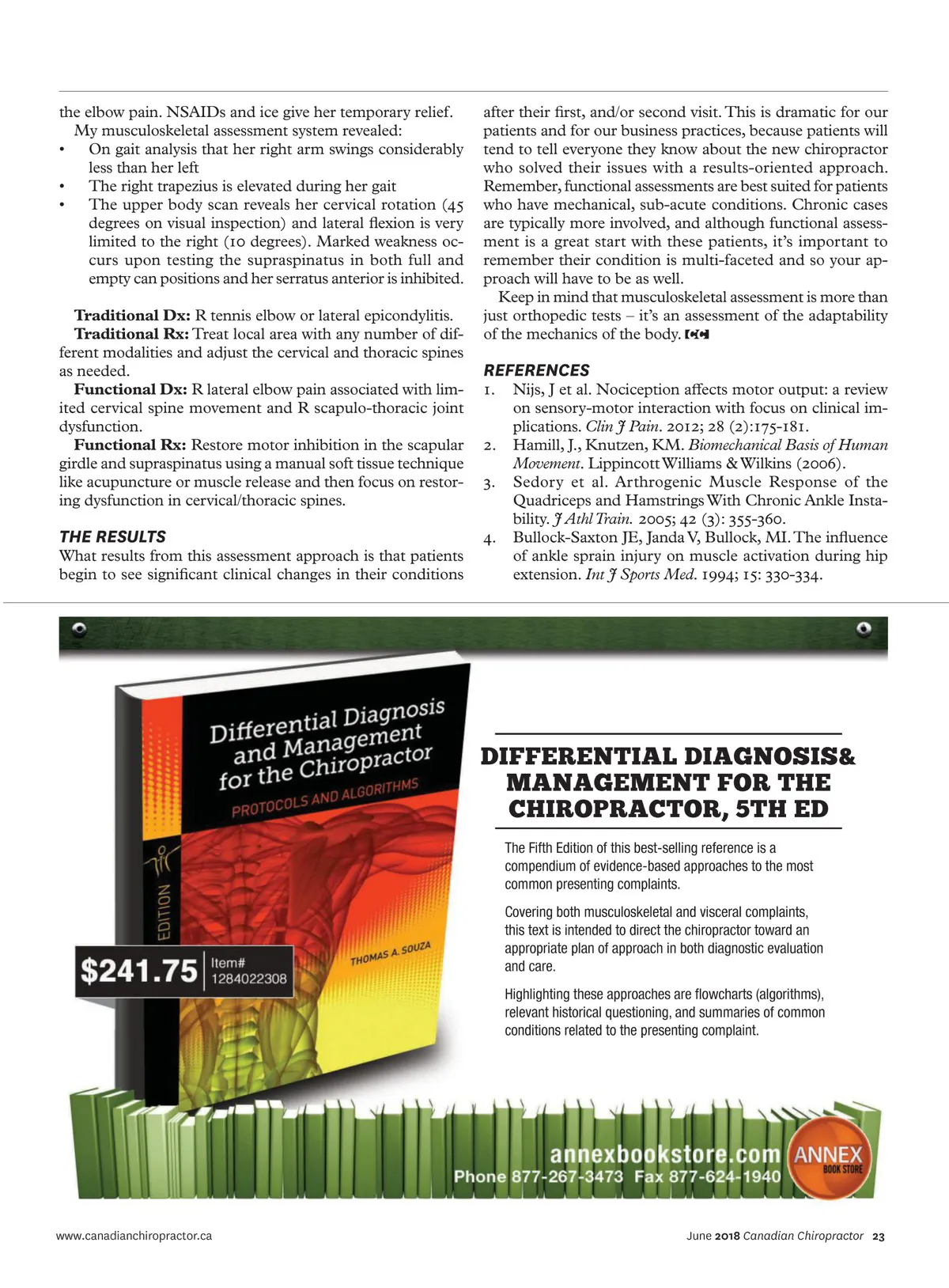
the elbow pain. NSAIDs and ice give her temporary relief. My musculoskeletal assessment system revealed: • On gait analysis that her right arm swings considerably less than her left • The right trapezius is elevated during her gait • The upper body scan reveals her cervical rotation (45 degrees on visual inspection) and lateral flexion is very limited to the right (10 degrees). Marked weakness oc-curs upon testing the supraspinatus in both full and empty can positions and her serratus anterior is inhibited. Traditional Dx: R tennis elbow or lateral epicondylitis. Traditional Rx: Treat local area with any number of dif-ferent modalities and adjust the cervical and thoracic spines as needed. Functional Dx: R lateral elbow pain associated with lim-ited cervical spine movement and R scapulo-thoracic joint dysfunction. Functional Rx: Restore motor inhibition in the scapular girdle and supraspinatus using a manual soft tissue technique like acupuncture or muscle release and then focus on restor-ing dysfunction in cervical/thoracic spines. after their first, and/or second visit. This is dramatic for our patients and for our business practices, because patients will tend to tell everyone they know about the new chiropractor who solved their issues with a results-oriented approach. Remember, functional assessments are best suited for patients who have mechanical, sub-acute conditions. Chronic cases are typically more involved, and although functional assess-ment is a great start with these patients, it’s important to remember their condition is multi-faceted and so your ap-proach will have to be as well. Keep in mind that musculoskeletal assessment is more than just orthopedic tests – it’s an assessment of the adaptability of the mechanics of the body. REFERENCES 1. Nijs, J et al. Nociception affects motor output: a review on sensory-motor interaction with focus on clinical im-plications. Clin J Pain . 2012; 28 (2):175-181. Hamill, J., Knutzen, KM. Biomechanical Basis of Human Movement . Lippincott Williams & Wilkins (2006). Sedory et al. Arthrogenic Muscle Response of the Quadriceps and Hamstrings With Chronic Ankle Insta-bility. J Athl Train. 2005; 42 (3): 355-360. Bullock-Saxton JE, Janda V, Bullock, MI. The influence of ankle sprain injury on muscle activation during hip extension. Int J Sports Med . 1994; 15: 330-334. 2. 3. THE RESULTS What results from this assessment approach is that patients begin to see significant clinical changes in their conditions 4. DIFFERENTIAL DIAGNOSIS& MANAGEMENT FOR THE CHIROPRACTOR, 5TH ED The Fifth Edition of this best-selling reference is a compendium of evidence-based approaches to the most common presenting complaints. Covering both musculoskeletal and visceral complaints, this text is intended to direct the chiropractor toward an appropriate plan of approach in both diagnostic evaluation and care. Highlighting these approaches are flowcharts (algorithms), relevant historical questioning, and summaries of common conditions related to the presenting complaint. www.canadianchiropractor.ca June 2018 Canadian Chiropractor 23
Chiropractic + Naturopathic Doctor June 2018: Page 23