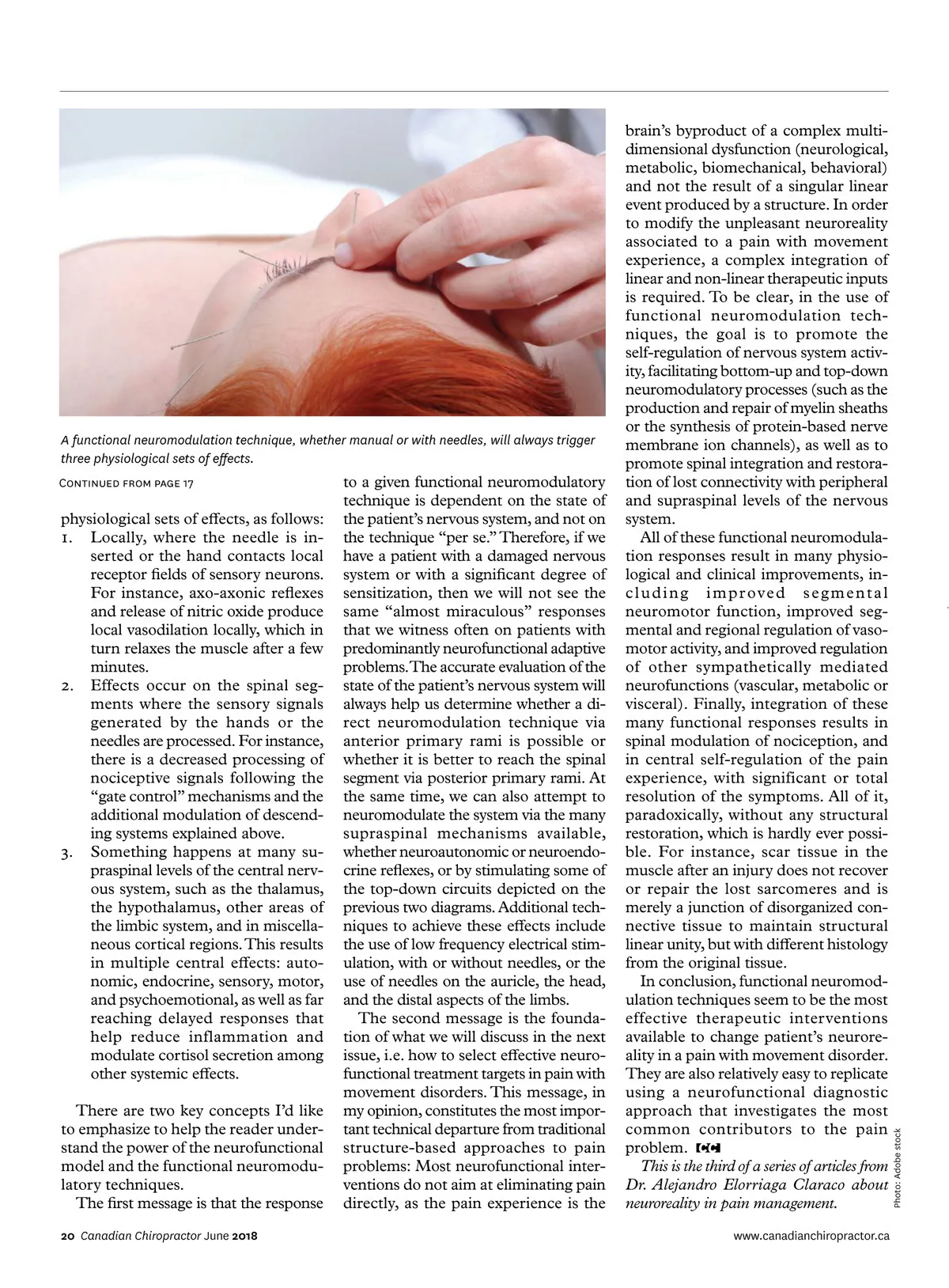
A functional neuromodulation technique, whether manual or with needles, will always trigger three physiological sets of effects. Continued from page 17 physiological sets of effects, as follows: 1. Locally, where the needle is in-serted or the hand contacts local receptor fields of sensory neurons. For instance, axo-axonic reflexes and release of nitric oxide produce local vasodilation locally, which in turn relaxes the muscle after a few minutes. 2. Effects occur on the spinal seg-ments where the sensory signals generated by the hands or the needles are processed. For instance, there is a decreased processing of nociceptive signals following the “gate control” mechanisms and the additional modulation of descend-ing systems explained above. 3. Something happens at many su-praspinal levels of the central nerv-ous system, such as the thalamus, the hypothalamus, other areas of the limbic system, and in miscella-neous cortical regions. This results in multiple central effects: auto-nomic, endocrine, sensory, motor, and psychoemotional, as well as far reaching delayed responses that help reduce inflammation and modulate cortisol secretion among other systemic effects. There are two key concepts I’d like to emphasize to help the reader under-stand the power of the neurofunctional model and the functional neuromodu-latory techniques. The first message is that the response 20 Canadian Chiropractor June 2018 to a given functional neuromodulatory technique is dependent on the state of the patient’s nervous system, and not on the technique “per se.” Therefore, if we have a patient with a damaged nervous system or with a significant degree of sensitization, then we will not see the same “almost miraculous” responses that we witness often on patients with predominantly neurofunctional adaptive problems. The accurate evaluation of the state of the patient’s nervous system will always help us determine whether a di-rect neuromodulation technique via anterior primary rami is possible or whether it is better to reach the spinal segment via posterior primary rami. At the same time, we can also attempt to neuromodulate the system via the many supraspinal mechanisms available, whether neuroautonomic or neuroendo-crine reflexes, or by stimulating some of the top-down circuits depicted on the previous two diagrams. Additional tech-niques to achieve these effects include the use of low frequency electrical stim-ulation, with or without needles, or the use of needles on the auricle, the head, and the distal aspects of the limbs. The second message is the founda-tion of what we will discuss in the next issue, i.e. how to select effective neuro-functional treatment targets in pain with movement disorders. This message, in my opinion, constitutes the most impor-tant technical departure from traditional structure-based approaches to pain problems: Most neurofunctional inter-ventions do not aim at eliminating pain directly, as the pain experience is the brain’s byproduct of a complex multi-dimensional dysfunction (neurological, metabolic, biomechanical, behavioral) and not the result of a singular linear event produced by a structure. In order to modify the unpleasant neuroreality associated to a pain with movement experience, a complex integration of linear and non-linear therapeutic inputs is required. To be clear, in the use of functional neuromodulation tech-niques, the goal is to promote the self-regulation of nervous system activ-ity, facilitating bottom-up and top-down neuromodulatory processes (such as the production and repair of myelin sheaths or the synthesis of protein-based nerve membrane ion channels), as well as to promote spinal integration and restora-tion of lost connectivity with peripheral and supraspinal levels of the nervous system. All of these functional neuromodula-tion responses result in many physio-logical and clinical improvements, in-cluding improved segmental neuromotor function, improved seg-mental and regional regulation of vaso-motor activity, and improved regulation of other sympathetically mediated neurofunctions (vascular, metabolic or visceral). Finally, integration of these many functional responses results in spinal modulation of nociception, and in central self-regulation of the pain experience, with significant or total resolution of the symptoms. All of it, paradoxically, without any structural restoration, which is hardly ever possi-ble. For instance, scar tissue in the muscle after an injury does not recover or repair the lost sarcomeres and is merely a junction of disorganized con-nective tissue to maintain structural linear unity, but with different histology from the original tissue. In conclusion, functional neuromod-ulation techniques seem to be the most effective therapeutic interventions available to change patient’s neurore-ality in a pain with movement disorder. They are also relatively easy to replicate using a neurofunctional diagnostic approach that investigates the most common contributors to the pain problem. This is the third of a series of articles from Dr. Alejandro Elorriaga Claraco about neuroreality in pain management. www.canadianchiropractor.ca Photo: Adobe stock
Chiropractic + Naturopathic Doctor June 2018: Page 20