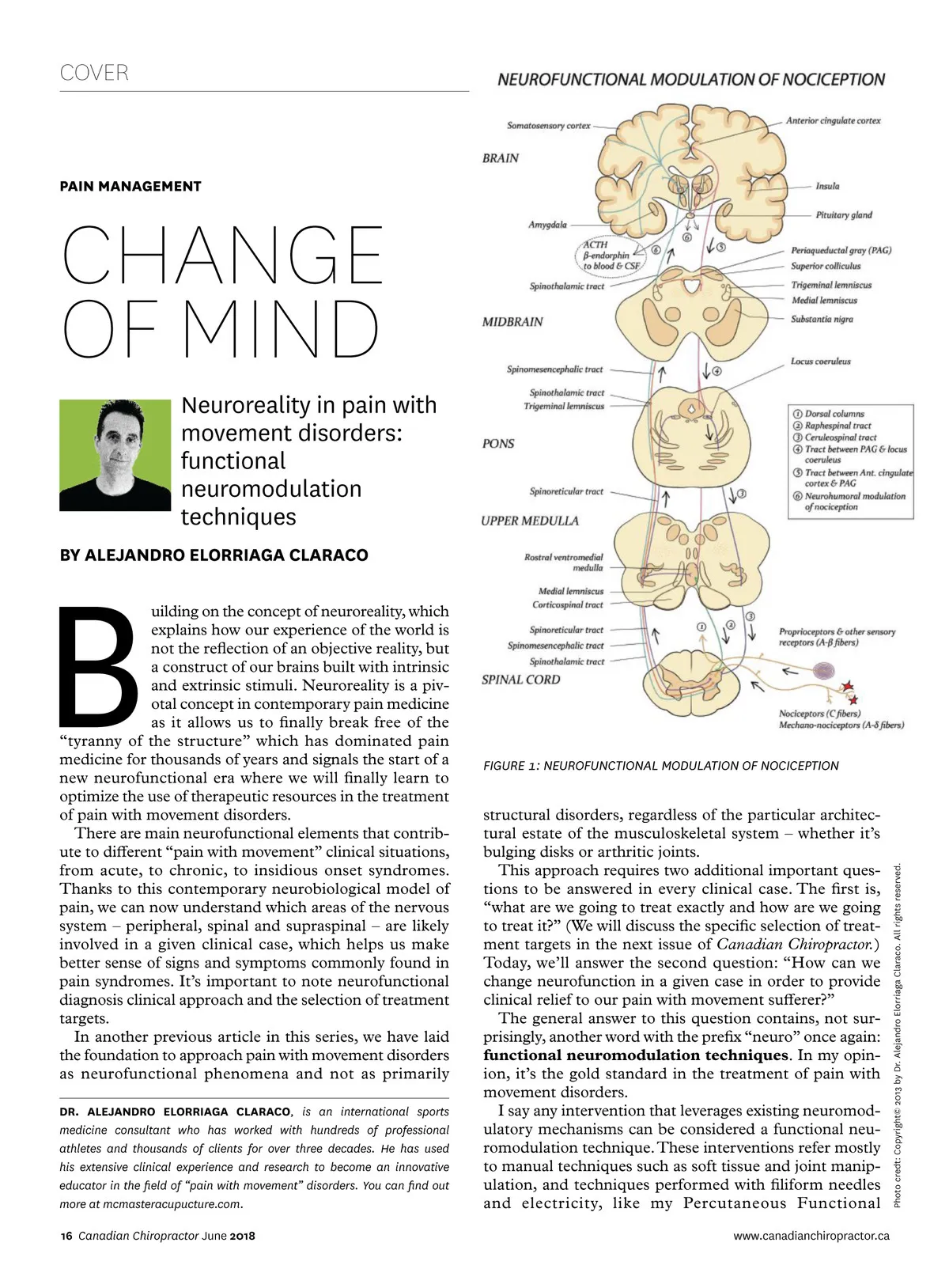
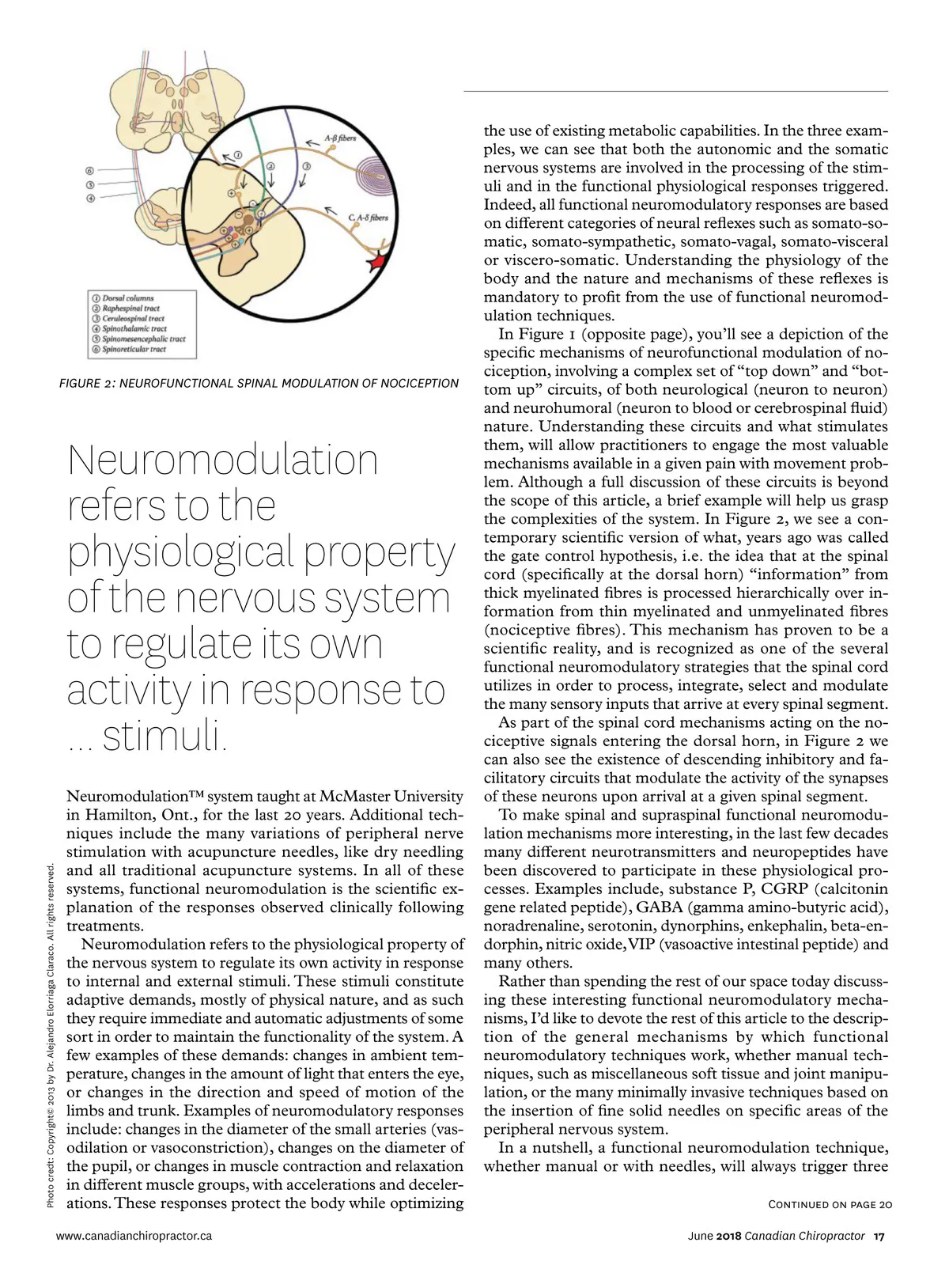
COVER PAIN MANAGEMENT CHANGE OF MIND Neuroreality in pain with movement disorders: functional neuromodulation techniques B BY ALEJANDRO ELORRIAGA CLARACO uilding on the concept of neuroreality, which explains how our experience of the world is not the reflection of an objective reality, but a construct of our brains built with intrinsic and extrinsic stimuli. Neuroreality is a piv-otal concept in contemporary pain medicine as it allows us to finally break free of the “tyranny of the structure” which has dominated pain medicine for thousands of years and signals the start of a new neurofunctional era where we will finally learn to optimize the use of therapeutic resources in the treatment of pain with movement disorders. There are main neurofunctional elements that contrib-ute to different “pain with movement” clinical situations, from acute, to chronic, to insidious onset syndromes. Thanks to this contemporary neurobiological model of pain, we can now understand which areas of the nervous system – peripheral, spinal and supraspinal – are likely involved in a given clinical case, which helps us make better sense of signs and symptoms commonly found in pain syndromes. It’s important to note neurofunctional diagnosis clinical approach and the selection of treatment targets. In another previous article in this series, we have laid the foundation to approach pain with movement disorders as neurofunctional phenomena and not as primarily FIGURE 1: NEUROFUNCTIONAL MODULATION OF NOCICEPTION DR. ALEJANDRO ELORRIAGA CLARACO , is an international sports medicine consultant who has worked with hundreds of professional athletes and thousands of clients for over three decades. He has used his extensive clinical experience and research to become an innovative educator in the field of “pain with movement” disorders. You can find out more at mcmasteracupucture.com. 16 Canadian Chiropractor June 2018 structural disorders, regardless of the particular architec-tural estate of the musculoskeletal system – whether it’s bulging disks or arthritic joints. This approach requires two additional important ques-tions to be answered in every clinical case. The first is, “what are we going to treat exactly and how are we going to treat it?” (We will discuss the specific selection of treat-ment targets in the next issue of Canadian Chiropractor. ) Today, we’ll answer the second question: “How can we change neurofunction in a given case in order to provide clinical relief to our pain with movement sufferer?” The general answer to this question contains, not sur-prisingly, another word with the prefix “neuro” once again: functional neuromodulation techniques . In my opin-ion, it’s the gold standard in the treatment of pain with movement disorders. I say any intervention that leverages existing neuromod-ulatory mechanisms can be considered a functional neu-romodulation technique. These interventions refer mostly to manual techniques such as soft tissue and joint manip-ulation, and techniques performed with filiform needles and electricity, like my Percutaneous Functional www.canadianchiropractor.ca Photo credt: Copyright© 2013 by Dr. Alejandro Elorriaga Claraco. All rights reserved.
Chiropractic + Naturopathic Doctor June 2018: Page 16