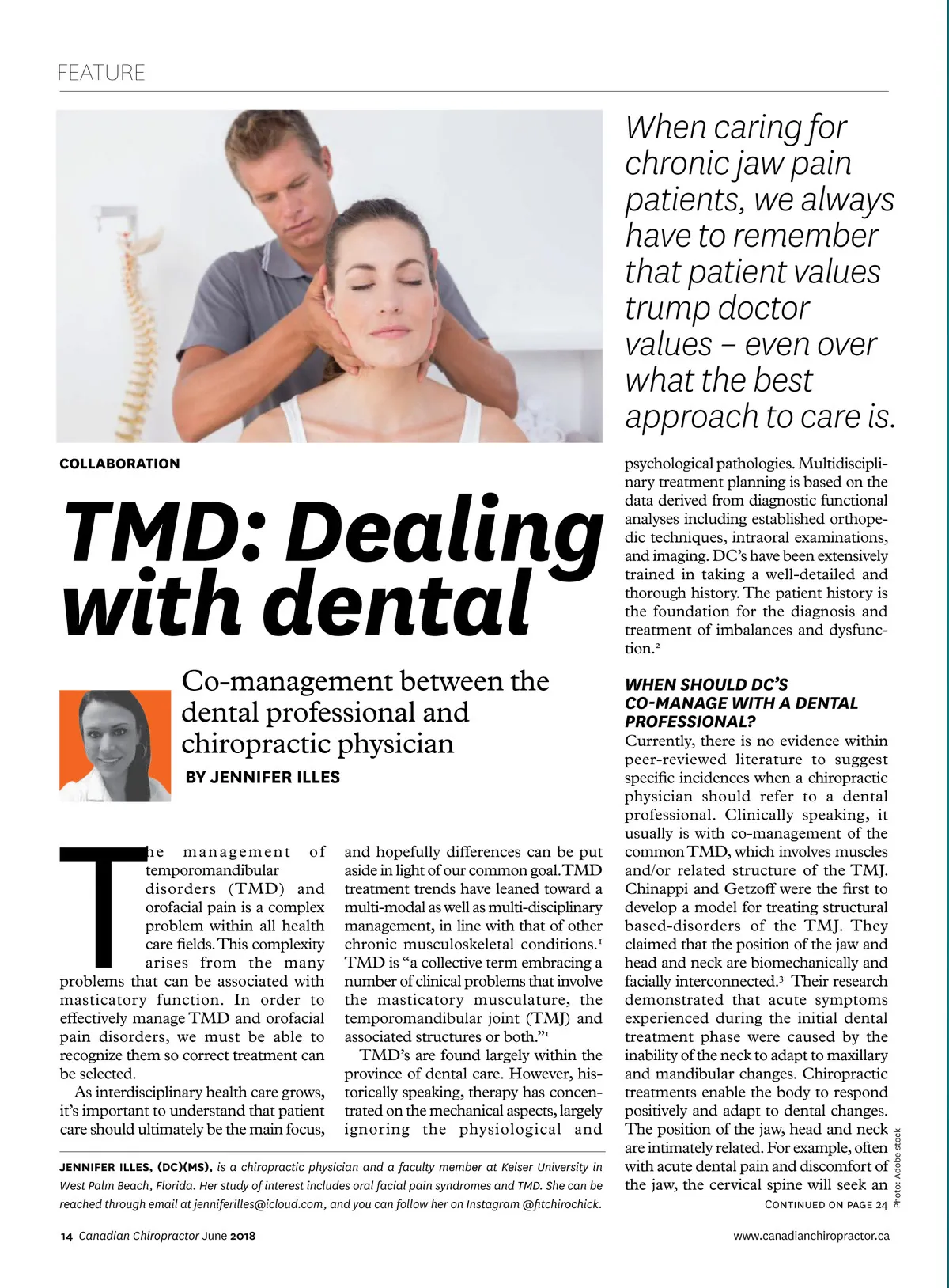
FEATURE When caring for chronic jaw pain patients, we always have to remember that patient values trump doctor values – even over what the best approach to care is. COLLABORATION TMD: Dealing with dental Co-management between the dental professional and chiropractic physician psychological pathologies. Multidiscipli-nary treatment planning is based on the data derived from diagnostic functional analyses including established orthope-dic techniques, intraoral examinations, and imaging. DC’s have been extensively trained in taking a well-detailed and thorough history. The patient history is the foundation for the diagnosis and treatment of imbalances and dysfunc-tion. 2 T BY JENNIFER ILLES JENNIFER ILLES, (DC)(MS), is a chiropractic physician and a faculty member at Keiser University in West Palm Beach, Florida. Her study of interest includes oral facial pain syndromes and TMD. She can be reached through email at [email protected], and you can follow her on Instagram @fitchirochick. 14 Canadian Chiropractor June 2018 Continued on page 24 www.canadianchiropractor.ca Photo: Adobe stock he management of temporomandibular disorders (TMD) and orofacial pain is a complex problem within all health care fields. This complexity arises from the many problems that can be associated with masticatory function. In order to effectively manage TMD and orofacial pain disorders, we must be able to recognize them so correct treatment can be selected. As interdisciplinary health care grows, it’s important to understand that patient care should ultimately be the main focus, and hopefully differences can be put aside in light of our common goal. TMD treatment trends have leaned toward a multi-modal as well as multi-disciplinary management, in line with that of other chronic musculoskeletal conditions. 1 TMD is “a collective term embracing a number of clinical problems that involve the masticatory musculature, the temporomandibular joint (TMJ) and associated structures or both.” 1 TMD’s are found largely within the province of dental care. However, his-torically speaking, therapy has concen-trated on the mechanical aspects, largely ignoring the physiological and Currently, there is no evidence within peer-reviewed literature to suggest specific incidences when a chiropractic physician should refer to a dental professional. Clinically speaking, it usually is with co-management of the common TMD, which involves muscles and/or related structure of the TMJ. Chinappi and Getzoff were the first to develop a model for treating structural based-disorders of the TMJ. They claimed that the position of the jaw and head and neck are biomechanically and facially interconnected. 3 Their research demonstrated that acute symptoms experienced during the initial dental treatment phase were caused by the inability of the neck to adapt to maxillary and mandibular changes. Chiropractic treatments enable the body to respond positively and adapt to dental changes. The position of the jaw, head and neck are intimately related. For example, often with acute dental pain and discomfort of the jaw, the cervical spine will seek an WHEN SHOULD DC’S CO-MANAGE WITH A DENTAL PROFESSIONAL?
Chiropractic + Naturopathic Doctor June 2018: Page 14