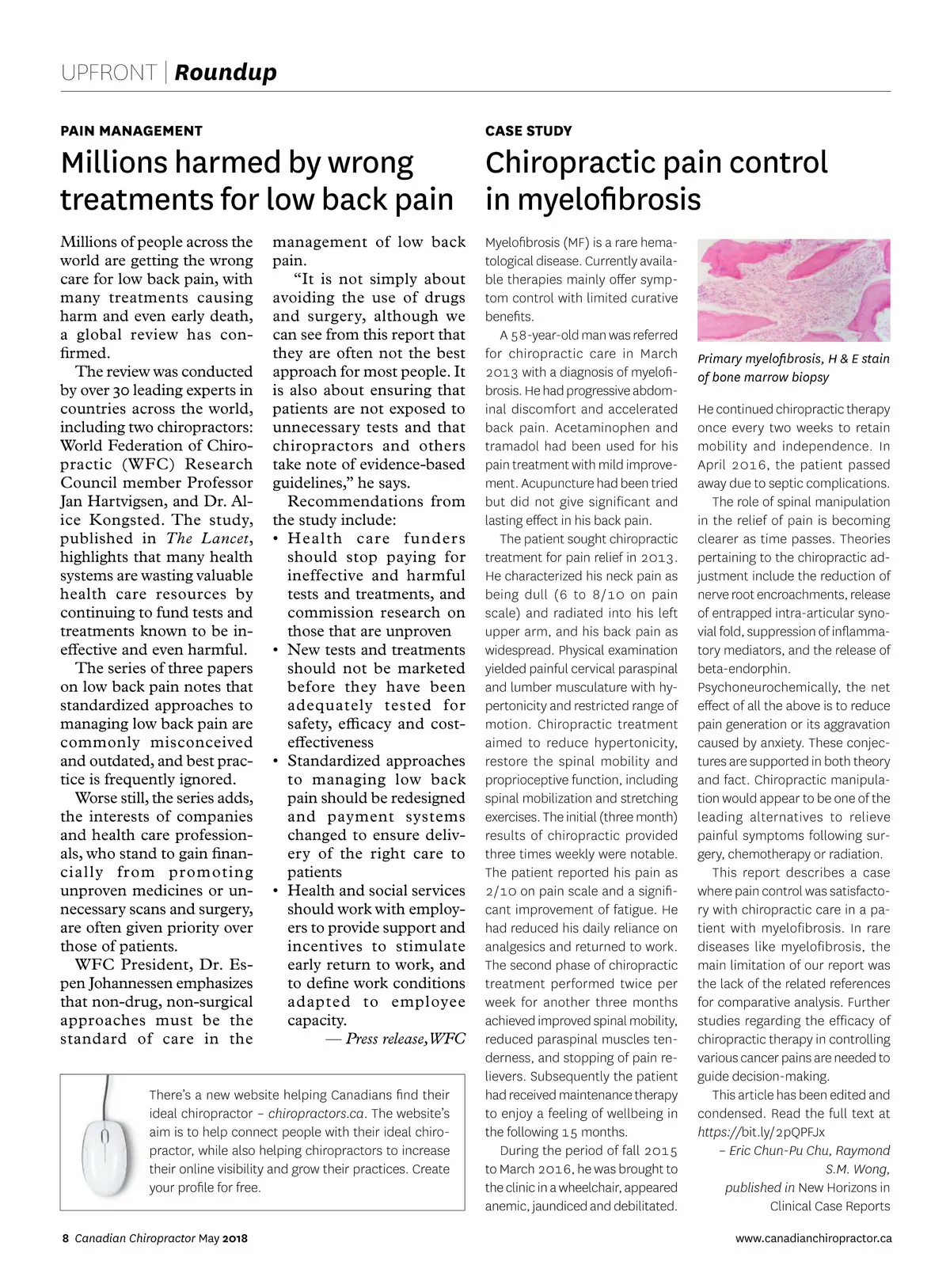
UPFRONT | Roundup PAIN MANAGEMENT Millions harmed by wrong Chiropractic pain control treatments for low back pain in myelofibrosis Millions of people across the world are getting the wrong care for low back pain, with many treatments causing harm and even early death, a global review has con-firmed. The review was conducted by over 30 leading experts in countries across the world, including two chiropractors: World Federation of Chiro-practic (WFC) Research Council member Professor Jan Hartvigsen, and Dr. Al-ice Kongsted. The study, published in The Lancet , highlights that many health systems are wasting valuable health care resources by continuing to fund tests and treatments known to be in-effective and even harmful. The series of three papers on low back pain notes that standardized approaches to managing low back pain are commonly misconceived and outdated, and best prac-tice is frequently ignored. Worse still, the series adds, the interests of companies and health care profession-als, who stand to gain finan-cially from promoting unproven medicines or un-necessary scans and surgery, are often given priority over those of patients. WFC President, Dr. Es-pen Johannessen emphasizes that non-drug, non-surgical approaches must be the standard of care in the management of low back pain. “It is not simply about avoiding the use of drugs and surgery, although we can see from this report that they are often not the best approach for most people. It is also about ensuring that patients are not exposed to unnecessary tests and that chiropractors and others take note of evidence-based guidelines,” he says. Recommendations from the study include: • Health care funders should stop paying for ineffective and harmful tests and treatments, and commission research on those that are unproven • New tests and treatments should not be marketed before they have been adequately tested for safety, efficacy and cost-effectiveness • Standardized approaches to managing low back pain should be redesigned and payment systems changed to ensure deliv-ery of the right care to patients • Health and social services should work with employ-ers to provide support and incentives to stimulate early return to work, and to define work conditions adapted to employee capacity. — Press release, WFC Myelofibrosis (MF) is a rare hema-tological disease. Currently availa-ble therapies mainly offer symp-tom control with limited curative benefits. A 58-year-old man was referred for chiropractic care in March 2013 with a diagnosis of myelofi-brosis. He had progressive abdom-inal discomfort and accelerated back pain. Acetaminophen and tramadol had been used for his pain treatment with mild improve-ment. Acupuncture had been tried but did not give significant and lasting effect in his back pain. The patient sought chiropractic treatment for pain relief in 2013. He characterized his neck pain as being dull (6 to 8/10 on pain scale) and radiated into his left upper arm, and his back pain as widespread. Physical examination yielded painful cervical paraspinal and lumber musculature with hy-pertonicity and restricted range of motion. Chiropractic treatment aimed to reduce hypertonicity, restore the spinal mobility and proprioceptive function, including spinal mobilization and stretching exercises. The initial (three month) results of chiropractic provided three times weekly were notable. The patient reported his pain as 2/10 on pain scale and a signifi-cant improvement of fatigue. He had reduced his daily reliance on analgesics and returned to work. The second phase of chiropractic treatment performed twice per week for another three months achieved improved spinal mobility, reduced paraspinal muscles ten-derness, and stopping of pain re-lievers. Subsequently the patient had received maintenance therapy to enjoy a feeling of wellbeing in the following 15 months. During the period of fall 2015 to March 2016, he was brought to the clinic in a wheelchair, appeared anemic, jaundiced and debilitated. CASE STUDY Primary myelofibrosis, H & E stain of bone marrow biopsy There’s a new website helping Canadians find their ideal chiropractor – chiropractors.ca . The website’s aim is to help connect people with their ideal chiro-practor, while also helping chiropractors to increase their online visibility and grow their practices. Create your profile for free. 8 Canadian Chiropractor May 2018 He continued chiropractic therapy once every two weeks to retain mobility and independence. In April 2016, the patient passed away due to septic complications. The role of spinal manipulation in the relief of pain is becoming clearer as time passes. Theories pertaining to the chiropractic ad-justment include the reduction of nerve root encroachments, release of entrapped intra-articular syno-vial fold, suppression of inflamma-tory mediators, and the release of beta-endorphin. Psychoneurochemically, the net effect of all the above is to reduce pain generation or its aggravation caused by anxiety. These conjec-tures are supported in both theory and fact. Chiropractic manipula-tion would appear to be one of the leading alternatives to relieve painful symptoms following sur-gery, chemotherapy or radiation. This report describes a case where pain control was satisfacto-ry with chiropractic care in a pa-tient with myelofibrosis. In rare diseases like myelofibrosis, the main limitation of our report was the lack of the related references for comparative analysis. Further studies regarding the efficacy of chiropractic therapy in controlling various cancer pains are needed to guide decision-making. This article has been edited and condensed. Read the full text at https:// bit.ly/2pQPFJx – Eric Chun-Pu Chu, Raymond S.M. Wong, published in New Horizons in Clinical Case Reports www.canadianchiropractor.ca
Chiropractic + Naturopathic Doctor May 2018: Page 8