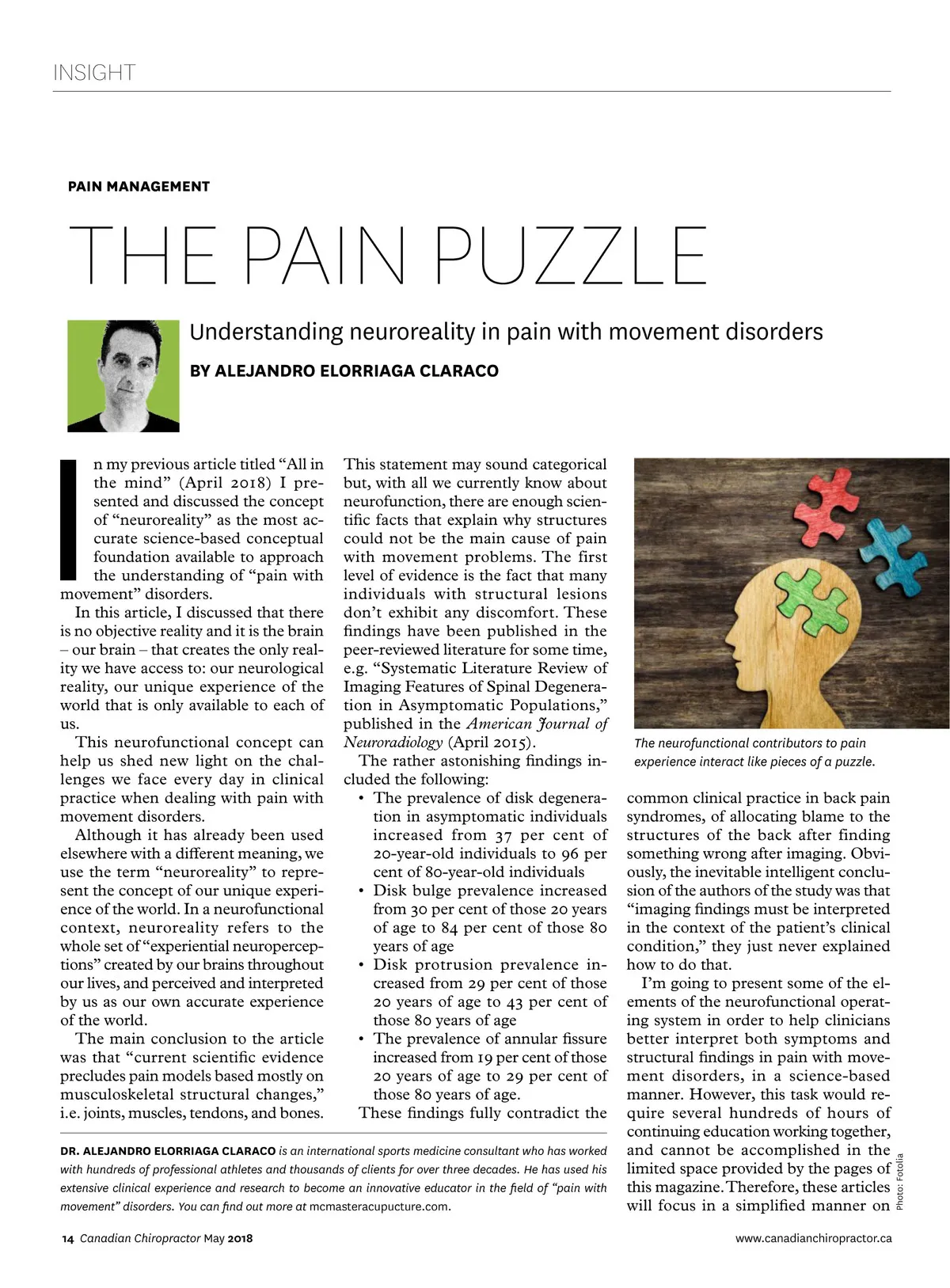
INSIGHT PAIN MANAGEMENT THE PAIN PUZZLE Understanding neuroreality in pain with movement disorders BY ALEJANDRO ELORRIAGA CLARACO I n my previous article titled “All in the mind” (April 2018) I pre-sented and discussed the concept of “neuroreality” as the most ac-curate science-based conceptual foundation available to approach the understanding of “pain with movement” disorders. In this article, I discussed that there is no objective reality and it is the brain – our brain – that creates the only real-ity we have access to: our neurological reality, our unique experience of the world that is only available to each of us. This neurofunctional concept can help us shed new light on the chal-lenges we face every day in clinical practice when dealing with pain with movement disorders. Although it has already been used elsewhere with a different meaning, we use the term “neuroreality” to repre-sent the concept of our unique experi-ence of the world. In a neurofunctional context, neuroreality refers to the whole set of “experiential neuropercep-tions” created by our brains throughout our lives, and perceived and interpreted by us as our own accurate experience of the world. The main conclusion to the article was that “current scientific evidence precludes pain models based mostly on musculoskeletal structural changes,” i.e. joints, muscles, tendons, and bones. This statement may sound categorical but, with all we currently know about neurofunction, there are enough scien-tific facts that explain why structures could not be the main cause of pain with movement problems. The first level of evidence is the fact that many individuals with structural lesions don’t exhibit any discomfort. These findings have been published in the peer-reviewed literature for some time, e.g. “Systematic Literature Review of Imaging Features of Spinal Degenera-tion in Asymptomatic Populations,” published in the American Journal of Neuroradiology (April 2015). The rather astonishing findings in-cluded the following: • The prevalence of disk degenera-tion in asymptomatic individuals increased from 37 per cent of 20-year-old individuals to 96 per cent of 80-year-old individuals • Disk bulge prevalence increased from 30 per cent of those 20 years of age to 84 per cent of those 80 years of age • Disk protrusion prevalence in-creased from 29 per cent of those 20 years of age to 43 per cent of those 80 years of age • The prevalence of annular fissure increased from 19 per cent of those 20 years of age to 29 per cent of those 80 years of age. These findings fully contradict the The neurofunctional contributors to pain experience interact like pieces of a puzzle. DR. ALEJANDRO ELORRIAGA CLARACO is an international sports medicine consultant who has worked with hundreds of professional athletes and thousands of clients for over three decades. He has used his extensive clinical experience and research to become an innovative educator in the field of “pain with movement” disorders. You can find out more at mcmasteracupucture.com. 14 Canadian Chiropractor May 2018 common clinical practice in back pain syndromes, of allocating blame to the structures of the back after finding something wrong after imaging. Obvi-ously, the inevitable intelligent conclu-sion of the authors of the study was that “imaging findings must be interpreted in the context of the patient’s clinical condition,” they just never explained how to do that. I’m going to present some of the el-ements of the neurofunctional operat-ing system in order to help clinicians better interpret both symptoms and structural findings in pain with move-ment disorders, in a science-based manner. However, this task would re-quire several hundreds of hours of continuing education working together, and cannot be accomplished in the limited space provided by the pages of this magazine. Therefore, these articles will focus in a simplified manner on www.canadianchiropractor.ca Photo: Fotolia
Chiropractic + Naturopathic Doctor May 2018: Page 14