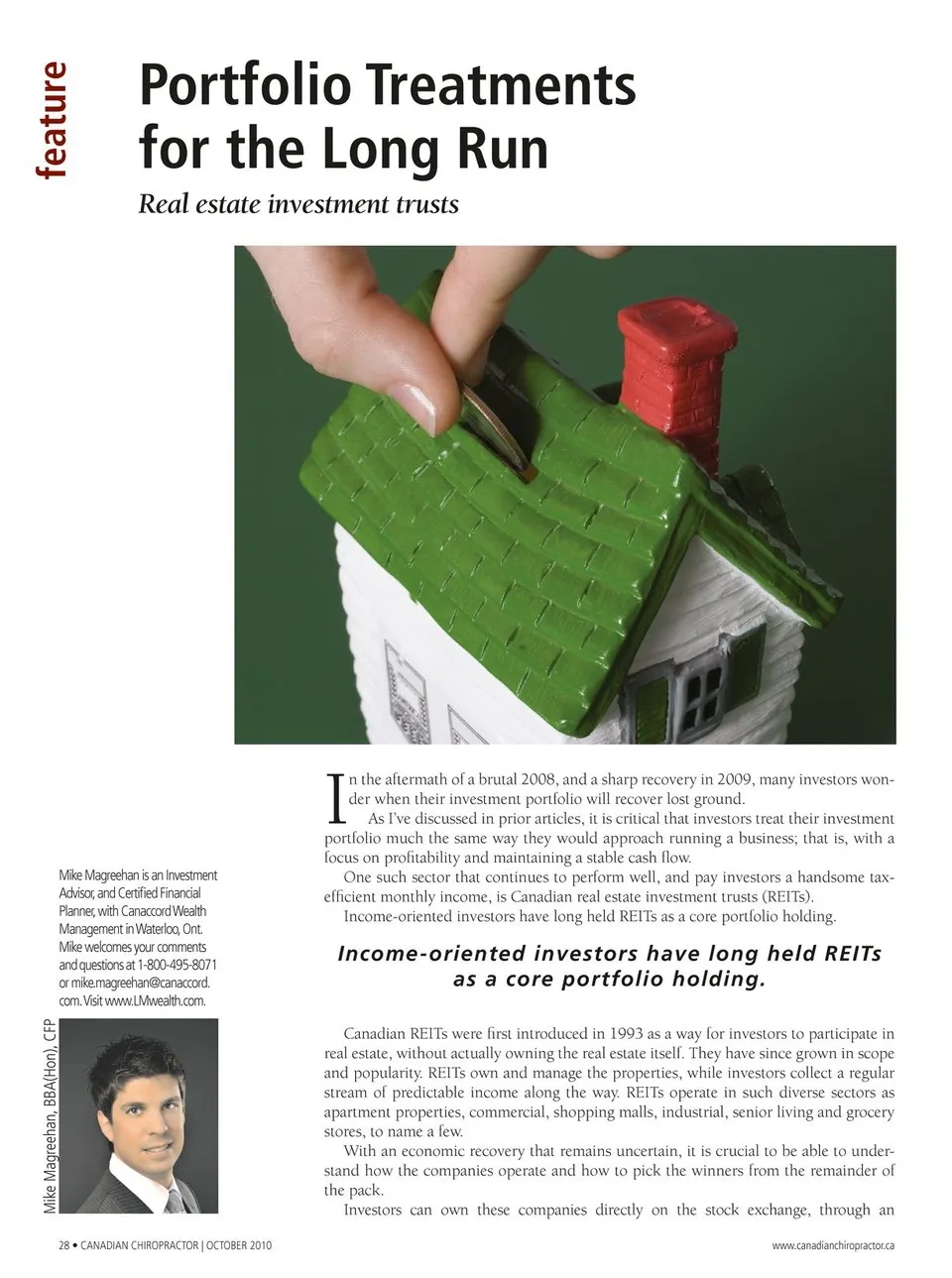
Portfolio Treatments for the Long Run Real estate investment trusts n the aftermath of a brutal 2008, and a sharp recovery in 2009, many investors won-der when their investment portfolio will recover lost ground. As I’ve discussed in prior articles, it is critical that investors treat their investment portfolio much the same way they would approach running a business; that is, with a focus on profitability and maintaining a stable cash flow. I Mike Magreehan is an Investment Advisor,and Certified Financial Planner,with Canaccord Wealth Management in Waterloo,Ont. Mike welcomes your comments and questions at 1-800-495-8071 or mike.magreehan@canaccord. com.Visit www.LMwealth.com. One such sector that continues to perform well, and pay investors a handsome tax-efficient monthly income, is Canadian real estate investment trusts (REITs). Income-oriented investors have long held REITs as a core portfolio holding. Income-oriented investors have long held REITs as a core portfolio holding. Canadian REITs were first introduced in 1993 as a way for investors to participate in real estate, without actually owning the real estate itself. They have since grown in scope and popularity. REITs own and manage the properties, while investors collect a regular stream of predictable income along the way. REITs operate in such diverse sectors as apartment properties, commercial, shopping malls, industrial, senior living and grocery stores, to name a few. With an economic recovery that remains uncertain, it is crucial to be able to under-stand how the companies operate and how to pick the winners from the remainder of the pack. 28 • CANADIAN CHIROPRACTOR | OCTOBER 2010 Investors can own these companies directly on the stock exchange, through an www.canadianchiropractor.ca Mike Magreehan, BBA(Hon), CFP feature
Chiropractic + Naturopathic Doctor October 2010: Page 28