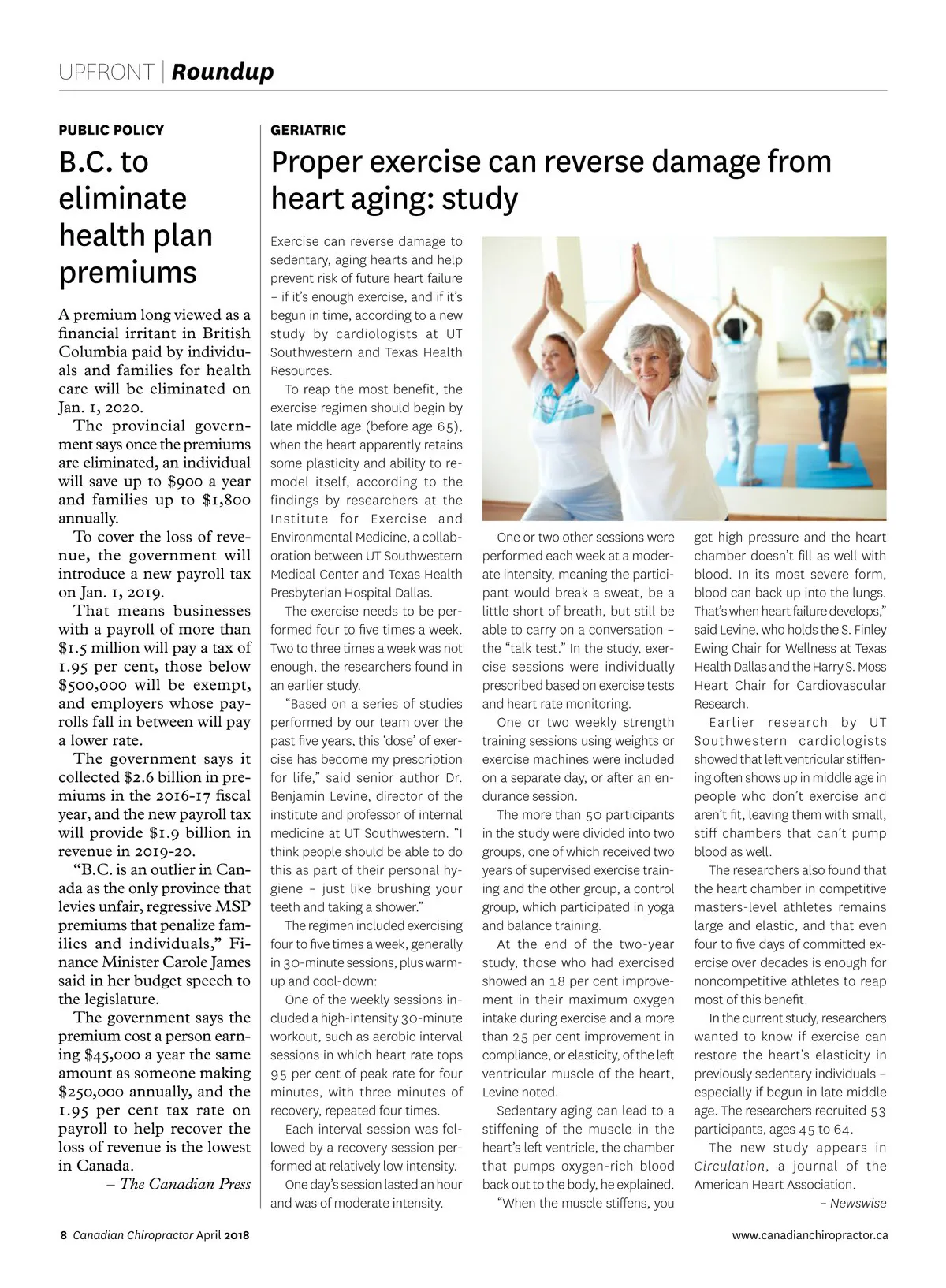
UPFRONT | Roundup PUBLIC POLICY B.C. to eliminate health plan premiums A premium long viewed as a financial irritant in British Columbia paid by individu-als and families for health care will be eliminated on Jan. 1, 2020. The provincial govern-ment says once the premiums are eliminated, an individual will save up to $900 a year and families up to $1,800 annually. To cover the loss of reve-nue, the government will introduce a new payroll tax on Jan. 1, 2019. That means businesses with a payroll of more than $1.5 million will pay a tax of 1.95 per cent, those below $500,000 will be exempt, and employers whose pay-rolls fall in between will pay a lower rate. The government says it collected $2.6 billion in pre-miums in the 2016-17 fiscal year, and the new payroll tax will provide $1.9 billion in revenue in 2019-20. “B.C. is an outlier in Can-ada as the only province that levies unfair, regressive MSP premiums that penalize fam-ilies and individuals,” Fi-nance Minister Carole James said in her budget speech to the legislature. The government says the premium cost a person earn-ing $45,000 a year the same amount as someone making $250,000 annually, and the 1.95 per cent tax rate on payroll to help recover the loss of revenue is the lowest in Canada. – The Canadian Press 8 Canadian Chiropractor April 2018 GERIATRIC Proper exercise can reverse damage from heart aging: study Exercise can reverse damage to sedentary, aging hearts and help prevent risk of future heart failure – if it’s enough exercise, and if it’s begun in time, according to a new study by cardiologists at UT Southwestern and Texas Health Resources. To reap the most benefit, the exercise regimen should begin by late middle age (before age 65), when the heart apparently retains some plasticity and ability to re-model itself, according to the findings by researchers at the Institute for Exercise and Environmental Medicine, a collab-oration between UT Southwestern Medical Center and Texas Health Presbyterian Hospital Dallas. The exercise needs to be per-formed four to five times a week. Two to three times a week was not enough, the researchers found in an earlier study. “Based on a series of studies performed by our team over the past five years, this ‘dose’ of exer-cise has become my prescription for life,” said senior author Dr. Benjamin Levine, director of the institute and professor of internal medicine at UT Southwestern. “I think people should be able to do this as part of their personal hy-giene – just like brushing your teeth and taking a shower.” The regimen included exercising four to five times a week, generally in 30-minute sessions, plus warm-up and cool-down: One of the weekly sessions in-cluded a high-intensity 30-minute workout, such as aerobic interval sessions in which heart rate tops 95 per cent of peak rate for four minutes, with three minutes of recovery, repeated four times. Each interval session was fol-lowed by a recovery session per-formed at relatively low intensity. One day’s session lasted an hour and was of moderate intensity. One or two other sessions were performed each week at a moder-ate intensity, meaning the partici-pant would break a sweat, be a little short of breath, but still be able to carry on a conversation – the “talk test.” In the study, exer-cise sessions were individually prescribed based on exercise tests and heart rate monitoring. One or two weekly strength training sessions using weights or exercise machines were included on a separate day, or after an en-durance session. The more than 50 participants in the study were divided into two groups, one of which received two years of supervised exercise train-ing and the other group, a control group, which participated in yoga and balance training. At the end of the two-year study, those who had exercised showed an 18 per cent improve-ment in their maximum oxygen intake during exercise and a more than 25 per cent improvement in compliance, or elasticity, of the left ventricular muscle of the heart, Levine noted. Sedentary aging can lead to a stiffening of the muscle in the heart’s left ventricle, the chamber that pumps oxygen-rich blood back out to the body, he explained. “When the muscle stiffens, you get high pressure and the heart chamber doesn’t fill as well with blood. In its most severe form, blood can back up into the lungs. That’s when heart failure develops,” said Levine, who holds the S. Finley Ewing Chair for Wellness at Texas Health Dallas and the Harry S. Moss Heart Chair for Cardiovascular Research. Earlier research by UT Southwestern cardiologists showed that left ventricular stiffen-ing often shows up in middle age in people who don’t exercise and aren’t fit, leaving them with small, stiff chambers that can’t pump blood as well. The researchers also found that the heart chamber in competitive masters-level athletes remains large and elastic, and that even four to five days of committed ex-ercise over decades is enough for noncompetitive athletes to reap most of this benefit. In the current study, researchers wanted to know if exercise can restore the heart’s elasticity in previously sedentary individuals – especially if begun in late middle age. The researchers recruited 53 participants, ages 45 to 64. The new study appears in Circulation, a journal of the American Heart Association. – Newswise www.canadianchiropractor.ca
Chiropractic + Naturopathic Doctor April 2018: Page 8