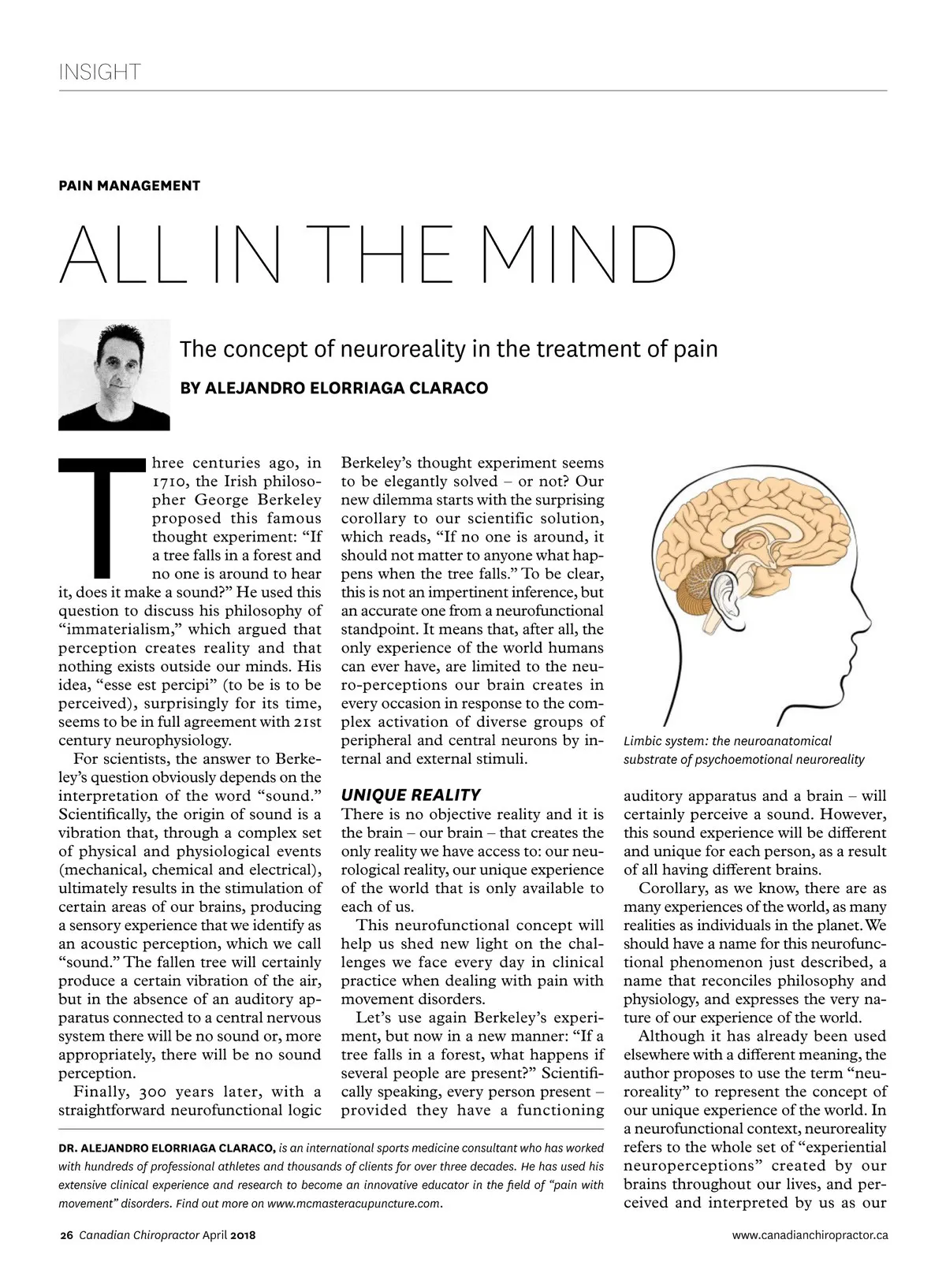
The concept of neuroreality precludes the long-held idea of pain as the objective reflection of a structural phenomenon. own accurate experience of the world. Not surprisingly, many contemporary models of brain function and conscious-ness have incorporated the concept of neuroreality, albeit using other termi-nology. For instance, Ronald Melzack’s neuromatrix theory in 1990 represents the “individual widespread neuronal activation associated to every pain ex-perience, acute or chronic.” The concept of neuroreality pre-sented in this article extends beyond the experience of pain, and attempts to become the foundational neurofunc-tional principle that represents the nature of our rather deceiving relation-ship with the world. Whatever we per-ceive is real to us, pain and pleasure alike, regardless of other people’s own perceptions, opinions, beliefs or ideas. PAIN PROBLEM Our individual neuroreality is built over a lifetime of conscious neuroper-ceptions generated by a myriad of ex-ternal and internal stimuli, such as www.canadianchiropractor.ca thoughts (personal or from others), emotions (pain, fear and pleasure mostly), and sensory perceptions (smell, touch, sound, sight, taste, tem-perature, vibration, etc.). The problem with the nature of neuroreality is that it conditions itself, i.e. it conditions the processing of new stimuli, giving every new experience or perception a bio-graphical and cultural dimension, in-cluding the experience of pain. The concept of neuroreality serves not only to validate Berkeley’s idea of a subjective universe but, at the same time and more importantly, it serves to liberate us from the tyranny of the structure that has dominated pain medicine for the most part of the his-tory of medicine. In a nutshell, over 2,500 years of philosophical adherence to a non-ex-istent objective universe, plus the re-ductionist view of the human body as a mechanism – instead of a complex biological system with mechanical and other dimensions – have led medicine in general and pain medicine in par-ticular to a linear (and often unidimen-sional) therapeutic approach, based on the principle of causality. This approach has often led to the search of single causes and single inter-ventions to treat pain problems. In this manner, particular structures have been signaled as the cause of specific pain problems, e.g. intervertebral discs, zygapophyseal joints, trochanteric bur-sae, subacromial or deltoid bursae, carpal tunnels/median nerves, thoracic outlets, sciatic nerves, plantar fasciae, iliotibial bands, and many others. The failure in resolving the pain problem when treating the offending structure, or worse, the existence of many people walking the streets with the same faulty structure but not symptoms, have not yet deterred main stream medicine from using this belief-based diagnostic system, where the structure is deemed to be the cause of the pain problem. As we all know, ignoring the concept of neuroreality in general and the April 2018 Canadian Chiropractor 27
Chiropractic + Naturopathic Doctor April 2018: Page 27