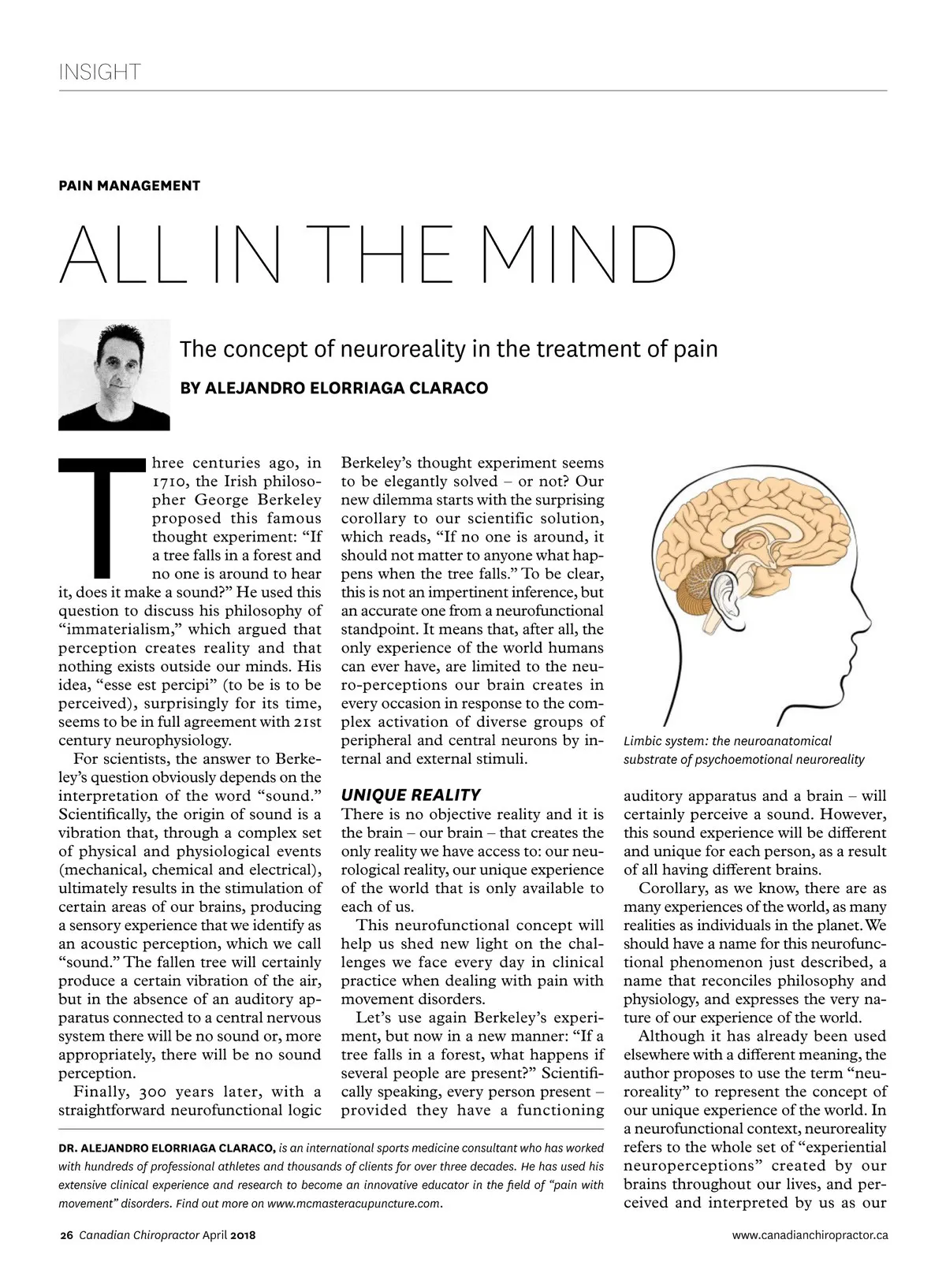
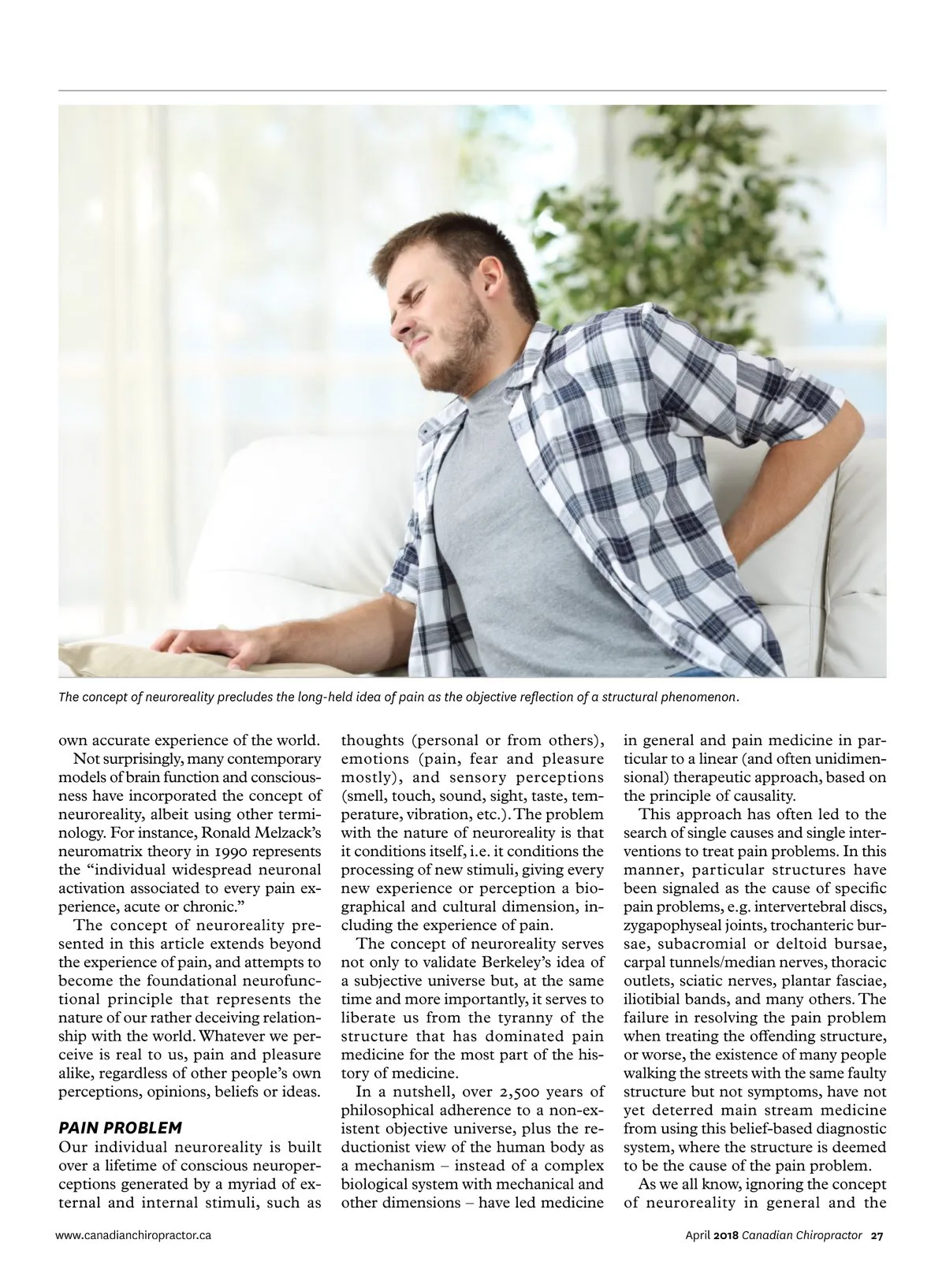
INSIGHT PAIN MANAGEMENT ALL IN THE MIND The concept of neuroreality in the treatment of pain T BY ALEJANDRO ELORRIAGA CLARACO hree centuries ago, in 1710, the Irish philoso-pher George Berkeley proposed this famous thought experiment: “If a tree falls in a forest and no one is around to hear it, does it make a sound?” He used this question to discuss his philosophy of “immaterialism,” which argued that perception creates reality and that nothing exists outside our minds. His idea, “esse est percipi” (to be is to be perceived), surprisingly for its time, seems to be in full agreement with 21st century neurophysiology. For scientists, the answer to Berke-ley’s question obviously depends on the interpretation of the word “sound.” Scientifically, the origin of sound is a vibration that, through a complex set of physical and physiological events (mechanical, chemical and electrical), ultimately results in the stimulation of certain areas of our brains, producing a sensory experience that we identify as an acoustic perception, which we call “sound.” The fallen tree will certainly produce a certain vibration of the air, but in the absence of an auditory ap-paratus connected to a central nervous system there will be no sound or, more appropriately, there will be no sound perception. Finally, 300 years later, with a straightforward neurofunctional logic Berkeley’s thought experiment seems to be elegantly solved – or not? Our new dilemma starts with the surprising corollary to our scientific solution, which reads, “If no one is around, it should not matter to anyone what hap-pens when the tree falls.” To be clear, this is not an impertinent inference, but an accurate one from a neurofunctional standpoint. It means that, after all, the only experience of the world humans can ever have, are limited to the neu-ro-perceptions our brain creates in every occasion in response to the com-plex activation of diverse groups of peripheral and central neurons by in-ternal and external stimuli. There is no objective reality and it is the brain – our brain – that creates the only reality we have access to: our neu-rological reality, our unique experience of the world that is only available to each of us. This neurofunctional concept will help us shed new light on the chal-lenges we face every day in clinical practice when dealing with pain with movement disorders. Let’s use again Berkeley’s experi-ment, but now in a new manner: “If a tree falls in a forest, what happens if several people are present?” Scientifi-cally speaking, every person present – provided they have a functioning Limbic system: the neuroanatomical substrate of psychoemotional neuroreality UNIQUE REALITY DR. ALEJANDRO ELORRIAGA CLARACO, is an international sports medicine consultant who has worked with hundreds of professional athletes and thousands of clients for over three decades. He has used his extensive clinical experience and research to become an innovative educator in the field of “pain with movement” disorders. Find out more on www.mcmasteracupuncture.com. 26 Canadian Chiropractor April 2018 auditory apparatus and a brain – will certainly perceive a sound. However, this sound experience will be different and unique for each person, as a result of all having different brains. Corollary, as we know, there are as many experiences of the world, as many realities as individuals in the planet. We should have a name for this neurofunc-tional phenomenon just described, a name that reconciles philosophy and physiology, and expresses the very na-ture of our experience of the world. Although it has already been used elsewhere with a different meaning, the author proposes to use the term “neu-roreality” to represent the concept of our unique experience of the world. In a neurofunctional context, neuroreality refers to the whole set of “experiential neuroperceptions” created by our brains throughout our lives, and per-ceived and interpreted by us as our www.canadianchiropractor.ca
Chiropractic + Naturopathic Doctor April 2018: Page 26