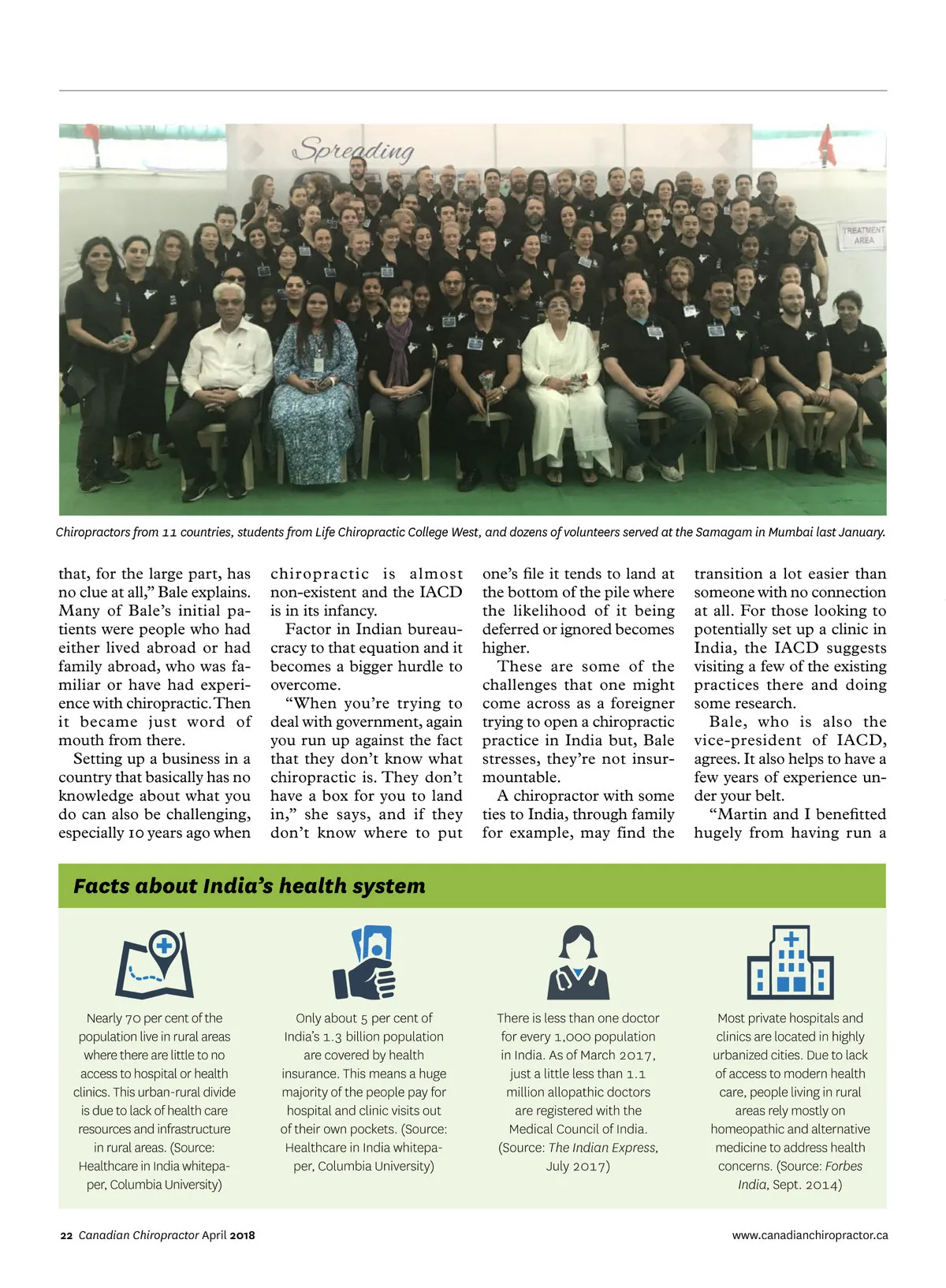
Chiropractors from 11 countries, students from Life Chiropractic College West, and dozens of volunteers served at the Samagam in Mumbai last January. that, for the large part, has no clue at all,” Bale explains. Many of Bale’s initial pa-tients were people who had either lived abroad or had family abroad, who was fa-miliar or have had experi-ence with chiropractic. Then it became just word of mouth from there. Setting up a business in a country that basically has no knowledge about what you do can also be challenging, especially 10 years ago when chiropractic is almost non-existent and the IACD is in its infancy. Factor in Indian bureau-cracy to that equation and it becomes a bigger hurdle to overcome. “When you’re trying to deal with government, again you run up against the fact that they don’t know what chiropractic is. They don’t have a box for you to land in,” she says, and if they don’t know where to put one’s file it tends to land at the bottom of the pile where the likelihood of it being deferred or ignored becomes higher. These are some of the challenges that one might come across as a foreigner trying to open a chiropractic practice in India but, Bale stresses, they’re not insur-mountable. A chiropractor with some ties to India, through family for example, may find the transition a lot easier than someone with no connection at all. For those looking to potentially set up a clinic in India, the IACD suggests visiting a few of the existing practices there and doing some research. Bale, who is also the vice-president of IACD, agrees. It also helps to have a few years of experience un-der your belt. “Martin and I benefitted hugely from having run a Facts about India’s health system Nearly 70 per cent of the population live in rural areas where there are little to no access to hospital or health clinics. This urban-rural divide is due to lack of health care resources and infrastructure in rural areas. (Source: Healthcare in India whitepa-per, Columbia University) 22 Canadian Chiropractor April 2018 Only about 5 per cent of India’s 1.3 billion population are covered by health insurance. This means a huge majority of the people pay for hospital and clinic visits out of their own pockets. (Source: Healthcare in India whitepa-per, Columbia University) There is less than one doctor for every 1,000 population in India. As of March 2017, just a little less than 1.1 million allopathic doctors are registered with the Medical Council of India. (Source: The Indian Express, July 2017) Most private hospitals and clinics are located in highly urbanized cities. Due to lack of access to modern health care, people living in rural areas rely mostly on homeopathic and alternative medicine to address health concerns. (Source: Forbes India, Sept. 2014) www.canadianchiropractor.ca
Chiropractic + Naturopathic Doctor April 2018: Page 22