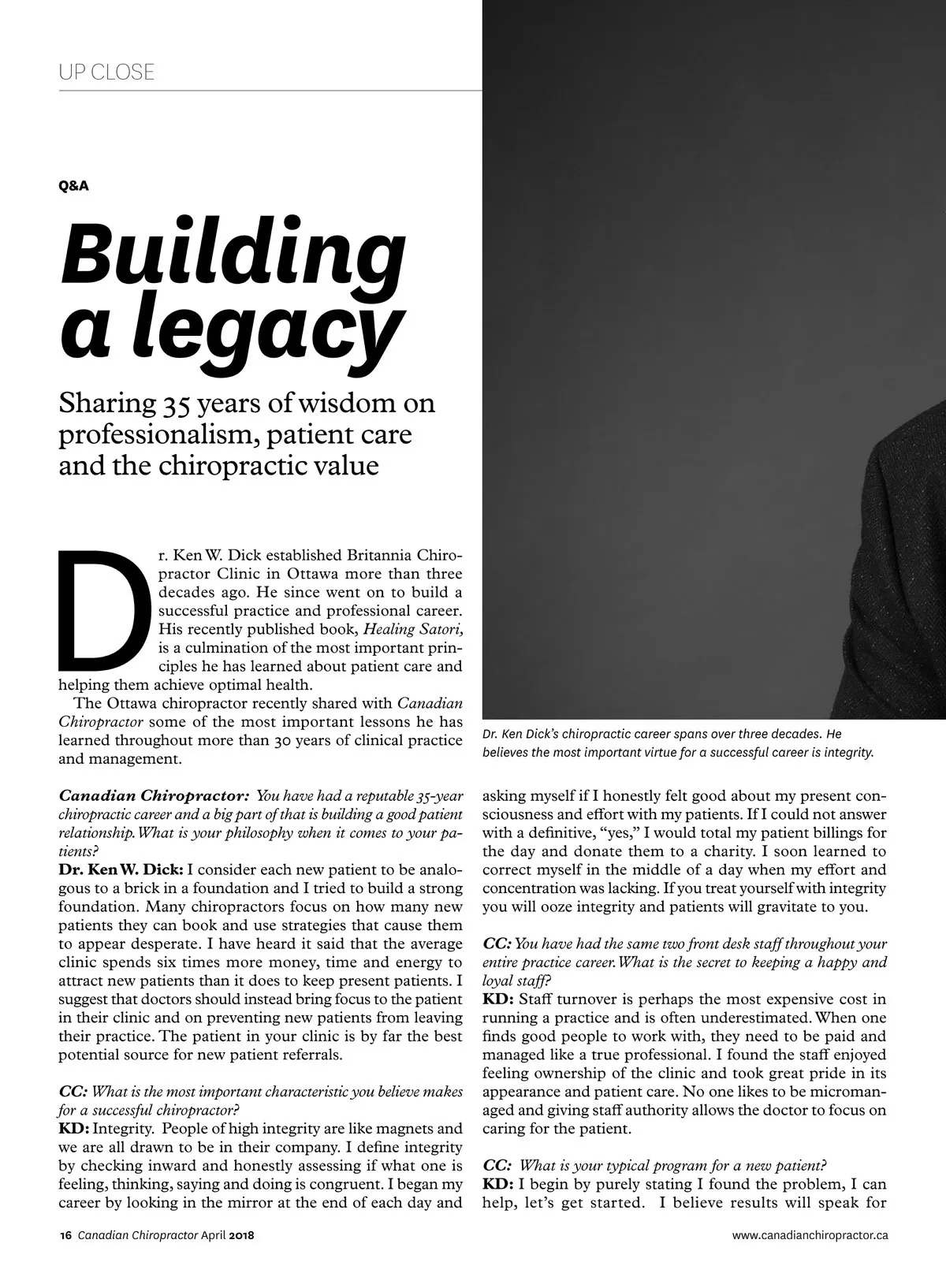
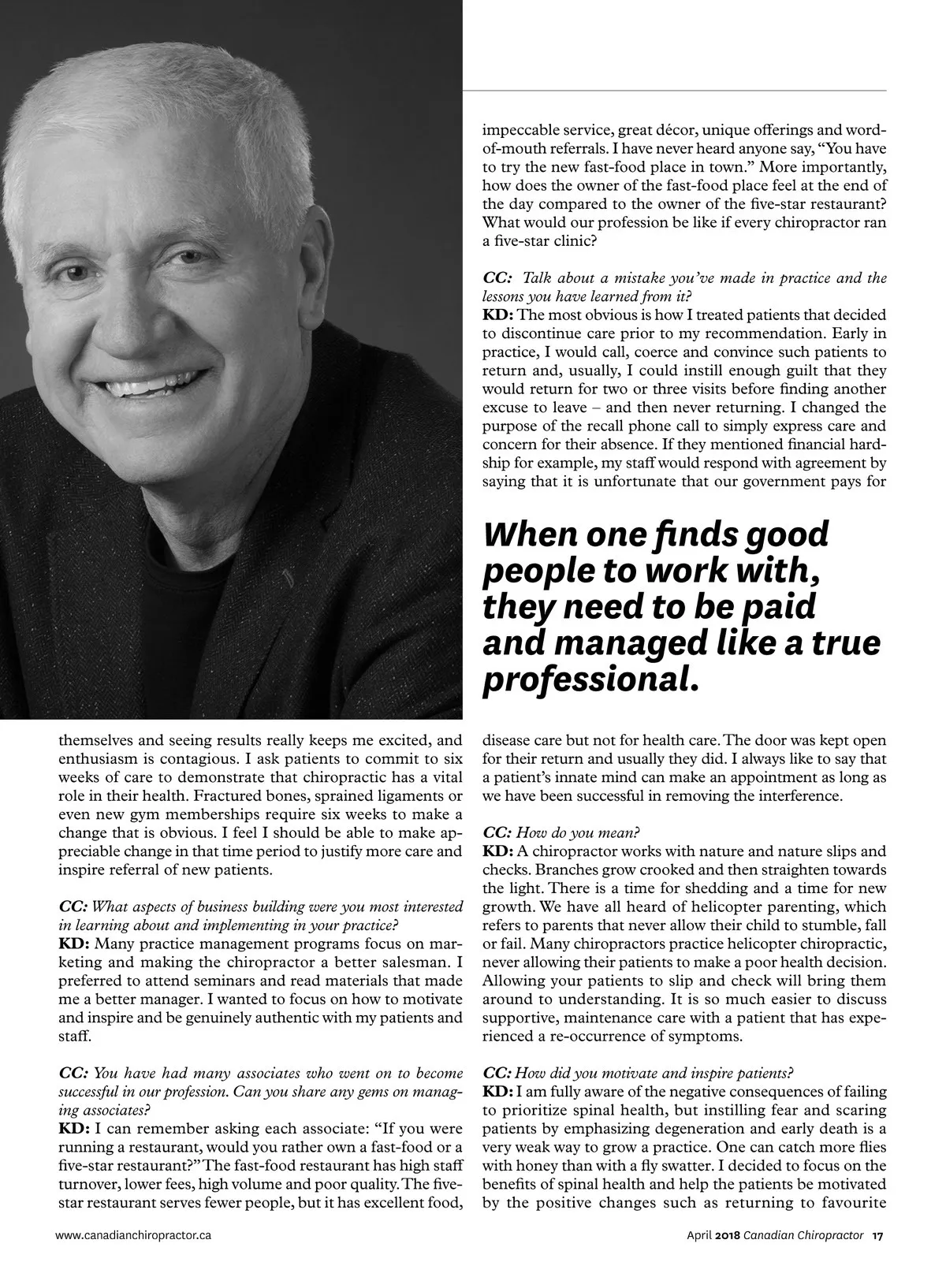
impeccable service, great décor, unique offerings and word-of-mouth referrals. I have never heard anyone say, “You have to try the new fast-food place in town.” More importantly, how does the owner of the fast-food place feel at the end of the day compared to the owner of the five-star restaurant? What would our profession be like if every chiropractor ran a five-star clinic? CC: Talk about a mistake you’ve made in practice and the lessons you have learned from it? KD: The most obvious is how I treated patients that decided to discontinue care prior to my recommendation. Early in practice, I would call, coerce and convince such patients to return and, usually, I could instill enough guilt that they would return for two or three visits before finding another excuse to leave – and then never returning. I changed the purpose of the recall phone call to simply express care and concern for their absence. If they mentioned financial hard-ship for example, my staff would respond with agreement by saying that it is unfortunate that our government pays for When one finds good people to work with, they need to be paid and managed like a true professional. themselves and seeing results really keeps me excited, and enthusiasm is contagious. I ask patients to commit to six weeks of care to demonstrate that chiropractic has a vital role in their health. Fractured bones, sprained ligaments or even new gym memberships require six weeks to make a change that is obvious. I feel I should be able to make ap-preciable change in that time period to justify more care and inspire referral of new patients. CC: What aspects of business building were you most interested in learning about and implementing in your practice? KD: Many practice management programs focus on mar-keting and making the chiropractor a better salesman. I preferred to attend seminars and read materials that made me a better manager. I wanted to focus on how to motivate and inspire and be genuinely authentic with my patients and staff. CC: You have had many associates who went on to become successful in our profession. Can you share any gems on manag-ing associates? KD: I can remember asking each associate: “If you were running a restaurant, would you rather own a fast-food or a five-star restaurant?” The fast-food restaurant has high staff turnover, lower fees, high volume and poor quality. The five-star restaurant serves fewer people, but it has excellent food, www.canadianchiropractor.ca disease care but not for health care. The door was kept open for their return and usually they did. I always like to say that a patient’s innate mind can make an appointment as long as we have been successful in removing the interference. CC: How do you mean? KD: A chiropractor works with nature and nature slips and checks. Branches grow crooked and then straighten towards the light. There is a time for shedding and a time for new growth. We have all heard of helicopter parenting, which refers to parents that never allow their child to stumble, fall or fail. Many chiropractors practice helicopter chiropractic, never allowing their patients to make a poor health decision. Allowing your patients to slip and check will bring them around to understanding. It is so much easier to discuss supportive, maintenance care with a patient that has expe-rienced a re-occurrence of symptoms. CC: How did you motivate and inspire patients? KD: I am fully aware of the negative consequences of failing to prioritize spinal health, but instilling fear and scaring patients by emphasizing degeneration and early death is a very weak way to grow a practice. One can catch more flies with honey than with a fly swatter. I decided to focus on the benefits of spinal health and help the patients be motivated by the positive changes such as returning to favourite April 2018 Canadian Chiropractor 17
Chiropractic + Naturopathic Doctor April 2018: Page 17