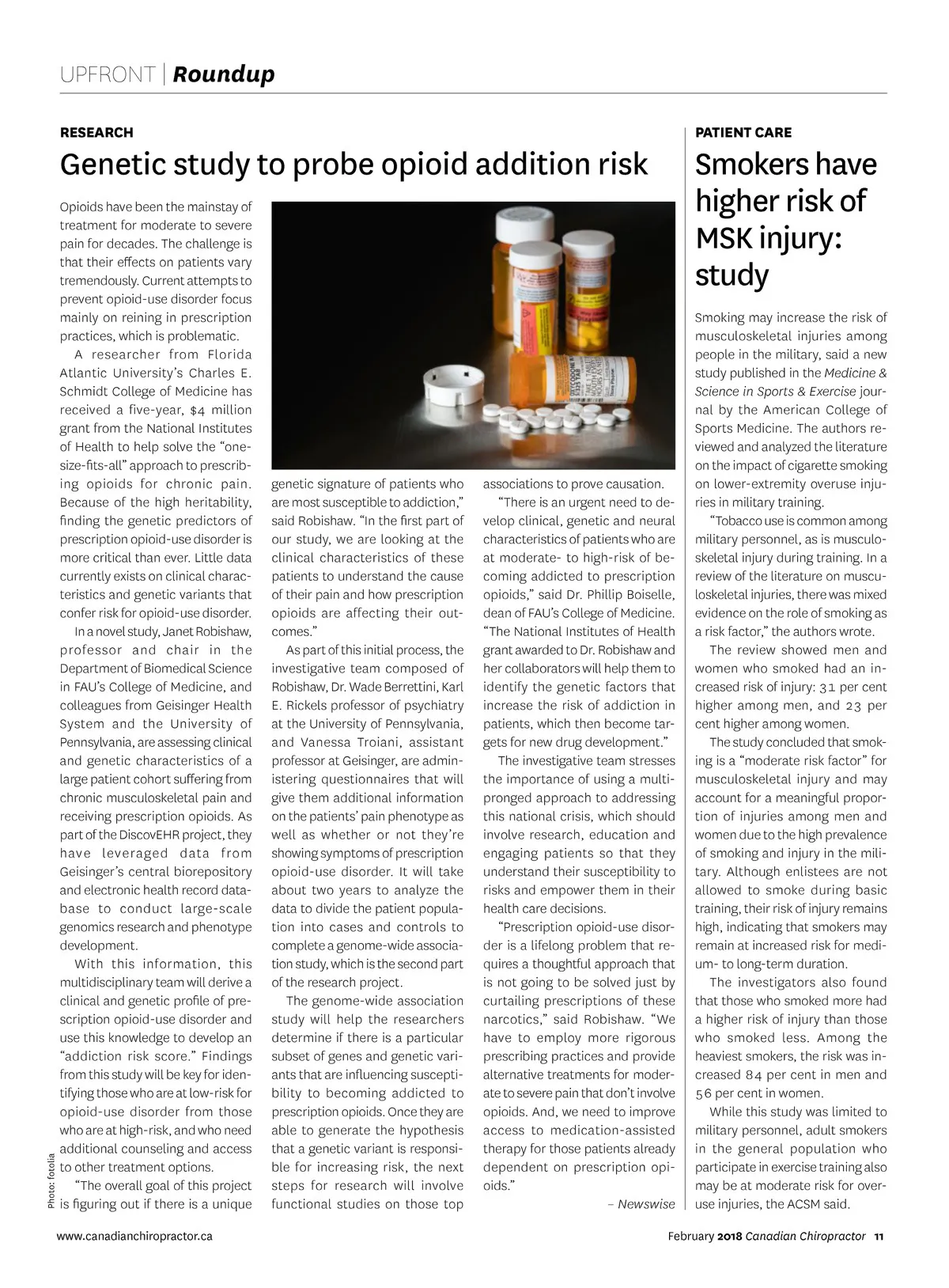
UPFRONT | Roundup RESEARCH Genetic study to probe opioid addition risk Opioids have been the mainstay of treatment for moderate to severe pain for decades. The challenge is that their effects on patients vary tremendously. Current attempts to prevent opioid-use disorder focus mainly on reining in prescription practices, which is problematic. A researcher from Florida Atlantic University’s Charles E. Schmidt College of Medicine has received a five-year, $4 million grant from the National Institutes of Health to help solve the “one-size-fits-all” approach to prescrib-ing opioids for chronic pain. Because of the high heritability, finding the genetic predictors of prescription opioid-use disorder is more critical than ever. Little data currently exists on clinical charac-teristics and genetic variants that confer risk for opioid-use disorder. In a novel study, Janet Robishaw, professor and chair in the Department of Biomedical Science in FAU’s College of Medicine, and colleagues from Geisinger Health System and the University of Pennsylvania, are assessing clinical and genetic characteristics of a large patient cohort suffering from chronic musculoskeletal pain and receiving prescription opioids. As part of the DiscovEHR project, they have leveraged data from Geisinger’s central biorepository and electronic health record data-base to conduct large-scale genomics research and phenotype development. With this information, this multidisciplinary team will derive a clinical and genetic profile of pre-scription opioid-use disorder and use this knowledge to develop an “addiction risk score.” Findings from this study will be key for iden-tifying those who are at low-risk for opioid-use disorder from those who are at high-risk, and who need additional counseling and access to other treatment options. “The overall goal of this project is figuring out if there is a unique www.canadianchiropractor.ca Smokers have higher risk of MSK injury: study Smoking may increase the risk of musculoskeletal injuries among people in the military, said a new study published in the Medicine & Science in Sports & Exercise jour-nal by the American College of Sports Medicine. The authors re-viewed and analyzed the literature on the impact of cigarette smoking on lower-extremity overuse inju-ries in military training. “Tobacco use is common among military personnel, as is musculo-skeletal injury during training. In a review of the literature on muscu-loskeletal injuries, there was mixed evidence on the role of smoking as a risk factor,” the authors wrote. The review showed men and women who smoked had an in-creased risk of injury: 31 per cent higher among men, and 23 per cent higher among women. The study concluded that smok-ing is a “moderate risk factor” for musculoskeletal injury and may account for a meaningful propor-tion of injuries among men and women due to the high prevalence of smoking and injury in the mili-tary. Although enlistees are not allowed to smoke during basic training, their risk of injury remains high, indicating that smokers may remain at increased risk for medi-um-to long-term duration. The investigators also found that those who smoked more had a higher risk of injury than those who smoked less. Among the heaviest smokers, the risk was in-creased 84 per cent in men and 56 per cent in women. While this study was limited to military personnel, adult smokers in the general population who participate in exercise training also may be at moderate risk for over-use injuries, the ACSM said. PATIENT CARE genetic signature of patients who are most susceptible to addiction,” said Robishaw. “In the first part of our study, we are looking at the clinical characteristics of these patients to understand the cause of their pain and how prescription opioids are affecting their out-comes.” As part of this initial process, the investigative team composed of Robishaw, Dr. Wade Berrettini, Karl E. Rickels professor of psychiatry at the University of Pennsylvania, and Vanessa Troiani, assistant professor at Geisinger, are admin-istering questionnaires that will give them additional information on the patients’ pain phenotype as well as whether or not they’re showing symptoms of prescription opioid-use disorder. It will take about two years to analyze the data to divide the patient popula-tion into cases and controls to complete a genome-wide associa-tion study, which is the second part of the research project. The genome-wide association study will help the researchers determine if there is a particular subset of genes and genetic vari-ants that are influencing suscepti-bility to becoming addicted to prescription opioids. Once they are able to generate the hypothesis that a genetic variant is responsi-ble for increasing risk, the next steps for research will involve functional studies on those top associations to prove causation. “There is an urgent need to de-velop clinical, genetic and neural characteristics of patients who are at moderate-to high-risk of be-coming addicted to prescription opioids,” said Dr. Phillip Boiselle, dean of FAU’s College of Medicine. “The National Institutes of Health grant awarded to Dr. Robishaw and her collaborators will help them to identify the genetic factors that increase the risk of addiction in patients, which then become tar-gets for new drug development.” The investigative team stresses the importance of using a multi-pronged approach to addressing this national crisis, which should involve research, education and engaging patients so that they understand their susceptibility to risks and empower them in their health care decisions. “Prescription opioid-use disor-der is a lifelong problem that re-quires a thoughtful approach that is not going to be solved just by curtailing prescriptions of these narcotics,” said Robishaw. “We have to employ more rigorous prescribing practices and provide alternative treatments for moder-ate to severe pain that don’t involve opioids. And, we need to improve access to medication-assisted therapy for those patients already dependent on prescription opi-oids.” – Newswise Photo: fotolia February 2018 Canadian Chiropractor 11
Chiropractic + Naturopathic Doctor February 2018: Page 11