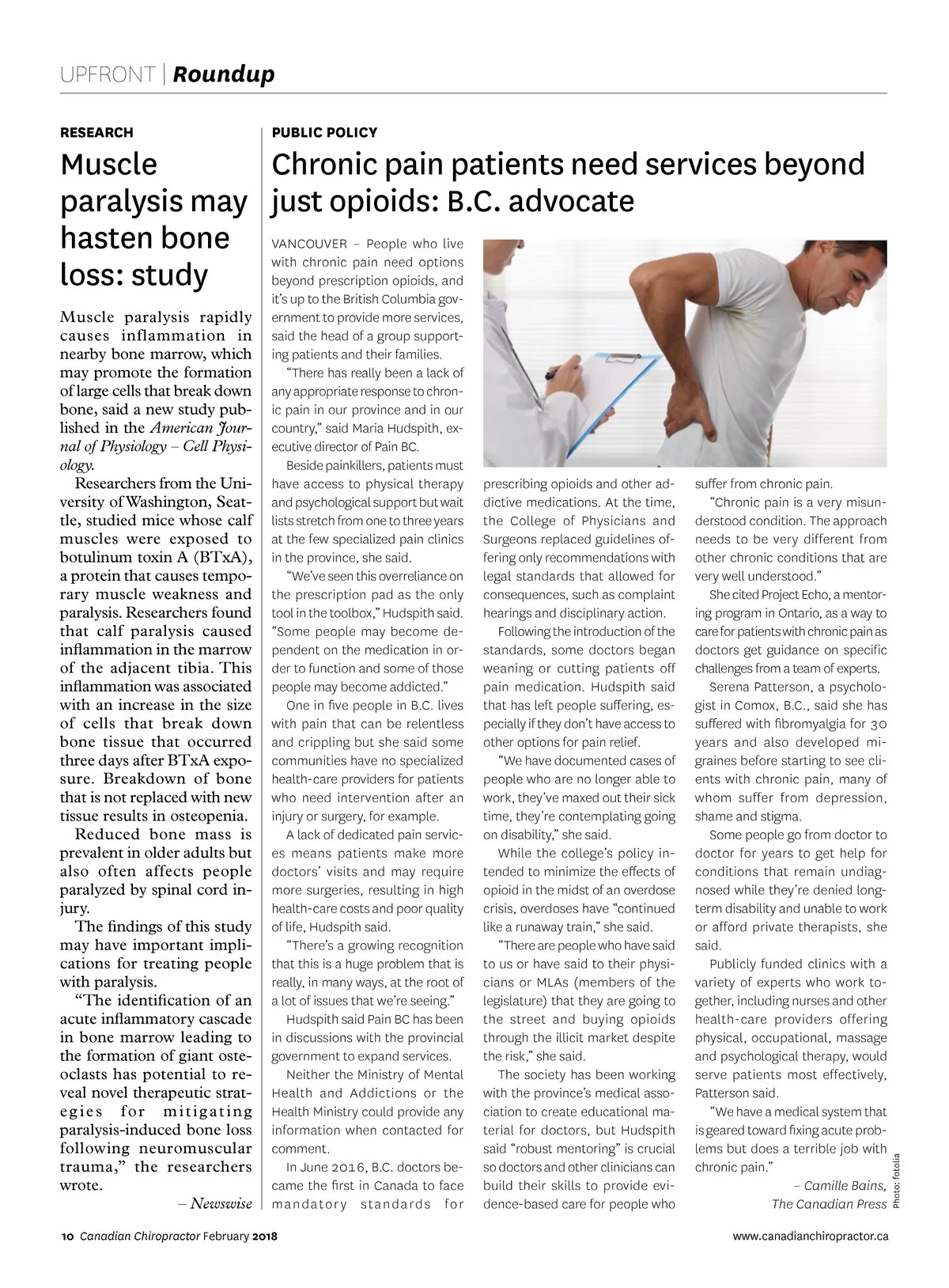
UPFRONT | Roundup RESEARCH Muscle Chronic pain patients need services beyond paralysis may just opioids: B.C. advocate hasten bone VANCOUVER – People who live with chronic pain need options loss: study beyond prescription opioids, and Muscle paralysis rapidly causes inflammation in nearby bone marrow, which may promote the formation of large cells that break down bone, said a new study pub-lished in the American Jour-nal of Physiology – Cell Physi-ology. Researchers from the Uni-versity of Washington, Seat-tle, studied mice whose calf muscles were exposed to botulinum toxin A (BTxA), a protein that causes tempo-rary muscle weakness and paralysis. Researchers found that calf paralysis caused inflammation in the marrow of the adjacent tibia. This inflammation was associated with an increase in the size of cells that break down bone tissue that occurred three days after BTxA expo-sure. Breakdown of bone that is not replaced with new tissue results in osteopenia. Reduced bone mass is prevalent in older adults but also often affects people paralyzed by spinal cord in-jury. The findings of this study may have important impli-cations for treating people with paralysis. “The identification of an acute inflammatory cascade in bone marrow leading to the formation of giant oste-oclasts has potential to re-veal novel therapeutic strat-egies for mitigating paralysis-induced bone loss following neuromuscular trauma,” the researchers wrote. – Newswise it’s up to the British Columbia gov-ernment to provide more services, said the head of a group support-ing patients and their families. “There has really been a lack of any appropriate response to chron-ic pain in our province and in our country,” said Maria Hudspith, ex-ecutive director of Pain BC. Beside painkillers, patients must have access to physical therapy and psychological support but wait lists stretch from one to three years at the few specialized pain clinics in the province, she said. “We’ve seen this overreliance on the prescription pad as the only tool in the toolbox,” Hudspith said. “Some people may become de-pendent on the medication in or-der to function and some of those people may become addicted.” One in five people in B.C. lives with pain that can be relentless and crippling but she said some communities have no specialized health-care providers for patients who need intervention after an injury or surgery, for example. A lack of dedicated pain servic-es means patients make more doctors’ visits and may require more surgeries, resulting in high health-care costs and poor quality of life, Hudspith said. “There’s a growing recognition that this is a huge problem that is really, in many ways, at the root of a lot of issues that we’re seeing.” Hudspith said Pain BC has been in discussions with the provincial government to expand services. Neither the Ministry of Mental Health and Addictions or the Health Ministry could provide any information when contacted for comment. In June 2016, B.C. doctors be-came the first in Canada to face mandatory standards for PUBLIC POLICY prescribing opioids and other ad-dictive medications. At the time, the College of Physicians and Surgeons replaced guidelines of-fering only recommendations with legal standards that allowed for consequences, such as complaint hearings and disciplinary action. Following the introduction of the standards, some doctors began weaning or cutting patients off pain medication. Hudspith said that has left people suffering, es-pecially if they don’t have access to other options for pain relief. “We have documented cases of people who are no longer able to work, they’ve maxed out their sick time, they’re contemplating going on disability,” she said. While the college’s policy in-tended to minimize the effects of opioid in the midst of an overdose crisis, overdoses have “continued like a runaway train,” she said. “There are people who have said to us or have said to their physi-cians or MLAs (members of the legislature) that they are going to the street and buying opioids through the illicit market despite the risk,” she said. The society has been working with the province’s medical asso-ciation to create educational ma-terial for doctors, but Hudspith said “robust mentoring” is crucial so doctors and other clinicians can build their skills to provide evi-dence-based care for people who suffer from chronic pain. “Chronic pain is a very misun-derstood condition. The approach needs to be very different from other chronic conditions that are very well understood.” She cited Project Echo, a mentor-ing program in Ontario, as a way to care for patients with chronic pain as doctors get guidance on specific challenges from a team of experts. Serena Patterson, a psycholo-gist in Comox, B.C., said she has suffered with fibromyalgia for 30 years and also developed mi-graines before starting to see cli-ents with chronic pain, many of whom suffer from depression, shame and stigma. Some people go from doctor to doctor for years to get help for conditions that remain undiag-nosed while they’re denied long-term disability and unable to work or afford private therapists, she said. Publicly funded clinics with a variety of experts who work to-gether, including nurses and other health-care providers offering physical, occupational, massage and psychological therapy, would serve patients most effectively, Patterson said. “We have a medical system that is geared toward fixing acute prob-lems but does a terrible job with chronic pain.” – Camille Bains, The Canadian Press www.canadianchiropractor.ca 10 Canadian Chiropractor February 2018 Photo: fotolia
Chiropractic + Naturopathic Doctor February 2018: Page 10