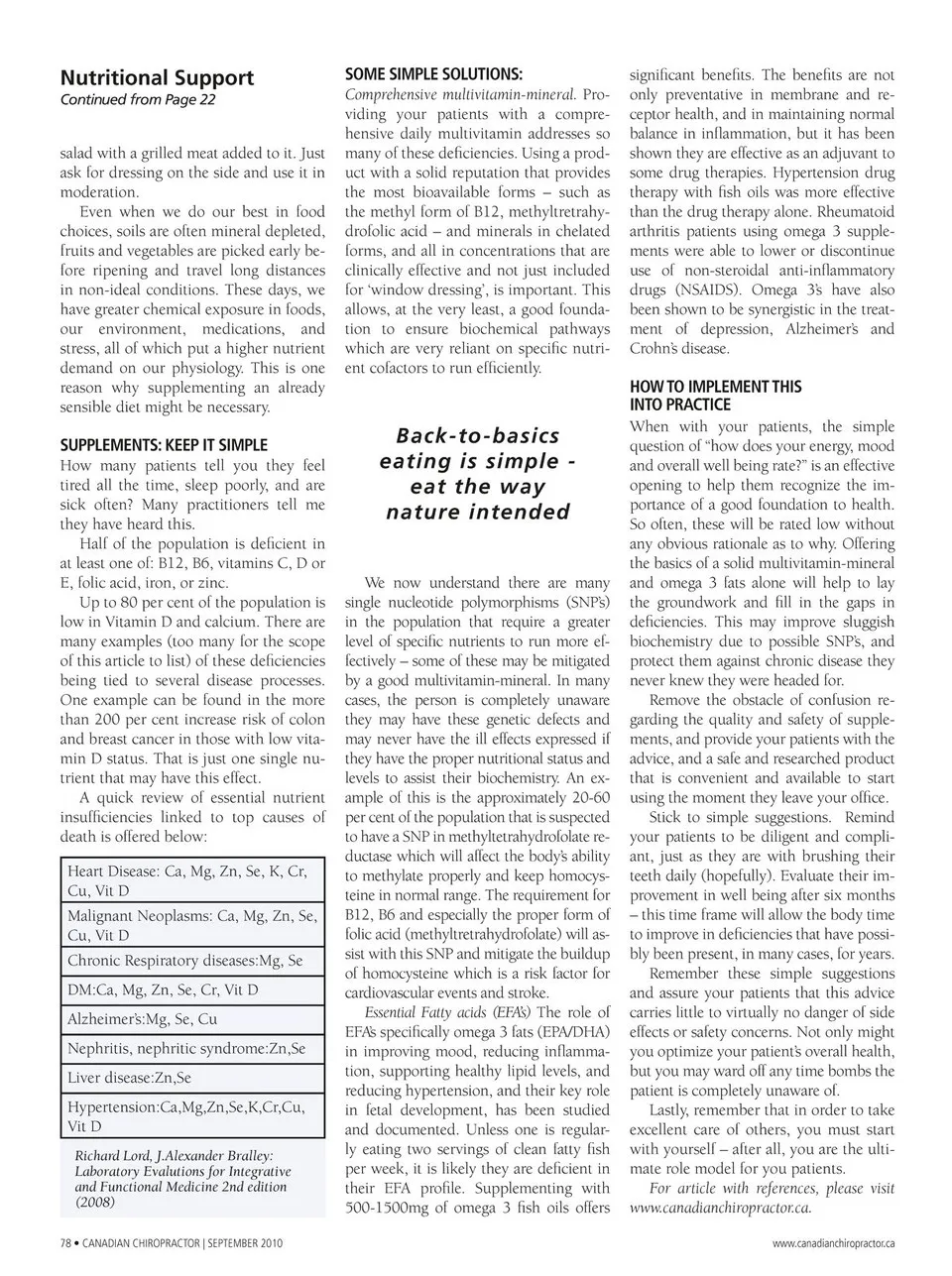
Nutritional Support Continued from Page 22 salad with a grilled meat added to it. Just ask for dressing on the side and use it in moderation. Even when we do our best in food choices, soils are often mineral depleted, fruits and vegetables are picked early be-fore ripening and travel long distances in non-ideal conditions. These days, we have greater chemical exposure in foods, our environment, medications, and stress, all of which put a higher nutrient demand on our physiology. This is one reason why supplementing an already sensible diet might be necessary. SUPPLEMENTS: KEEP IT SIMPLE How many patients tell you they feel tired all the time, sleep poorly, and are sick often? Many practitioners tell me they have heard this. Half of the population is deficient in at least one of: B12, B6, vitamins C, D or E, folic acid, iron, or zinc. Up to 80 per cent of the population is low in Vitamin D and calcium. There are many examples (too many for the scope of this article to list) of these deficiencies being tied to several disease processes. One example can be found in the more than 200 per cent increase risk of colon and breast cancer in those with low vita-min D status. That is just one single nu-trient that may have this effect. A quick review of essential nutrient insufficiencies linked to top causes of death is offered below: Heart Disease: Ca, Mg, Zn, Se, K, Cr, Cu, Vit D Malignant Neoplasms: Ca, Mg, Zn, Se, Cu, Vit D Chronic Respiratory diseases:Mg, Se DM:Ca, Mg, Zn, Se, Cr, Vit D Alzheimer’s:Mg, Se, Cu Nephritis, nephritic syndrome:Zn,Se Liver disease:Zn,Se Hypertension:Ca,Mg,Zn,Se,K,Cr,Cu, Vit D Richard Lord, J.Alexander Bralley: Laboratory Evalutions for Integrative and Functional Medicine 2nd edition (2008) 78 • CANADIAN CHIROPRACTOR | SEPTEMBER 2010 SOME SIMPLE SOLUTIONS: Comprehensive multivitamin-mineral. Pro-viding your patients with a compre-hensive daily multivitamin addresses so many of these deficiencies. Using a prod-uct with a solid reputation that provides the most bioavailable forms – such as the methyl form of B12, methyltretrahy-drofolic acid – and minerals in chelated forms, and all in concentrations that are clinically effective and not just included for ‘window dressing’, is important. This allows, at the very least, a good founda-tion to ensure biochemical pathways which are very reliant on specific nutri-ent cofactors to run efficiently. Back-to-basics eating is simple -eat the way nature intended We now understand there are many single nucleotide polymorphisms (SNP’s) in the population that require a greater level of specific nutrients to run more ef-fectively – some of these may be mitigated by a good multivitamin-mineral. In many cases, the person is completely unaware they may have these genetic defects and may never have the ill effects expressed if they have the proper nutritional status and levels to assist their biochemistry. An ex-ample of this is the approximately 20-60 per cent of the population that is suspected to have a SNP in methyltetrahydrofolate re-ductase which will affect the body’s ability to methylate properly and keep homocys-teine in normal range. The requirement for B12, B6 and especially the proper form of folic acid (methyltretrahydrofolate) will as-sist with this SNP and mitigate the buildup of homocysteine which is a risk factor for cardiovascular events and stroke. Essential Fatty acids (EFA’s) The role of EFA’s specifically omega 3 fats (EPA/DHA) in improving mood, reducing inflamma-tion, supporting healthy lipid levels, and reducing hypertension, and their key role in fetal development, has been studied and documented. Unless one is regular-ly eating two servings of clean fatty fish per week, it is likely they are deficient in their EFA profile. Supplementing with 500-1500mg of omega 3 fish oils offers significant benefits. The benefits are not only preventative in membrane and re-ceptor health, and in maintaining normal balance in inflammation, but it has been shown they are effective as an adjuvant to some drug therapies. Hypertension drug therapy with fish oils was more effective than the drug therapy alone. Rheumatoid arthritis patients using omega 3 supple-ments were able to lower or discontinue use of non-steroidal anti-inflammatory drugs (NSAIDS). Omega 3’s have also been shown to be synergistic in the treat-ment of depression, Alzheimer’s and Crohn’s disease. HOW TO IMPLEMENT THIS INTO PRACTICE When with your patients, the simple question of “how does your energy, mood and overall well being rate?” is an effective opening to help them recognize the im-portance of a good foundation to health. So often, these will be rated low without any obvious rationale as to why. Offering the basics of a solid multivitamin-mineral and omega 3 fats alone will help to lay the groundwork and fill in the gaps in deficiencies. This may improve sluggish biochemistry due to possible SNP’s, and protect them against chronic disease they never knew they were headed for. Remove the obstacle of confusion re-garding the quality and safety of supple-ments, and provide your patients with the advice, and a safe and researched product that is convenient and available to start using the moment they leave your office. Stick to simple suggestions. Remind your patients to be diligent and compli-ant, just as they are with brushing their teeth daily (hopefully). Evaluate their im-provement in well being after six months – this time frame will allow the body time to improve in deficiencies that have possi-bly been present, in many cases, for years. Remember these simple suggestions and assure your patients that this advice carries little to virtually no danger of side effects or safety concerns. Not only might you optimize your patient’s overall health, but you may ward off any time bombs the patient is completely unaware of. Lastly, remember that in order to take excellent care of others, you must start with yourself – after all, you are the ulti-mate role model for you patients. For article with references, please visit www.canadianchiropractor.ca. www.canadianchiropractor.ca
Chiropractic + Naturopathic Doctor September 2010: Page 78