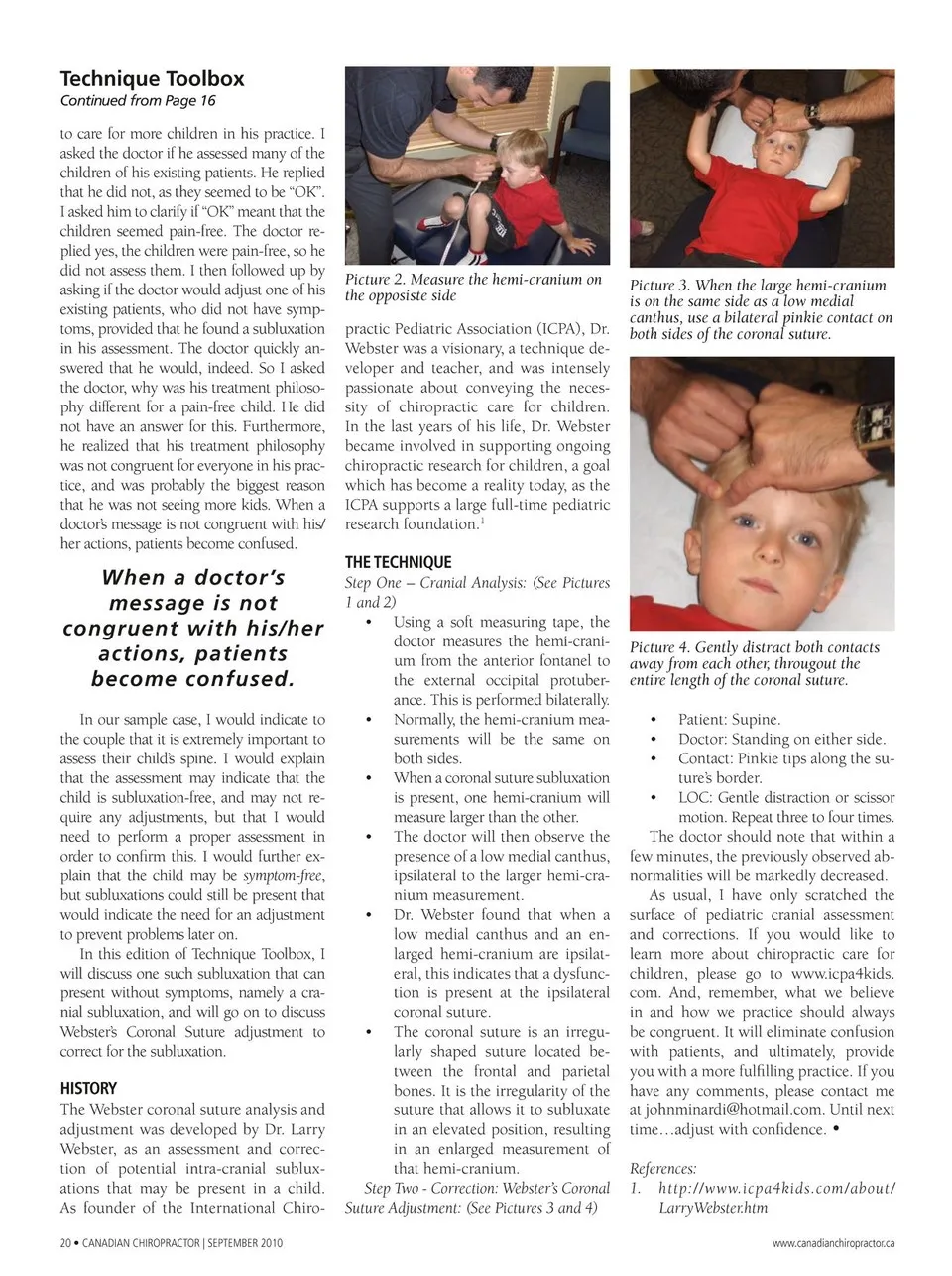
Technique Toolbox Continued from Page 16 to care for more children in his practice. I asked the doctor if he assessed many of the children of his existing patients. He replied that he did not, as they seemed to be “OK”. I asked him to clarify if “OK” meant that the children seemed pain-free. The doctor re-plied yes, the children were pain-free, so he did not assess them. I then followed up by asking if the doctor would adjust one of his existing patients, who did not have symp-toms, provided that he found a subluxation in his assessment. The doctor quickly an-swered that he would, indeed. So I asked the doctor, why was his treatment philoso-phy different for a pain-free child. He did not have an answer for this. Furthermore, he realized that his treatment philosophy was not congruent for everyone in his prac-tice, and was probably the biggest reason that he was not seeing more kids. When a doctor’s message is not congruent with his/ her actions, patients become confused. When a doctor’s message is not congruent with his/her actions, patients become confused. In our sample case, I would indicate to the couple that it is extremely important to assess their child’s spine. I would explain that the assessment may indicate that the child is subluxation-free, and may not re-quire any adjustments, but that I would need to perform a proper assessment in order to confirm this. I would further ex-plain that the child may be symptom-free, but subluxations could still be present that would indicate the need for an adjustment to prevent problems later on. In this edition of Technique Toolbox, I will discuss one such subluxation that can present without symptoms, namely a cra-nial subluxation, and will go on to discuss Webster’s Coronal Suture adjustment to correct for the subluxation. HISTORY The Webster coronal suture analysis and adjustment was developed by Dr. Larry Webster, as an assessment and correc-tion of potential intra-cranial sublux-ations that may be present in a child. As founder of the International Chiro-20 • CANADIAN CHIROPRACTOR | SEPTEMBER 2010 Picture 2. Measure the hemi-cranium on the opposiste side practic Pediatric Association (ICPA), Dr. Webster was a visionary, a technique de-veloper and teacher, and was intensely passionate about conveying the neces-sity of chiropractic care for children. In the last years of his life, Dr. Webster became involved in supporting ongoing chiropractic research for children, a goal which has become a reality today, as the ICPA supports a large full-time pediatric research foundation.1 THE TECHNIQUE Step One – Cranial Analysis: (See Pictures 1 and 2) • Using a soft measuring tape, the doctor measures the hemi-crani-um from the anterior fontanel to the external occipital protuber-ance. This is performed bilaterally. • Normally, the hemi-cranium mea-surements will be the same on both sides. • When a coronal suture subluxation is present, one hemi-cranium will measure larger than the other. • The doctor will then observe the presence of a low medial canthus, ipsilateral to the larger hemi-cra-nium measurement. • Dr. Webster found that when a low medial canthus and an en-larged hemi-cranium are ipsilat-eral, this indicates that a dysfunc-tion is present at the ipsilateral coronal suture. • The coronal suture is an irregu-larly shaped suture located be-tween the frontal and parietal bones. It is the irregularity of the suture that allows it to subluxate in an elevated position, resulting in an enlarged measurement of that hemi-cranium. Step Two -Correction: Webster’s Coronal Suture Adjustment: (See Pictures 3 and 4) Picture 3. When the large hemi-cranium is on the same side as a low medial canthus, use a bilateral pinkie contact on both sides of the coronal suture. Picture 4. Gently distract both contacts away from each other, througout the entire length of the coronal suture. • Patient: Supine. • Doctor: Standing on either side. • Contact: Pinkie tips along the su-ture’s border. • LOC: Gentle distraction or scissor motion. Repeat three to four times. The doctor should note that within a few minutes, the previously observed ab-normalities will be markedly decreased. As usual, I have only scratched the surface of pediatric cranial assessment and corrections. If you would like to learn more about chiropractic care for children, please go to www.icpa4kids. com. And, remember, what we believe in and how we practice should always be congruent. It will eliminate confusion with patients, and ultimately, provide you with a more fulfilling practice. If you have any comments, please contact me at [email protected]. Until next time…adjust with confidence. • References: 1. http://www.icpa4kids.com/about/ LarryWebster.htm www.canadianchiropractor.ca
Chiropractic + Naturopathic Doctor September 2010: Page 20