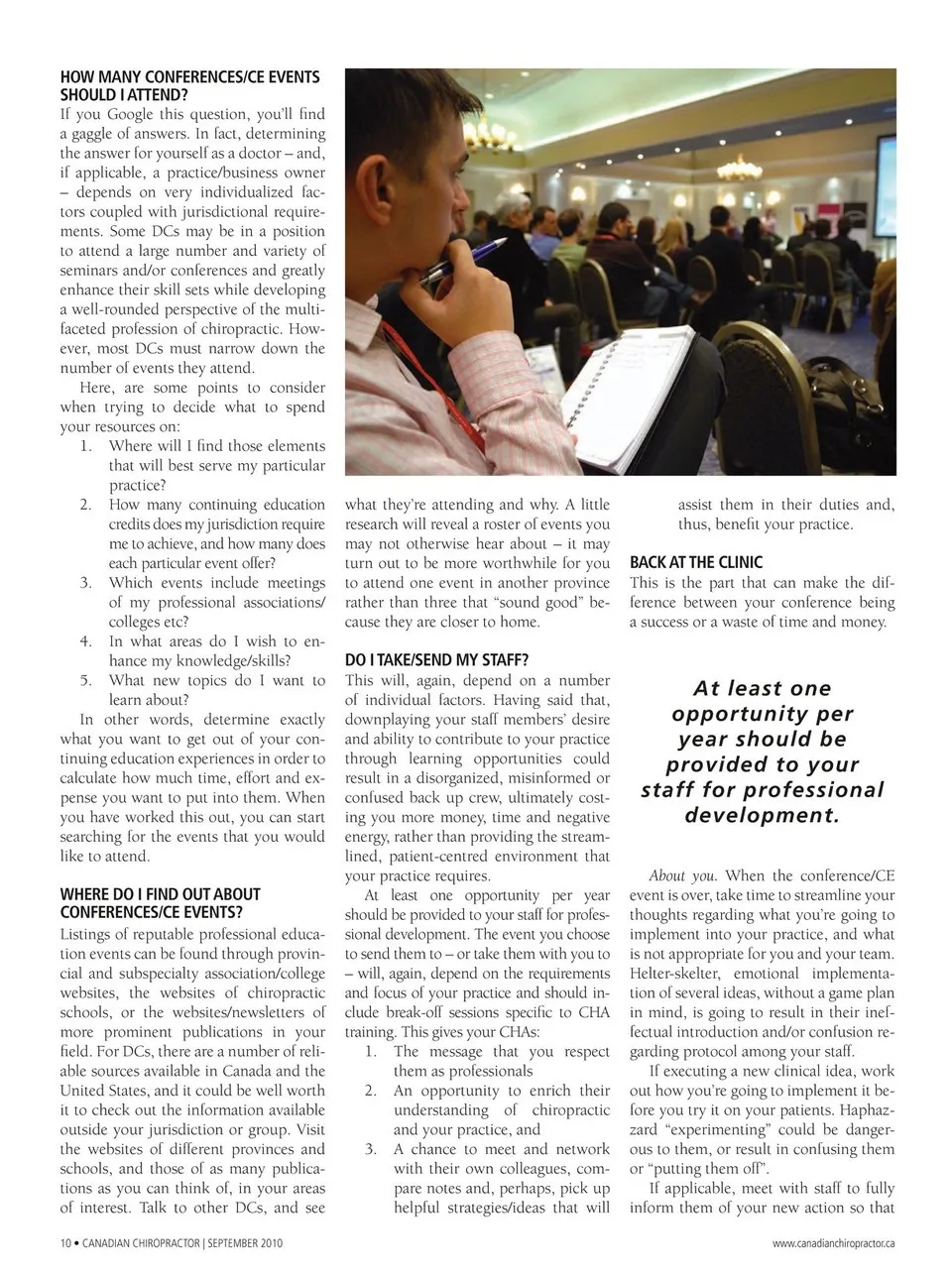
HOW MANY CONFERENCES/CE EVENTS SHOULD I ATTEND? If you Google this question, you’ll find a gaggle of answers. In fact, determining the answer for yourself as a doctor – and, if applicable, a practice/business owner – depends on very individualized fac-tors coupled with jurisdictional require-ments. Some DCs may be in a position to attend a large number and variety of seminars and/or conferences and greatly enhance their skill sets while developing a well-rounded perspective of the multi-faceted profession of chiropractic. How-ever, most DCs must narrow down the number of events they attend. Here, are some points to consider when trying to decide what to spend your resources on: 1. Where will I find those elements that will best serve my particular practice? 2. How many continuing education credits does my jurisdiction require me to achieve, and how many does each particular event offer? 3. Which events include meetings of my professional associations/ colleges etc? 4. In what areas do I wish to en-hance my knowledge/skills? 5. What new topics do I want to learn about? In other words, determine exactly what you want to get out of your con-tinuing education experiences in order to calculate how much time, effort and ex-pense you want to put into them. When you have worked this out, you can start searching for the events that you would like to attend. WHERE DO I FIND OUT ABOUT CONFERENCES/CE EVENTS? Listings of reputable professional educa-tion events can be found through provin-cial and subspecialty association/college websites, the websites of chiropractic schools, or the websites/newsletters of more prominent publications in your field. For DCs, there are a number of reli-able sources available in Canada and the United States, and it could be well worth it to check out the information available outside your jurisdiction or group. Visit the websites of different provinces and schools, and those of as many publica-tions as you can think of, in your areas of interest. Talk to other DCs, and see 10 • CANADIAN CHIROPRACTOR | SEPTEMBER 2010 what they’re attending and why. A little research will reveal a roster of events you may not otherwise hear about – it may turn out to be more worthwhile for you to attend one event in another province rather than three that “sound good” be-cause they are closer to home. DO I TAKE/SEND MY STAFF? This will, again, depend on a number of individual factors. Having said that, downplaying your staff members’ desire and ability to contribute to your practice through learning opportunities could result in a disorganized, misinformed or confused back up crew, ultimately cost-ing you more money, time and negative energy, rather than providing the stream-lined, patient-centred environment that your practice requires. At least one opportunity per year should be provided to your staff for profes-sional development. The event you choose to send them to – or take them with you to – will, again, depend on the requirements and focus of your practice and should in-clude break-off sessions specific to CHA training. This gives your CHAs: 1. The message that you respect them as professionals 2. An opportunity to enrich their understanding of chiropractic and your practice, and 3. A chance to meet and network with their own colleagues, com-pare notes and, perhaps, pick up helpful strategies/ideas that will assist them in their duties and, thus, benefit your practice. BACK AT THE CLINIC This is the part that can make the dif-ference between your conference being a success or a waste of time and money. At least one opportunity per year should be provided to your staff for professional development. About you. When the conference/CE event is over, take time to streamline your thoughts regarding what you’re going to implement into your practice, and what is not appropriate for you and your team. Helter-skelter, emotional implementa-tion of several ideas, without a game plan in mind, is going to result in their inef-fectual introduction and/or confusion re-garding protocol among your staff. If executing a new clinical idea, work out how you’re going to implement it be-fore you try it on your patients. Haphaz-zard “experimenting” could be danger-ous to them, or result in confusing them or “putting them off”. If applicable, meet with staff to fully inform them of your new action so that www.canadianchiropractor.ca
Chiropractic + Naturopathic Doctor September 2010: Page 10