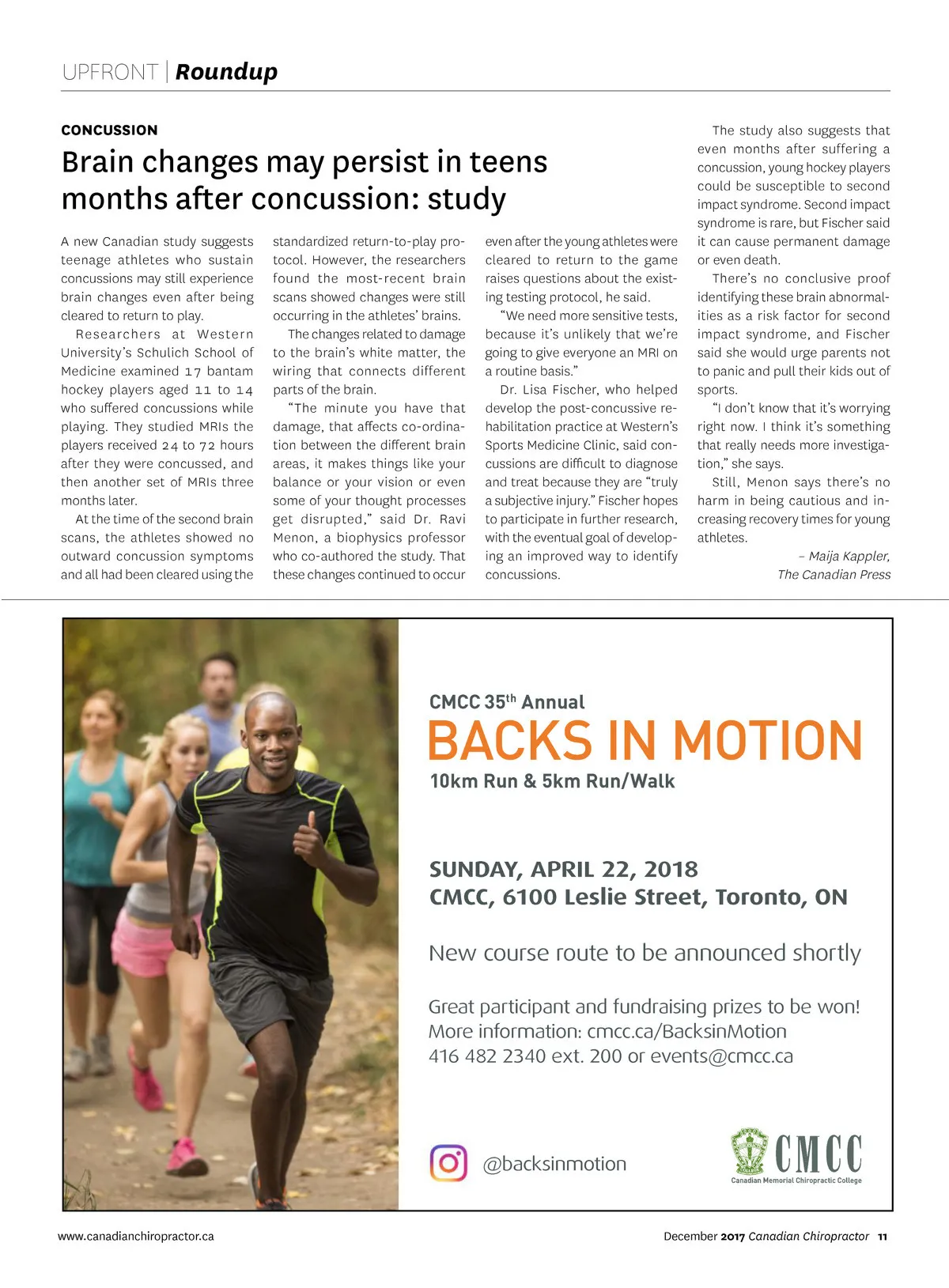
UPFRONT | Roundup CONCUSSION Brain changes may persist in teens months after concussion: study A new Canadian study suggests teenage athletes who sustain concussions may still experience brain changes even after being cleared to return to play. Researchers at Western University’s Schulich School of Medicine examined 17 bantam hockey players aged 11 to 14 who suffered concussions while playing. They studied MRIs the players received 24 to 72 hours after they were concussed, and then another set of MRIs three months later. At the time of the second brain scans, the athletes showed no outward concussion symptoms and all had been cleared using the standardized return-to-play pro-tocol. However, the researchers found the most-recent brain scans showed changes were still occurring in the athletes’ brains. The changes related to damage to the brain’s white matter, the wiring that connects different parts of the brain. “The minute you have that damage, that affects co-ordina-tion between the different brain areas, it makes things like your balance or your vision or even some of your thought processes get disrupted,” said Dr. Ravi Menon, a biophysics professor who co-authored the study. That these changes continued to occur even after the young athletes were cleared to return to the game raises questions about the exist-ing testing protocol, he said. “We need more sensitive tests, because it’s unlikely that we’re going to give everyone an MRI on a routine basis.” Dr. Lisa Fischer, who helped develop the post-concussive re-habilitation practice at Western’s Sports Medicine Clinic, said con-cussions are difficult to diagnose and treat because they are “truly a subjective injury.” Fischer hopes to participate in further research, with the eventual goal of develop-ing an improved way to identify concussions. The study also suggests that even months after suffering a concussion, young hockey players could be susceptible to second impact syndrome. Second impact syndrome is rare, but Fischer said it can cause permanent damage or even death. There’s no conclusive proof identifying these brain abnormal-ities as a risk factor for second impact syndrome, and Fischer said she would urge parents not to panic and pull their kids out of sports. “I don’t know that it’s worrying right now. I think it’s something that really needs more investiga-tion,” she says. Still, Menon says there’s no harm in being cautious and in-creasing recovery times for young athletes. – Maija Kappler, The Canadian Press Canadian Memorial Chiropractic College BACKS IN MOTION 10km Run & 5km Run/Walk CMCC 35 th Annual SUNDAY, APRIL 22, 2018 CMCC, 6100 Leslie Street, Toronto, ON New course route to be announced shortly Great participant and fundraising prizes to be won! More information: cmcc.ca/BacksinMotion 416 482 2340 ext. 200 or [email protected] @backsinmotion www.canadianchiropractor.ca CC_CMCC_BackinMotion_Dec17_CSA.indd 1 December 2017 Canadian Chiropractor 11 2017-11-09 11:34 AM
Chiropractic + Naturopathic Doctor December 2017: Page 11