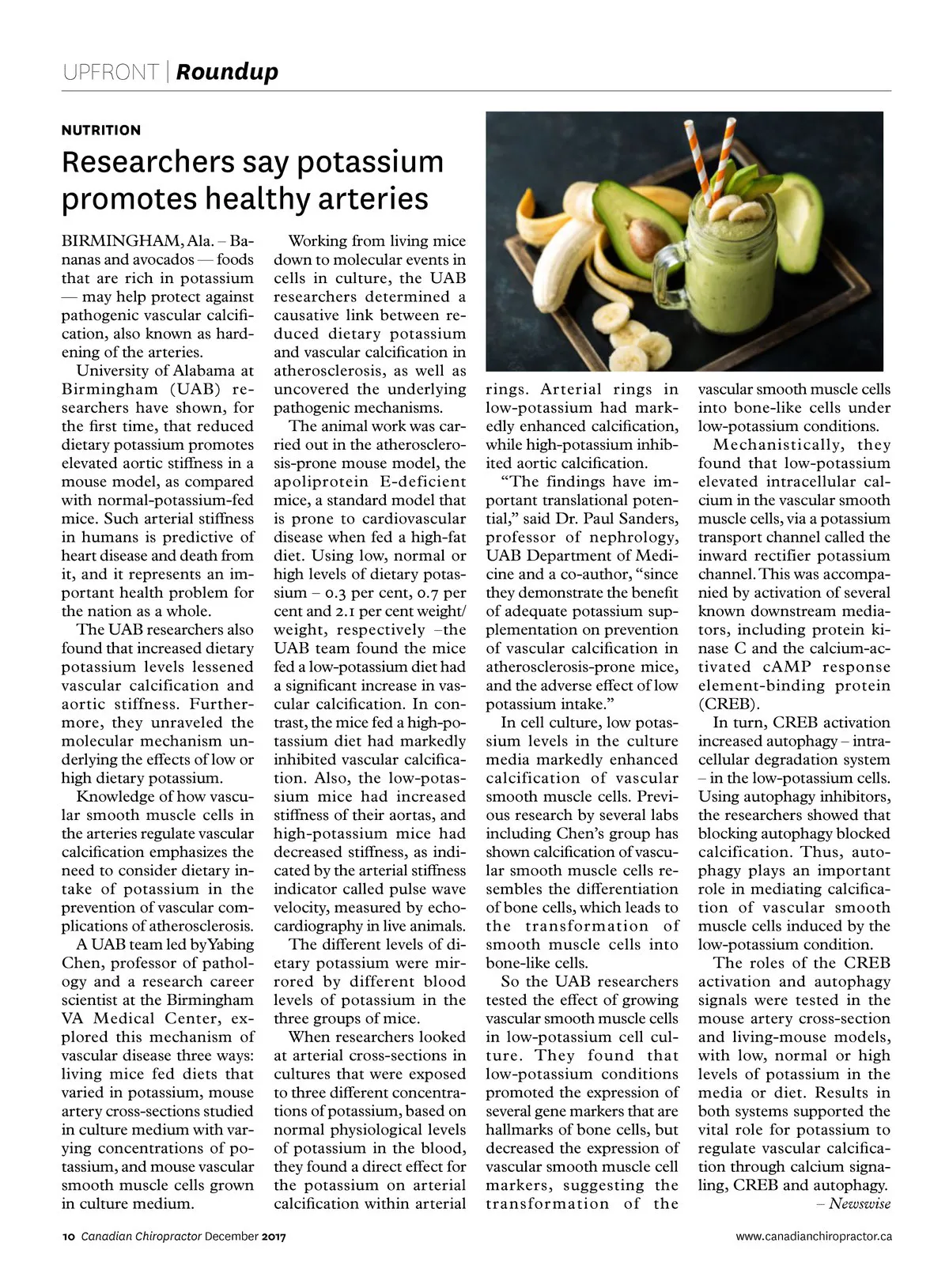
UPFRONT | Roundup NUTRITION Researchers say potassium promotes healthy arteries BIRMINGHAM, Ala. – Ba-nanas and avocados — foods that are rich in potassium — may help protect against pathogenic vascular calcifi-cation, also known as hard-ening of the arteries. University of Alabama at Birmingham (UAB) re-searchers have shown, for the first time, that reduced dietary potassium promotes elevated aortic stiffness in a mouse model, as compared with normal-potassium-fed mice. Such arterial stiffness in humans is predictive of heart disease and death from it, and it represents an im-portant health problem for the nation as a whole. The UAB researchers also found that increased dietary potassium levels lessened vascular calcification and aortic stiffness. Further-more, they unraveled the molecular mechanism un-derlying the effects of low or high dietary potassium. Knowledge of how vascu-lar smooth muscle cells in the arteries regulate vascular calcification emphasizes the need to consider dietary in-take of potassium in the prevention of vascular com-plications of atherosclerosis. A UAB team led by Yabing Chen, professor of pathol-ogy and a research career scientist at the Birmingham VA Medical Center, ex-plored this mechanism of vascular disease three ways: living mice fed diets that varied in potassium, mouse artery cross-sections studied in culture medium with var-ying concentrations of po-tassium, and mouse vascular smooth muscle cells grown in culture medium. Working from living mice down to molecular events in cells in culture, the UAB researchers determined a causative link between re-duced dietary potassium and vascular calcification in atherosclerosis, as well as uncovered the underlying pathogenic mechanisms. The animal work was car-ried out in the atherosclero-sis-prone mouse model, the apoliprotein E-deficient mice, a standard model that is prone to cardiovascular disease when fed a high-fat diet. Using low, normal or high levels of dietary potas-sium – 0.3 per cent, 0.7 per cent and 2.1 per cent weight/ weight, respectively –the UAB team found the mice fed a low-potassium diet had a significant increase in vas-cular calcification. In con-trast, the mice fed a high-po-tassium diet had markedly inhibited vascular calcifica-tion. Also, the low-potas-sium mice had increased stiffness of their aortas, and high-potassium mice had decreased stiffness, as indi-cated by the arterial stiffness indicator called pulse wave velocity, measured by echo-cardiography in live animals. The different levels of di-etary potassium were mir-rored by different blood levels of potassium in the three groups of mice. When researchers looked at arterial cross-sections in cultures that were exposed to three different concentra-tions of potassium, based on normal physiological levels of potassium in the blood, they found a direct effect for the potassium on arterial calcification within arterial rings. Arterial rings in low-potassium had mark-edly enhanced calcification, while high-potassium inhib-ited aortic calcification. “The findings have im-portant translational poten-tial,” said Dr. Paul Sanders, professor of nephrology, UAB Department of Medi-cine and a co-author, “since they demonstrate the benefit of adequate potassium sup-plementation on prevention of vascular calcification in atherosclerosis-prone mice, and the adverse effect of low potassium intake.” In cell culture, low potas-sium levels in the culture media markedly enhanced calcification of vascular smooth muscle cells. Previ-ous research by several labs including Chen’s group has shown calcification of vascu-lar smooth muscle cells re-sembles the differentiation of bone cells, which leads to the transformation of smooth muscle cells into bone-like cells. So the UAB researchers tested the effect of growing vascular smooth muscle cells in low-potassium cell cul-ture. They found that low-potassium conditions promoted the expression of several gene markers that are hallmarks of bone cells, but decreased the expression of vascular smooth muscle cell markers, suggesting the transformation of the vascular smooth muscle cells into bone-like cells under low-potassium conditions. Mechanistically, they found that low-potassium elevated intracellular cal-cium in the vascular smooth muscle cells, via a potassium transport channel called the inward rectifier potassium channel. This was accompa-nied by activation of several known downstream media-tors, including protein ki-nase C and the calcium-ac-tivated cAMP response element-binding protein (CREB). In turn, CREB activation increased autophagy – intra-cellular degradation system – in the low-potassium cells. Using autophagy inhibitors, the researchers showed that blocking autophagy blocked calcification. Thus, auto-phagy plays an important role in mediating calcifica-tion of vascular smooth muscle cells induced by the low-potassium condition. The roles of the CREB activation and autophagy signals were tested in the mouse artery cross-section and living-mouse models, with low, normal or high levels of potassium in the media or diet. Results in both systems supported the vital role for potassium to regulate vascular calcifica-tion through calcium signa-ling, CREB and autophagy. – Newswise www.canadianchiropractor.ca 10 Canadian Chiropractor December 2017
Chiropractic + Naturopathic Doctor December 2017: Page 10