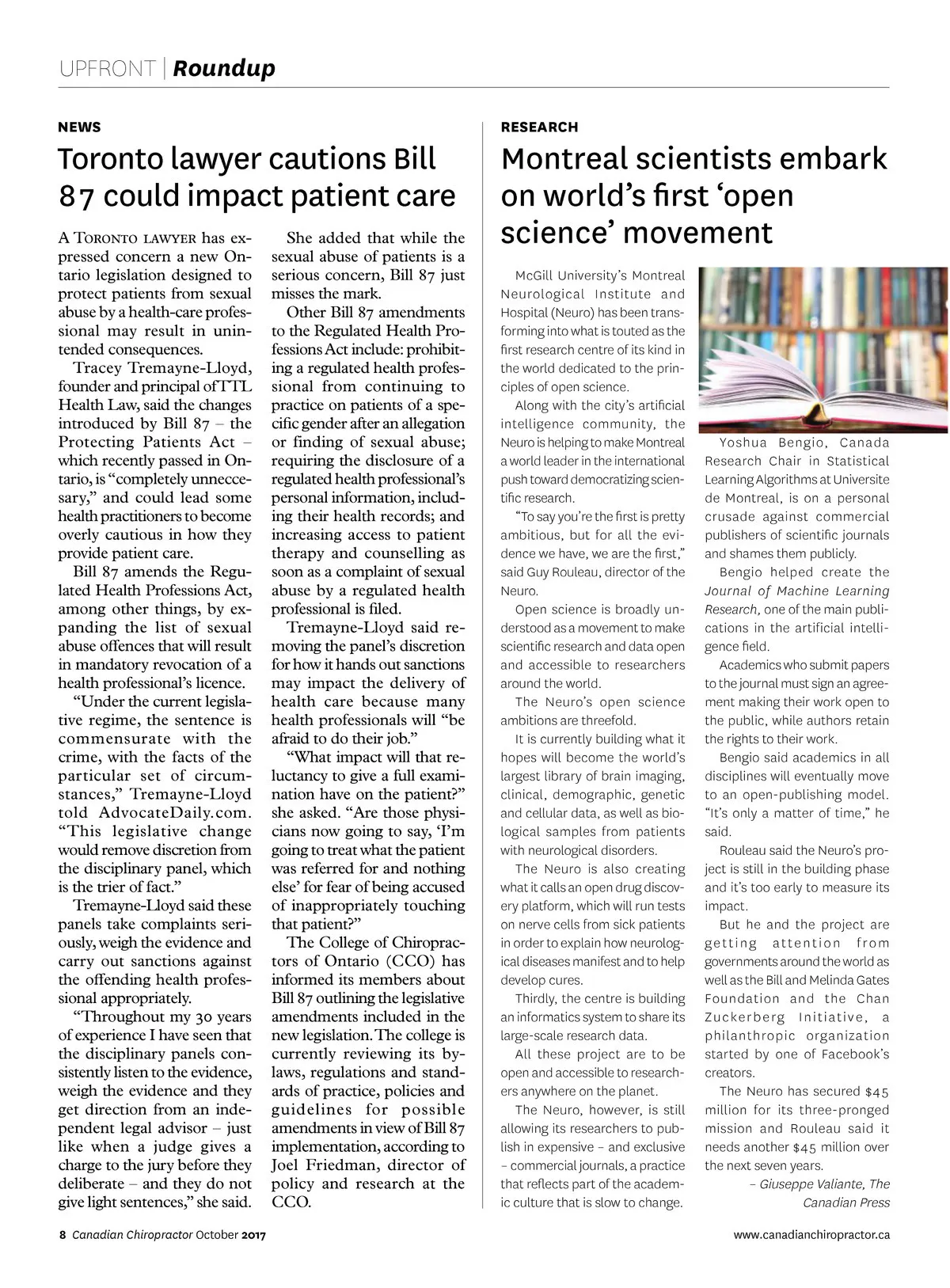
UPFRONT | Roundup NEWS Toronto lawyer cautions Bill 87 could impact patient care A Toronto lawyer has ex-pressed concern a new On-tario legislation designed to protect patients from sexual abuse by a health-care profes-sional may result in unin-tended consequences. Tracey Tremayne-Lloyd, founder and principal of TTL Health Law, said the changes introduced by Bill 87 – the Protecting Patients Act – which recently passed in On-tario, is “completely unnecce-sary,” and could lead some health practitioners to become overly cautious in how they provide patient care. Bill 87 amends the Regu-lated Health Professions Act, among other things, by ex-panding the list of sexual abuse offences that will result in mandatory revocation of a health professional’s licence. “Under the current legisla-tive regime, the sentence is commensurate with the crime, with the facts of the particular set of circum-stances,” Tremayne-Lloyd told AdvocateDaily.com. “This legislative change would remove discretion from the disciplinary panel, which is the trier of fact.” Tremayne-Lloyd said these panels take complaints seri-ously, weigh the evidence and carry out sanctions against the offending health profes-sional appropriately. “Throughout my 30 years of experience I have seen that the disciplinary panels con-sistently listen to the evidence, weigh the evidence and they get direction from an inde-pendent legal advisor – just like when a judge gives a charge to the jury before they deliberate – and they do not give light sentences,” she said. 8 Canadian Chiropractor October 2017 RESEARCH She added that while the sexual abuse of patients is a serious concern, Bill 87 just misses the mark. Other Bill 87 amendments to the Regulated Health Pro-fessions Act include: prohibit-ing a regulated health profes-sional from continuing to practice on patients of a spe-cific gender after an allegation or finding of sexual abuse; requiring the disclosure of a regulated health professional’s personal information, includ-ing their health records; and increasing access to patient therapy and counselling as soon as a complaint of sexual abuse by a regulated health professional is filed. Tremayne-Lloyd said re-moving the panel’s discretion for how it hands out sanctions may impact the delivery of health care because many health professionals will “be afraid to do their job.” “What impact will that re-luctancy to give a full exami-nation have on the patient?” she asked. “Are those physi-cians now going to say, ‘I’m going to treat what the patient was referred for and nothing else’ for fear of being accused of inappropriately touching that patient?” The College of Chiroprac-tors of Ontario (CCO) has informed its members about Bill 87 outlining the legislative amendments included in the new legislation. The college is currently reviewing its by-laws, regulations and stand-ards of practice, policies and guidelines for possible amendments in view of Bill 87 implementation, according to Joel Friedman, director of policy and research at the CCO. Montreal scientists embark on world’s first ‘open science’ movement McGill University’s Montreal Neurological Institute and Hospital (Neuro) has been trans-forming into what is touted as the first research centre of its kind in the world dedicated to the prin-ciples of open science. Along with the city’s artificial intelligence community, the Neuro is helping to make Montreal a world leader in the international push toward democratizing scien-tific research. “To say you’re the first is pretty ambitious, but for all the evi-dence we have, we are the first,” said Guy Rouleau, director of the Neuro. Open science is broadly un-derstood as a movement to make scientific research and data open and accessible to researchers around the world. The Neuro’s open science ambitions are threefold. It is currently building what it hopes will become the world’s largest library of brain imaging, clinical, demographic, genetic and cellular data, as well as bio-logical samples from patients with neurological disorders. The Neuro is also creating what it calls an open drug discov-ery platform, which will run tests on nerve cells from sick patients in order to explain how neurolog-ical diseases manifest and to help develop cures. Thirdly, the centre is building an informatics system to share its large-scale research data. All these project are to be open and accessible to research-ers anywhere on the planet. The Neuro, however, is still allowing its researchers to pub-lish in expensive – and exclusive – commercial journals, a practice that reflects part of the academ-ic culture that is slow to change. Yoshua Bengio, Canada Research Chair in Statistical Learning Algorithms at Universite de Montreal, is on a personal crusade against commercial publishers of scientific journals and shames them publicly. Bengio helped create the Journal of Machine Learning Research, one of the main publi-cations in the artificial intelli-gence field. Academics who submit papers to the journal must sign an agree-ment making their work open to the public, while authors retain the rights to their work. Bengio said academics in all disciplines will eventually move to an open-publishing model. “It’s only a matter of time,” he said. Rouleau said the Neuro’s pro-ject is still in the building phase and it’s too early to measure its impact. But he and the project are getting attention from governments around the world as well as the Bill and Melinda Gates Foundation and the Chan Zuckerberg Initiative, a philanthropic organization started by one of Facebook’s creators. The Neuro has secured $45 million for its three-pronged mission and Rouleau said it needs another $45 million over the next seven years. – Giuseppe Valiante, The Canadian Press www.canadianchiropractor.ca
Chiropractic + Naturopathic Doctor October 2017: Page 8