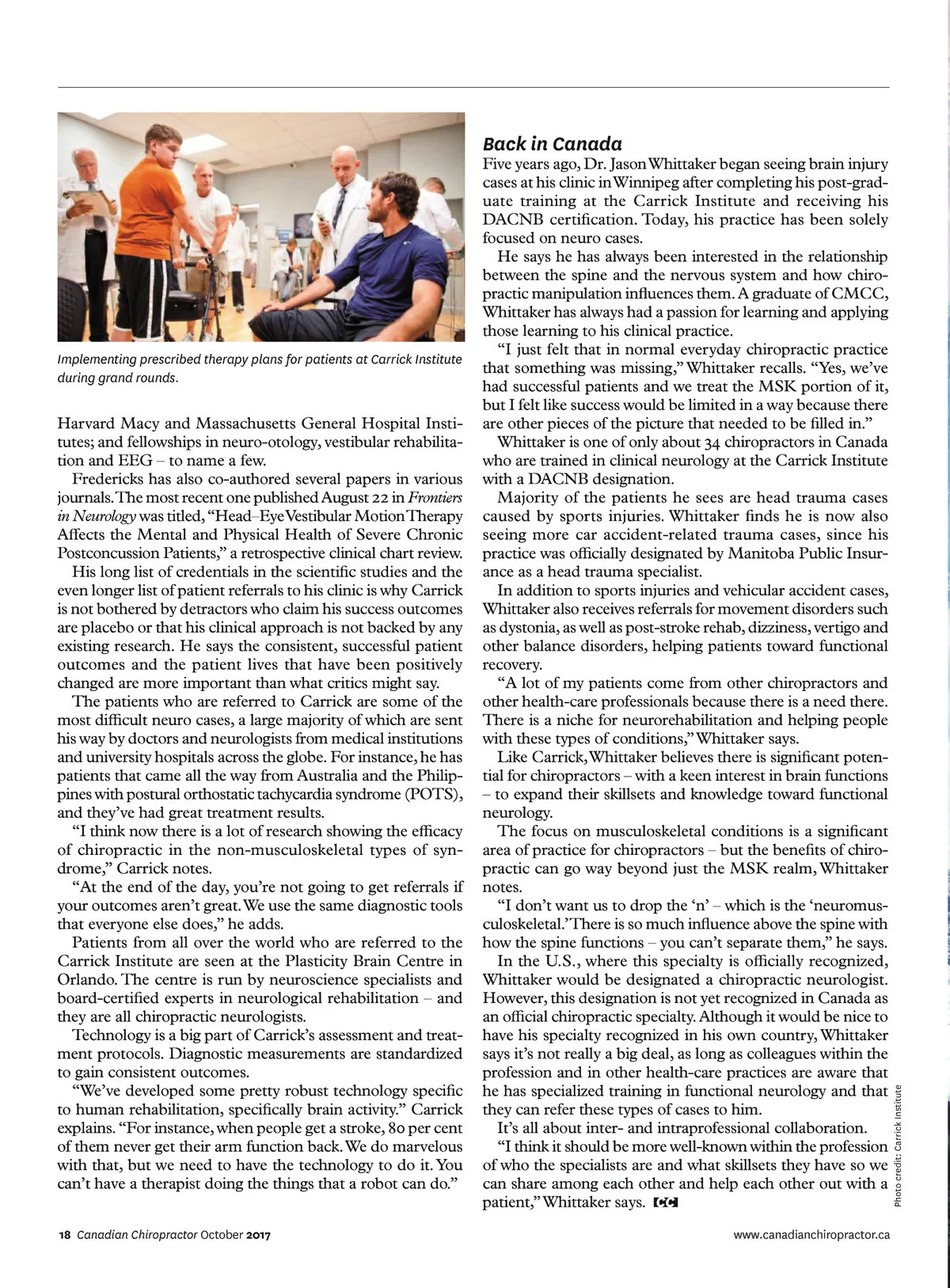
Back in Canada Implementing prescribed therapy plans for patients at Carrick Institute during grand rounds. 18 Canadian Chiropractor October 2017 www.canadianchiropractor.ca Photo credit: Carrick Institute Harvard Macy and Massachusetts General Hospital Insti-tutes; and fellowships in neuro-otology, vestibular rehabilita-tion and EEG – to name a few. Fredericks has also co-authored several papers in various journals. The most recent one published August 22 in Frontiers in Neurology was titled, “Head–Eye Vestibular Motion Therapy Affects the Mental and Physical Health of Severe Chronic Postconcussion Patients,” a retrospective clinical chart review. His long list of credentials in the scientific studies and the even longer list of patient referrals to his clinic is why Carrick is not bothered by detractors who claim his success outcomes are placebo or that his clinical approach is not backed by any existing research. He says the consistent, successful patient outcomes and the patient lives that have been positively changed are more important than what critics might say. The patients who are referred to Carrick are some of the most difficult neuro cases, a large majority of which are sent his way by doctors and neurologists from medical institutions and university hospitals across the globe. For instance, he has patients that came all the way from Australia and the Philip-pines with postural orthostatic tachycardia syndrome (POTS), and they’ve had great treatment results. “I think now there is a lot of research showing the efficacy of chiropractic in the non-musculoskeletal types of syn-drome,” Carrick notes. “At the end of the day, you’re not going to get referrals if your outcomes aren’t great. We use the same diagnostic tools that everyone else does,” he adds. Patients from all over the world who are referred to the Carrick Institute are seen at the Plasticity Brain Centre in Orlando. The centre is run by neuroscience specialists and board-certified experts in neurological rehabilitation – and they are all chiropractic neurologists. Technology is a big part of Carrick’s assessment and treat-ment protocols. Diagnostic measurements are standardized to gain consistent outcomes. “We’ve developed some pretty robust technology specific to human rehabilitation, specifically brain activity.” Carrick explains. “For instance, when people get a stroke, 80 per cent of them never get their arm function back. We do marvelous with that, but we need to have the technology to do it. You can’t have a therapist doing the things that a robot can do.” Five years ago, Dr. Jason Whittaker began seeing brain injury cases at his clinic in Winnipeg after completing his post-grad-uate training at the Carrick Institute and receiving his DACNB certification. Today, his practice has been solely focused on neuro cases. He says he has always been interested in the relationship between the spine and the nervous system and how chiro-practic manipulation influences them. A graduate of CMCC, Whittaker has always had a passion for learning and applying those learning to his clinical practice. “I just felt that in normal everyday chiropractic practice that something was missing,” Whittaker recalls. “Yes, we’ve had successful patients and we treat the MSK portion of it, but I felt like success would be limited in a way because there are other pieces of the picture that needed to be filled in.” Whittaker is one of only about 34 chiropractors in Canada who are trained in clinical neurology at the Carrick Institute with a DACNB designation. Majority of the patients he sees are head trauma cases caused by sports injuries. Whittaker finds he is now also seeing more car accident-related trauma cases, since his practice was officially designated by Manitoba Public Insur-ance as a head trauma specialist. In addition to sports injuries and vehicular accident cases, Whittaker also receives referrals for movement disorders such as dystonia, as well as post-stroke rehab, dizziness, vertigo and other balance disorders, helping patients toward functional recovery. “A lot of my patients come from other chiropractors and other health-care professionals because there is a need there. There is a niche for neurorehabilitation and helping people with these types of conditions,” Whittaker says. Like Carrick, Whittaker believes there is significant poten-tial for chiropractors – with a keen interest in brain functions – to expand their skillsets and knowledge toward functional neurology. The focus on musculoskeletal conditions is a significant area of practice for chiropractors – but the benefits of chiro-practic can go way beyond just the MSK realm, Whittaker notes. “I don’t want us to drop the ‘n’ – which is the ‘neuromus-culoskeletal.’ There is so much influence above the spine with how the spine functions – you can’t separate them,” he says. In the U.S., where this specialty is officially recognized, Whittaker would be designated a chiropractic neurologist. However, this designation is not yet recognized in Canada as an official chiropractic specialty. Although it would be nice to have his specialty recognized in his own country, Whittaker says it’s not really a big deal, as long as colleagues within the profession and in other health-care practices are aware that he has specialized training in functional neurology and that they can refer these types of cases to him. It’s all about inter-and intraprofessional collaboration. “I think it should be more well-known within the profession of who the specialists are and what skillsets they have so we can share among each other and help each other out with a patient,” Whittaker says.
Chiropractic + Naturopathic Doctor October 2017: Page 18