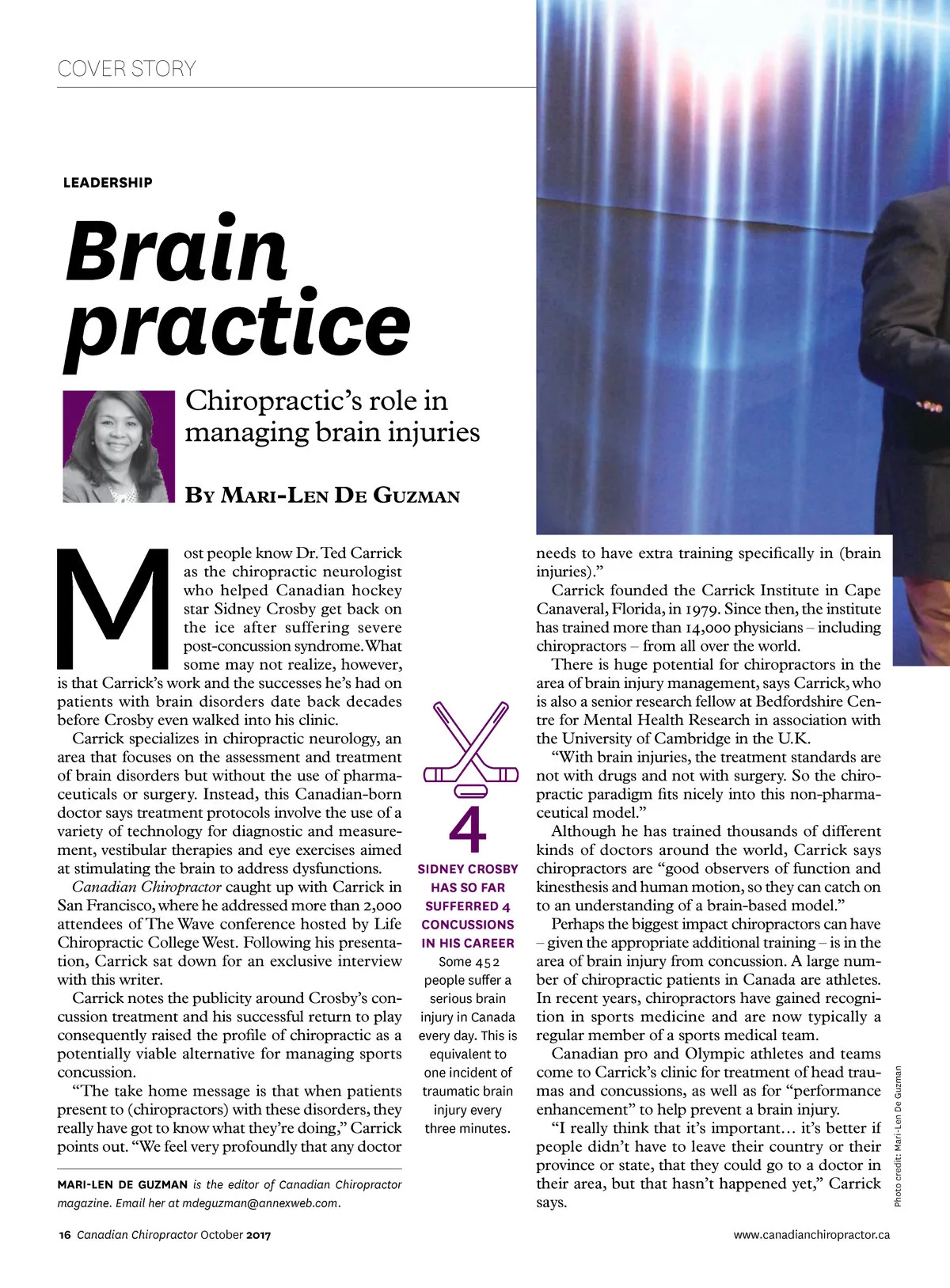
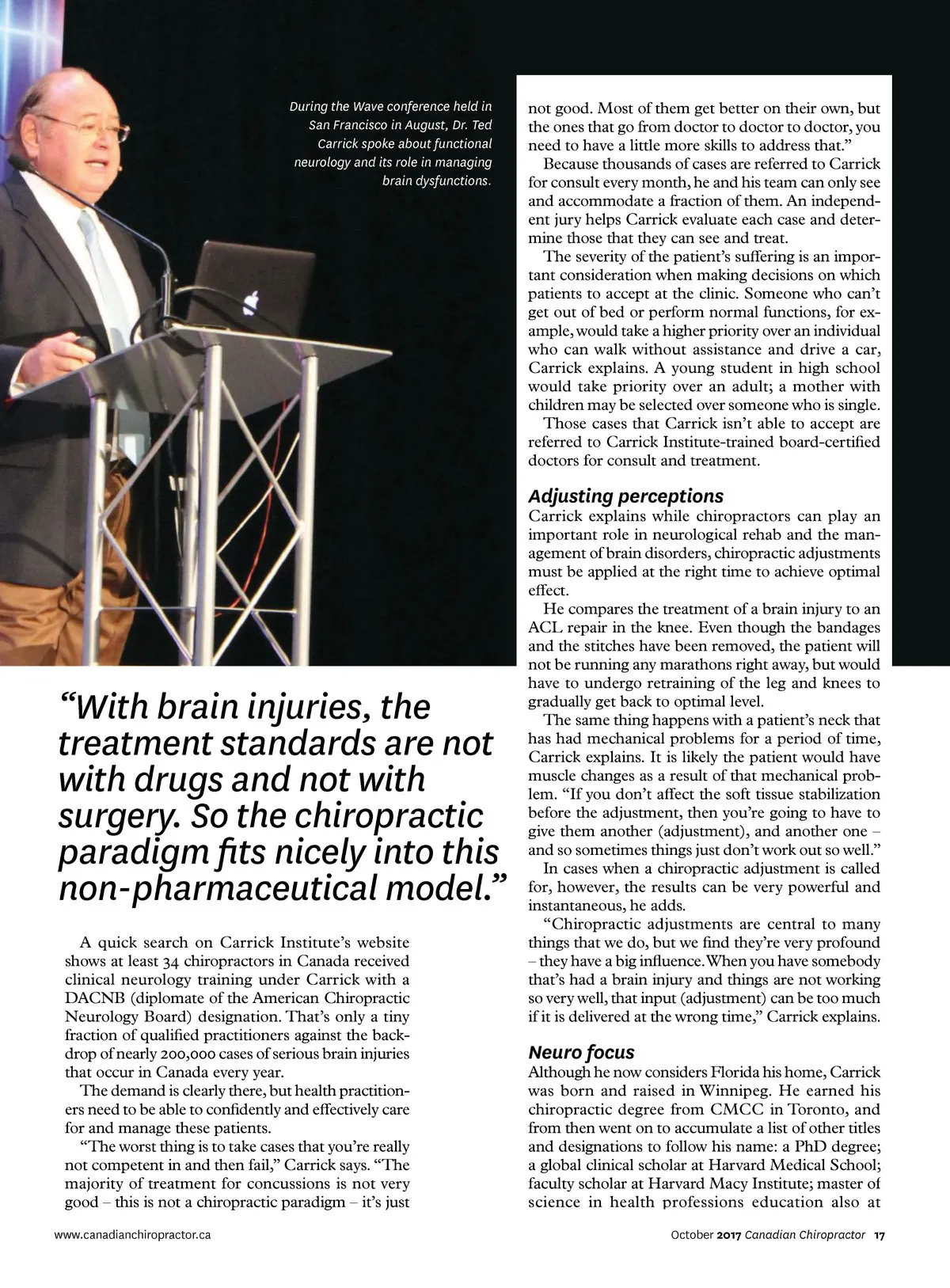
During the Wave conference held in San Francisco in August, Dr. Ted Carrick spoke about functional neurology and its role in managing brain dysfunctions. not good. Most of them get better on their own, but the ones that go from doctor to doctor to doctor, you need to have a little more skills to address that.” Because thousands of cases are referred to Carrick for consult every month, he and his team can only see and accommodate a fraction of them. An independ-ent jury helps Carrick evaluate each case and deter-mine those that they can see and treat. The severity of the patient’s suffering is an impor-tant consideration when making decisions on which patients to accept at the clinic. Someone who can’t get out of bed or perform normal functions, for ex-ample, would take a higher priority over an individual who can walk without assistance and drive a car, Carrick explains. A young student in high school would take priority over an adult; a mother with children may be selected over someone who is single. Those cases that Carrick isn’t able to accept are referred to Carrick Institute-trained board-certified doctors for consult and treatment. Adjusting perceptions “With brain injuries, the treatment standards are not with drugs and not with surgery. So the chiropractic paradigm fits nicely into this non-pharmaceutical model.” A quick search on Carrick Institute’s website shows at least 34 chiropractors in Canada received clinical neurology training under Carrick with a DACNB (diplomate of the American Chiropractic Neurology Board) designation. That’s only a tiny fraction of qualified practitioners against the back-drop of nearly 200,000 cases of serious brain injuries that occur in Canada every year. The demand is clearly there, but health practition-ers need to be able to confidently and effectively care for and manage these patients. “The worst thing is to take cases that you’re really not competent in and then fail,” Carrick says. “The majority of treatment for concussions is not very good – this is not a chiropractic paradigm – it’s just www.canadianchiropractor.ca Carrick explains while chiropractors can play an important role in neurological rehab and the man-agement of brain disorders, chiropractic adjustments must be applied at the right time to achieve optimal effect. He compares the treatment of a brain injury to an ACL repair in the knee. Even though the bandages and the stitches have been removed, the patient will not be running any marathons right away, but would have to undergo retraining of the leg and knees to gradually get back to optimal level. The same thing happens with a patient’s neck that has had mechanical problems for a period of time, Carrick explains. It is likely the patient would have muscle changes as a result of that mechanical prob-lem. “If you don’t affect the soft tissue stabilization before the adjustment, then you’re going to have to give them another (adjustment), and another one – and so sometimes things just don’t work out so well.” In cases when a chiropractic adjustment is called for, however, the results can be very powerful and instantaneous, he adds. “Chiropractic adjustments are central to many things that we do, but we find they’re very profound – they have a big influence. When you have somebody that’s had a brain injury and things are not working so very well, that input (adjustment) can be too much if it is delivered at the wrong time,” Carrick explains. Neuro focus Although he now considers Florida his home, Carrick was born and raised in Winnipeg. He earned his chiropractic degree from CMCC in Toronto, and from then went on to accumulate a list of other titles and designations to follow his name: a PhD degree; a global clinical scholar at Harvard Medical School; faculty scholar at Harvard Macy Institute; master of science in health professions education also at October 2017 Canadian Chiropractor 17
Chiropractic + Naturopathic Doctor October 2017: Page 17